Showing posts with label tools. Show all posts

Friday, November 13, 2020

Pandemic postcard #34: Life as one big art project


February:
 I did not see this coming. My daughter Natalie announces on social media that she has recorded an album, and I spend my next-to-next-to-last night in Guadalajara marveling at her nine-track Something to Harvest release on BandCamp. Performing as "Fine Hands," Natalie wrote all the songs, played all the instruments, overdubbed her vocals, even painted the cover art. One of my favorite lyrics becomes all too poignant within a few weeks: "I know you said handshakes give you anxiety. So give me your hand, I'll hold it still as can be."

March: It's a few weeks into the pandemic. "Give me something small to paint," Natalie writes on her Instagram story. "Self portrait but as a snail," writes one friend. "A lone backroad under the stars at night," suggests one, and another wants to see a cat playing drums. My request is for "the tiny sea creature of  your choice." Natalie paints and posts a series of watercolors, and they're all gone within 24 hours. At least I get some screenshots.

April: Natalie does her hair and applies theatrical makeup, dons a velveteen green pantsuit, becomes "Boo Boo the Fool," and posts photos on social media, all in the name of amusing herself and her friends as the weeks of social isolation turn into months.  

May: It's Mother's Day and I'm opening my gifts on a Zoom call with Natalie. One of them is the original watercolor from her Instagram session, the little horseshoe crab she painted for me. It's one of the best gifts I've ever received.

July: It's Natalie's COVID birthday, and she makes the best of it, baking herself a beautiful cheesecake garnished with berries and mint and candles. Her creativity extends to the domestic life, from artful cookery to inspired thrift-shopping.

September: In another Instagram story, Natalie posts pix of her latest "Sunday Craft Day," little heart-shaped earrings that read "Love They Neighbor" and "Abolish ICE." (In addition to her artistic ventures and holding a full-time job, Natalie has dedicated hundreds of hours this year to speaking out for racial justice. I have learned much from her--and from other young adults in my life--on that front, too.)

November: A week ago Tuesday, I get a text from Nat. "Putting up holiday decor while watching election coverage to try and balance the vibes," she writes. Natalie has always loved Christmas, and by last weekend, her apartment was a wonderland of lights and music and good cheer, and why not? We all need all of the above this year more than most. 

____

I'll accept a tiny bit of credit for Natalie's creativity. I played in a band and we recorded a single when I was her age, I introduced her to The Beatles when she was little, and I dragged her to art museums even when she really didn't want to go. Her dad is musical, too, and he brought home big rolls of newsprint for her to spend hours coloring and drawing freehand on the living room floor. She has had many other mentors along the way, including Karen, who ran a storefront art studio for kids in Twin Falls, Idaho; the music department at Boise High School; and the creative community she has claimed as her own as a young adult, in Boise and beyond. No one creates in a vacuum, and we all have abundant inspirations and influences. 

But what thrills me about Natalie's creativity is that so much of it is self-directed and self-generative--she never spends much money in pursuit of her muse--and she follows through. Plenty of us dabble in creativity. Natalie, more than most people, embodies it. If I have one resolution for the rest of this pandemic period, it's to be more like my daughter. I want to spend fewer hours worrying about the future and more hours producing joy through music and art and random reveries of fancy. 

None of this is frivolous. All of it is life-affirming and counter-cultural, signaling to society that happiness can be made, not bought, and that each of us has the ability to live life like it is one big art project. Short of a residency on Kauai (unfortunately not in the cards), I can't imagine a better way to spend the long pandemic winter ahead.

Friday, August 14, 2020

Pandemic postcard #21: Summer reading report

All my life, I have dreamed of having endless time to read, and I've always figured I'd need to wait until retirement for that dream to come true. Then 2020 happened. I have had plenty of time to get lost in a book these past many months. 

Here's a selection of books I've enjoyed so far during the pandemic. All are available via The Optimist, my online independent bookstore at Bookshop.org, and if you enjoy Surely Joy, it'd mean a lot to me if you'd buy a book, any book. Your purchase will help me...and small bricks-and-mortar bookstores, too. As I write this, Bookshop.org says it has raised nearly $6 million for indie bookshops. I'm still working on my first $25. Still, every little bit helps, especially now that the CARES Act unemployment pay is gone.

So without further begging or ado ... 

How to Do Nothing: Resisting the Attention Economy by Jenny Odell. This book captivated me from its first pages, where Odell describes one of her favorite parks in Oakland. (I know it, too.) Odell's mission is to help us pay attention, not to the endless clatter of commerce, but to our heart and soul's delight. This is my favorite book of the year so far. 

The Art of the Wasted Day by Patricia Hampl is part memoir, part travelogue, part meditation on loss. We can't justify distant travel this summer, but we can travel via books. Hampl ranges widely in this volume, from Iron Curtain-era Eastern Europe to Montaigne's France, but I was most captivated by the trip she took closest to home on the upper stretches of the Mississippi River. Like Odell, Hampl understands the inherent value of day-dreaming and drift.

The Vanishing Half  by Brit Bennett. "I've been reading too much non-fiction this summer," I told my daughter. "I really want to read a novel." So this was a birthday gift from her to me, fitting because this is also a story about family love: in our families of origin, families of choice, and families lost and found. It's also timely with its themes of racial and gender identity.

The Hummingbird's Daughter by Luis Alberto Urrea. This had been on my to-read list a long time, and it was the very first book I was able to check out of my local library once it reopened for curbside service last month. Urrea, who spent a few decades researching this satisfying historical novel, has a knack for creating big, well-drawn casts of characters. I look forward to reading the sequel to this, too, as well as The Devil's Highway, Urrea's nonfiction book about U.S.-Mexican border culture. The latter should be a good companion to something else I read earlier this summer, On the Plain of Snakes, a warts-and-all love letter to Mexico by Paul Theroux.

Old in Art School by Nell Irvin Painter. The author is best-known as an acclaimed historian (The History of White People), but she always wanted to paint, so she chased that dream into her 60s while also looking after her elderly parents, who lived 3,000 miles away. An inspiring, illuminating look at one woman disregarding ageism and racism.

The Cactus League by Emily Nemens. One of two fine baseball novels released this year, both written by women. Nemens turns an unassisted triple play with her debut, deftly wrangling multiple plot lines, indelible characters, and strong sense of place. I also enjoyed The Resisters, an anti-authoritarian tale by Gish Jen.

Becoming Wise: An Inquiry Into the Art & Mystery of Living by Krista Tippett. The On Being Project created a new position this summer, Audience Editor. I wanted it so bad, but I'm sure they've hired someone brilliant to help amplify the project's mix of thoughtful voices and practical wisdom for tumultuous times. I've been an On Being fan forever, listened to this on CD when it came out a while back, and recently revisited it via a copy in a Little Free Library.

Keep Going: 10 Ways to Stay Creative in Good Times and Bad by Austin Kleon. I bought this when it came out last year, then it sat on my shelf until May. It was time...and it still is.

When Things Fall Apart: Heart Advice for Difficult Times by Pema Chodron. Another book that merits re-reading, with short chapters that share Buddhist wisdom on how to sit with uncertainty. 

Atlas Obscura Explorer's Journal. I used this for what turned out to be Volume One of my Pandemic Journal. (I started Volume Three last week.) It's too big to use as a travel journal, but it was perfect for documenting the weird inner journey that is 2020.

Next up on my reading list ...

I've been dipping in and out of The Warmth of Other Suns: The Epic Story of America's Great Migration for the past month. I'll finish it this weekend, and I look forward to author Isabel Wilkerson's brand-new book, Caste: The Origins of Our Discontents.

Next up is my library book of On Earth We're Briefly Gorgeous by Ocean Vuong, another novel I've been meaning to read for a while.

I also just ordered a copy of Jailed for Freedom: A First-Person Account of the Militant Fight for Women's Rights. This little-known book by Doris Stevens is the source material for Suffragist, a new Broadway musical that was to premiere in league with this summer's centennial of the 19th Amendment. The production is delayed now, but just hearing creator Shaina Taub describe her discovery of this book was enough to make me want to read it.

Friday, July 31, 2020

Pandemic postcard #19: Keep calm and get ready to vote

It's three months before the general election, and things are getting wacky. Just this past week, the would-be king canceled his coronation party and wonder-tweeted about whether the election ought to be delayed. I honestly have no idea what we're in for these next 93 days--and indeed, what might transpire between now and January 20, when a peaceful transfer of power should occur. Given what's already gone down in 2020, anything could happen. 

Yet I know the Constitution provides guardrails in these matters. I believe that the better angels President Lincoln summoned are still looking out for us, and that other events this week--federal troops standing down and past presidents from both parties eulogizing the great patriot John Lewis--show that cooler heads will prevail as this tense national drama unspools. 

Meanwhile, it's still primary election season in Washington state. We vote by mail, so I am able to complete my ballot in a leisurely, considered way. Yesterday, while getting dinner ready, I listened to a debate in the lieutenant governor's race--one of the most interesting contests we have this year. The current office holder, Cyrus Habib, is leaving politics to become a Jesuit priest, so it's an open seat. Our likely-to-be-re-elected governor Jay Inslee may well wind up in the next Cabinet, so Habib's successor might get a swift promotion. I'll read up on this key race and several others this weekend, and I'll make my picks by Sunday night. On Monday, I'll drop my completed ballot in the mail--or probably one of the special collection drop boxes my county provides to make voting even easier.   

Five states now do all their voting by mail, and every state allows it in what's usually called absentee voting, though some states make it more difficult than others. This year, alternatives to in-person Election Day voting have become essential due to the dangers of COVID-19 and attacks on voting rights, yet this has also turned vote-by-mail and absentee voting into political flash points. I get it; for decades, I loved the ritual of going to the polling place on Election Day and casting my ballot. My daughter reports that she'll vote in person this fall; she likes the tradition, too. 

However you choose to vote this fall, it's important to have a plan for how you'll get it done--and for planning to do it as soon as you can. In addition to voting by mail or absentee voting, many states have in-person early voting, where you can go to your polling place at your convenience a week or two before the first Tuesday in November. Early voting cuts down on long lines, so it's an especially good option this year. 

Or say you're voting by mail but you wonder whether the United States Postal Service might somehow bend to political shenanigans--or maybe you simply don't have a stamp. In many states, you can drop off your ballot in person. Here in the only U.S. county named for Dr. Martin Luther King Jr., we have nearly 70 ballot drop boxes that are available 24/7 for several weeks before Election Day. So easy. Our ballot return envelopes are postage paid, too, eliminating yet another hurdle for people who choose to put their ballots in the USPS' care. (By the way, Washington state's top elections official is a Republican--and I will likely vote for her again.)

I suspect that most of my readers are registered to vote, rarely miss an election, and don't need this information. But if you're curious about voting by mail, early voting, or absentee voting, now is the time to do some research, learn about your options, get ready to vote--and maybe have a Plan B. I've included a couple of tools below for super-easy registration and an absentee ballot request via Vote.org. Your state and county elections offices are your best source for in-person early voting information. And of course, those who seek to subvert this election are going to be messing with us at every opportunity. Don't believe everything you hear, read, or see. Don't believe most of it. Do your own research; use multiple sources and fact-checking sites. This is my favorite.

It's easy to feel a boy-who-cried-wolf vibe when people invariably say that an election is "the most important of our lives." Don't we hear that every four years? But 2020 is not simply another year. Most of us sense that a functioning, fair democracy is clearly at risk. The decision atop the ballot is one that might save our country, and the down-ballot races are opportunities to make progress toward the nation we want to be. 

It's been more than a century since more than two-thirds of voting-age America turned out for a presidential election, and barely half of us showed up in 2016. We can do better, America--in so many ways--and this year, we must, and we will.  


Friday, June 12, 2020

Pandemic postcard #13: Anti-racism as a practice

There is no anti-racist certification class. It's a set of socioeconomic traps and cultural values that are fired up every time we interact with the world. It is a thing you have to keep scooping out of the boat of your life to keep from drowning in it.  -- Scott Woods

It's been another monumental week in America as we wrestle with our trio of pandemics: COVID-19, the recession, and our collective awakening over racism. So many of us now feel the urgency of taking a hard look at the complacency and privilege we have enjoyed for so long. Until two weeks ago, I sometimes thought my anti-racist studies were done, that I had graduated and gotten that certification of allyship. Now, I finally understand that anti-racism is a lifelong practice I must undertake together with every other white person.

We will now--hopefully--be giving this issue its due for some time to come. So just as we can't revert to lax hygiene routines, we must now figure out how to make anti-racism a daily practice. I want to define and pursue that practice for myself. You should, too. No one else can do it for you.

For some people, anti-racism will mean being a physical presence in the streets, calling the structures of power and abuse to account. For others, there will be a more inward journey of reading, writing, reflection, and learning. For many of us, it will mean increasing our support of black-owned businesses and black artists. Perhaps the key thing I've learned this past week is that addressing white supremacy must be an embodied journey--one we inhabit not only in our heads, but in our hearts and in our souls, for privilege and racial harm are deeply lodged in our DNA. (Thanks to the conversation between Resmaa Menakem and Krista Tippett from last week's "On Being" for this knowledge.)

Last Friday night, there was a Black Lives Matter protest at a large park near me in Seattle. I didn't attend, but I wound up there on my early morning walk the next day, as I do on many days. The names of people of color who'd been killed by police were chalked every few feet around the half-mile path around the park. I said their names aloud as I circled the loop in a kind of walking meditation. It felt like a start in what I need to do. Writing this post is another step.

Although I've been reading rafts of essays about racism and privilege and white supremacy over the past fortnight, few statements boil the issue down as well as the passage from Scott Woods that I quote at the top of this post. (You can read the whole 2014 essay it comes from here.) If you're viewing this blog on a desktop, you can scroll down to see a 3-D collage I made in 2016 at the end of a year in Wellspring, a program of deep spiritual reflection I've done twice through my church. It's centered on "a palette of practice" that features the tools and values I try to use regularly in my life. The collage hangs on the wall over my desk, so I see it every day. I took my Sharpie this week and added the words "Bail out your boat."

God of our Being, Spirit of Light and Life, help me see and address my privilege every day. Help all my white brothers and sisters begin to reckon with this reality, one step at a time. After 400 years, we may finally be getting a chance to set things right. Let's not turn away now.

Friday, May 15, 2020

Pandemic postcard #9: A shelter within the shelter

I've written before about how I began 2020 with my first-ever sabbatical, five weeks in Guadalajara, Mexico, learning how to teach English as a foreign language. I arrived back in Seattle on March 1, and it wasn't long before I realized this sabbatical might be a lot longer than I had expected. As of now, there's no end in sight. I've lost my two biggest editorial clients and my part-time job at the ballpark is on hold, too.

One thing I've done with all this extra time is spend a lot of it online. That's true for most of us. I've also become much more intentional about taking a full day away from technology every week. Writer and filmmaker Tiffany Shlain has been doing this with her family for a decade. They call the weekly pause their Tech Shabbat; on a Zoom call this week, Tiffany said that during the pandemic, the practice feels like a shelter within the sheltering that we're all doing these days.

That phrase seems right to me, too. Online connection has been lovely and sustaining in many ways over the past few months, and it will be for the foreseeable future as we continue to live much of our lives online. I've enjoyed gatherings with my family, friends, and faith community; I've been in a weekly ukulele play-along group; and I've sat in on a few virtual reunions and many worthy arts events. Still, I think we're all experiencing some degree of screen fatigue. Unplugging for a full 24 hours is one way to relieve it.

I typically start my tech sabbath at sunset on Friday and sometimes extend it all the way to Sunday morning, but it's flexible. This week, I will start it before noon on Friday because I want to see some friends via Zoom on Saturday afternoon. I stay away from news and social media, but I have streamed online music. I still carry my phone-camera-pedometer on my weekend walks and sometimes take a photo or two, but I'll refrain from posting anything until I'm back online. 

Most of us have a yearning now to think about the sort of world we'd like to live in now that the ground is shifting beneath us. A weekly tech sabbath gives us that opportunity. Much as our brains need a nightly respite to process everything we experience during the day, a weekly break from screens can give our souls a chance to catch up. In her new book* 24/6, Shlain calls it "one of the most profound ways I've found to have the time and space to think about who I am, what I value, and what I can bring to the world."

I'm a believer.

Another milestone: This past week, I filled the last blank pages in volume one of my pandemic journal and began a new one. If you don't already keep a journal, you might consider doing so now. Your future self will want to remember how you made it through these days--the ups and downs and the depths--and of course, any descendants you might have and historians will value what you have to say, too. Here are some tips on how to get started.


P.S. A few housekeeping notes: This week, I'd like to thank a friend who told me he subscribes to my posts via email and finds quiet time to sit and absorb each entry. Thank you, Steve, and everyone else who subscribes. If you'd like to get Surely Joy via email, you'll find a link for that near the top right-hand corner of the page. If you're reading on a mobile device, find the "view web version" link near the bottom of your screen, and that will take you to the desktop view where the email link will be visible.

Also, the starred link above to Tiffany Shlain's book goes to my online storefront at Bookshop.org, where your purchase of that book--or any other you search for--will benefit both me and small bricks-and-mortar bookstores. I'm supporting my local bookshops and hope you will, too, but if you can throw a bit of business my way, I will be grateful.

Thursday, September 19, 2019

To be with one another

My friend Cai recently posted a bucket list on Facebook. Along with wishes for far-off travel and adventure, she said she hopes to meet each of her Facebook friends in person.

Remember a few years ago—well, maybe it’s been a decade or more—when we started using the acronym IRL (in real life)? It seems quaint now, since so much of our lives are lived online, mediated and facilitated and sometimes complicated by our screens, but as real as can be.

Sort of. I’m writing this on my “phone” (and I did actually make a call on it today, amid the emails and texts and updates) as I’m sitting outdoors, in nature, for what feels like the first time all week. I remind myself to look up and out, not just down, but so much happens in these few square inches: Friends posting photos from their travels. Classmates organizing our reunion. Another friend's successful surgery. Smiling babies, sleeping cats, people imperiling the real world, people imploring us to act before it's too late. And you ... you are reading this on a screen right now, and I thank you.

And yet there is a world IRL, beyond the screens, the world that Cai wants to experience. One of my Facebook friends recently traveled from her home in Washington, DC, to the other Washington. She messaged me the week before, wondering if I wanted to get coffee.

I have a lot of Facebook friends, given how I’ve lived in a lot of places and had a lot of jobs in my dozen years on the site—and especially how I used it in its early years, as an organizing tool. I racked my brain and tried to remember how I’d met this person. I couldn’t recall, but from her profile, it was clear that we share some key interests and could have a good conversation--and so mindful of Cai’s vow to meet all her Facebook friends IRL, I accepted the invitation. My correspondent reminded me which of our mutual friends introduced us online a decade or so ago and confirmed that no, we had not actually met face to face.

But now we have. I passed a fine late-summer hour talking urbanism and walkability and travel with Eileen in a favorite little park in Seattle, a place I’m always eager to be sure visitors see. I won’t tell you more here, because if we are friends on Facebook or Twitter or Instagram or LinkedIn, I’ll tell you once you get in touch to tell me you’re in Seattle and want to meet up IRL.
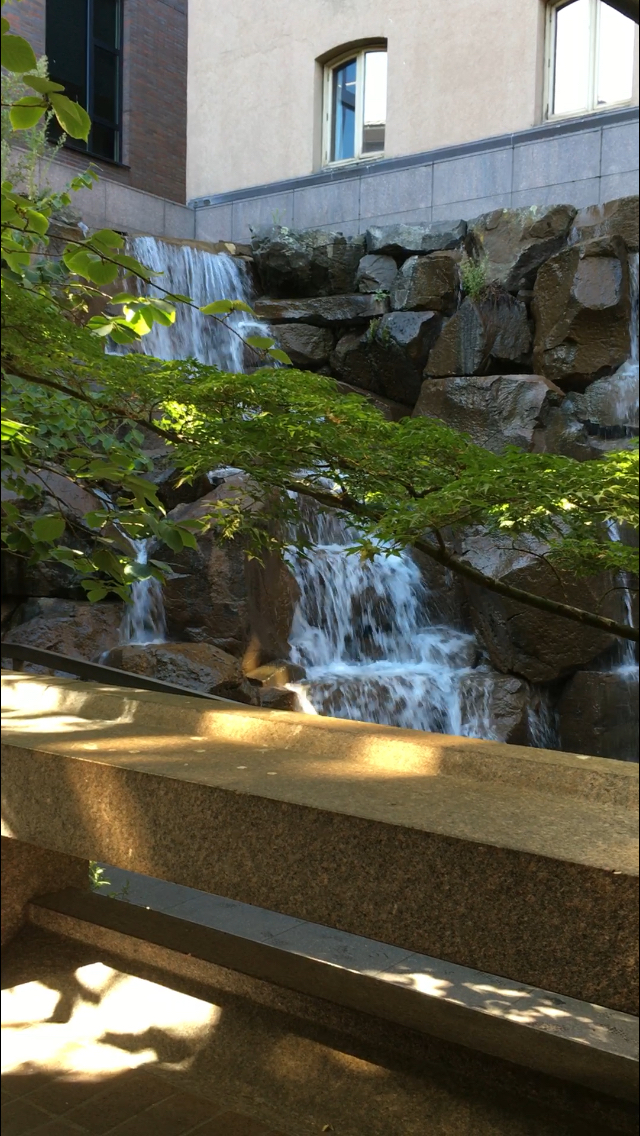
We'll go here when we meet IRL in Seattle.

Thank you, Eileen, for reaching out to meet when you were here. Thank you, Cai, for challenging us all to seek each other out.

A postscript: My daughter was a bridesmaid last weekend and she mentioned that everyone kept their phones put away during the ceremony. This surprised me a little--and delighted me, too. The couple hired a great photographer and let her document the event so everyone else could be fully present in the moment (though someone did crack a joke about doing a Facebook Live of it).

Natalie reported that she actually kept her phone stowed in her bag the entire wedding day, the longest time she can remember going without it except while camping. For this reason and others, I am not too worried about the Millennials. (And big congrats, Kelli and Gus.)

Tuesday, May 21, 2019

Writing down the days

This morning, I am grateful for the wonderful day Tom and I had yesterday (and for Tom's mindfulness in mentioning several times how wonderful it was).

This is a sentence from my journal a year ago today. I mentioned a while back that although I post infrequently here, I write every day in my journal. I'm grateful that I have this practice and I can revisit where I was--physically, emotionally, and/or spiritually--at times in my past.

I've been in a grief and loss group at church this spring, and one of the other participants asked whether I could have coffee to talk about journaling, something she'd like to do more of. We haven't had a chance to do that yet, and I figure other people may be interested, too, so I'm writing some thoughts here.

Although I've kept journals off and on most of my life, I've become much more intentional about it over the past few years. I don't think your journal needs to take any special form, and mixing them up is fine. Mine is often a gratitude journal; I often write first thing in the morning and recount what I was grateful for the previous day. I know other people do the same thing just before bed--write about what they loved in the day just ending, and that seems like a lovely way to finish one's day.

In The Artist's Way, Julia Cameron advocates for writing three free-form, loose-leaf "morning pages" first thing each day, basically as a way to get whatever's on your mind out of your head and onto the page so you can go about the rest of your day. I've done these occasionally, and I think they can be helpful as a creative exercise. For me, though, one of the best parts of journaling is storing my thoughts bound in a beautiful book, either one I've found that I love or one I've made. (I enjoy taking a plain old composition book and pasting stuff on it.)


Art by William S. Rice
Art by Hannah Viano


A trip journal
I have "home" journals for my everyday writing and "away" journals for when I travel; the latter are wonderful souvenirs. I always bring a glue stick when I travel so I can paste in ticket stubs and other mementos. I leave empty pages for adding other things later, such as photos or even an empty packet of seeds from Monet's garden in Giverny. (Here's a lovely essay from Rick Steves on why he journals as he travels.) I also have an especially nice journal in which I write only once a year, on or near my birthday.

Some people journal online, and if that's the best way for you, why not? Although I do most of my journaling on paper, I use my phone's notes app when I'm out and about and want to capture some thoughts. One digital journaling tool I especially love is the FutureMe website, which allows you to write a letter to yourself to be delivered via email in the future; you specify the date you'd like to receive it, whether a few months or a few years down the road. I've written about a dozen letters to myself via this site, usually when I am going through periods of transition and need to think about how things can and will get better.

Journals can be tools of optimism. In February 2018, Tom started on a clinical drug trial that we hoped would help him beat back another recurrence of cancer. That month, my Valentine's Day gift to both of us was a guided journal, One Question a Day for You & Me, with room for three years' worth of daily reflections. We only got a few months, but I treasure this book--both for what's in it and the memory of how, each night before bed, I'd ask the day's question and write down our answers.

A year ago, as Tom was caught in a swirl of medical procedures and I helplessly went along for the ride, journaling nearly every day helped me vent my fear and frustration and keep sight of what was good, even in difficult times. "I'm counting up the days and nights I get to spend with this remarkable man," I wrote a year ago today in my "everyday" journal, not knowing how much time we had left ... days, weeks, months, years?

One more thought: Although social media has its downsides, it is a record of your life. Many of us now have a decade's worth of Facebook posts documenting our days, and that is a journal of sorts, too. I try to use my social media time in this way, so if Instagram still exists 10 years from now, I'll remember this beautiful flower I saw on my way home from work one May day in 2019.


Life can be a blur, but if you take some time to write every day, you can see a bit of the shape of your life--where you've been, where you are now, where you may be going.

Monday, September 3, 2018

Here's to the working people

That's most of us, right? I am going to work a bit today, but that's because I took an early holiday weekend Thursday through Saturday. Being my own boss means having the flexibility to time-shift my time off. But since today is Labor Day, I'm also thinking about the other people who are working today, especially in low-wage jobs and contract labor with no benefits.

I shy far away from politics these days, but today I want to salute organized labor. For two years (2010-2012), I worked alongside and on behalf of thousands of educators in Idaho during a time when they were fighting several pitched battles on behalf of their students and themselves. These were amazing people who put in long hours on their jobs as teachers and coaches and counselors, and who knew the power of spending a bit more time to organize and negotiate good working conditions, wages, and benefits for themselves and their colleagues.

Missouri voters recently said no to a "right-to-work-for-less" proposition on their ballot. This was one of the best developments for American working people in many years. Organizing takes time, people, and money. It's only fair that all the workers who benefit from the fruits of labor negotiations help pay for them.

Those of us who work for ourselves--who've created our own jobs--can take advantage of the Affordable Care Act (which was a brilliant job-creation bill) and grant ourselves time off as we need it. For teachers and nurses and police officers and firefighters and skilled craftspeople--not to mention retail and service and healthcare workers who need advocacy more than most--organizing is one way employers and employees can work together to be sure hard work is valued and recognized.

It'll be great if we can one day live in a world where all work--including the work of parenting and caregiving--were justly valued and fairly compensated, and where we all enjoy healthcare, paid time off, guaranteed retirement income, and the other rewards of hard work. Until then, happy day of remembering that unions built the American middle class and the 40-hour workweek. And don't forget to vote.

Tuesday, March 27, 2018

Many, many thanks

Sixth in a series for #UULent2018.

Today's UULent word is gratitude. As I've noted a few times, I'm taking part in UU Wellspring--Spiritual Practices at my church. As befits our spacious Unitarian Universalist faith, we are encouraged to try any number of practices to see which ones work best in our lives. Back in January, we were encouraged to begin a gratitude journal: basically, to take time every night before bed to write down five things for which we were grateful that day.

I've fitfully kept gratitude journals before, as far back as 2005. This time, though, I've done it faithfully nearly every day since starting January 3. Two weeks after I started, I wrote, "This was a good exercise. It helped me recognize how grateful I am for my life as it is right now and that little things mean the most."

I like the idea of going to sleep with a grateful heart, but I've found that it's easier for me to write my gratitudes as part of the quiet mornings I enjoy most days: often before I read a while, sometimes after. Either way, it helps set the stage for a grateful day.

Gratitude journals past and present

Thursday, October 12, 2017

Dig it all

I got a new phone this week. Not the one that costs a thousand bucks, but an 18-month-old model that somehow is now already two or three generations old; I've lost count. 

I'm a dedicated medium-late adopter, so by the time I get around to buying any hardware, the price has dropped and the bugs are fixed. This phone replaces one that served me well for (gulp) more than four years. I almost hate to let go of the latter since 50 months is by far the longest I've ever kept a phone and I really liked it, but the battery life was starting to fade.

Like my previous phone, this new one fits in one hand and in my front pocket, important since I like to go places without a purse when I can. (I don’t understand how some people carry their phone in their back pocket, which seems like an invitation both to butt-dials and theft. But I digress.) With twice the memory of my old phone, a far better camera, and a speedy processor, it's definitely a step up. It was time. 

I know it’s important to back up your contacts before getting a new phone. I’d done that with my previous phones, but I’d never pared them down. I did so this time, culling my contacts by more than half. Gone are the dozens of duplicates. So, too, are the names and numbers of most of the big team of health professionals that helped my Dad through his final years. 

So are contacts from jobs I had in the late 2000s, and the names and numbers of my daughter’s friends from the same era. (I'd inherited her first phone, an orange LG one with an inner keyboard.) As an aside, I really hated touch-screen smart phones when they first came out, but of course I got used to them -- and I wrote most of this in the Notes app on my new phone, waiting for the bus today. 

I've recycled most of my old phones, but I still have that orange one, just because it is an awesome relic from the not-distant past. (See below.) And I still have its predecessor, a flip phone from near the turn of the century,  just in case I someday need to live even leaner than I do now. But for now, I'm living large--for me, anyway--with my not-so-new smartphone. 


Thursday, October 13, 2016

Autumn is sending you invitations


This was one of the first fallen autumn leaves I saw this year, on September 17, by itself on a sidewalk in my neighborhood. I took its picture and posted it on Instagram and Facebook with the caption, "This seems to happen earlier these days. #fleeting #cultivatecalm." About two dozen of my Facebook friends and acquaintances liked the post, and one added a comment:

Autumn is sending you invitations!

Sometimes I'm tempted to give up social media, but it's moments like this I know I probably never will. I've been meditating on Sara's five words ever since that day, thinking about why the falling leaves are astonishing and poignant and meaningful, and why they become more so every year we spend on this planet.

This has been a year full of reflection for me. On the nature of work, as always. On the importance of love, and the balance between solitude and companionship. These matters merit my attention, and they help direct my attention to the handful of people who need me most (and from whom I am learning the most, too).

This blog takes its name from something Henry David Thoreau wrote, something I first read on a bumper sticker at the Walden Pond gift shop, "Surely joy is the condition of life." I bought three or four stickers and gave them to friends over the years. At long last, during my Wellspring travels and our study of the writer's work earlier this year, I was compelled to finally read this phrase in its context.

In his 1842 essay Natural History of Massachusetts, Thoreau wrote of growing weary of politics and even "the din of religion, literature, and philosophy," then he describes how his spirit is continually refreshed and renewed by nature, by

the young fry that leap in ponds, the myriads of insects ushered into being on a summer evening, the incessant note of the hyla with which the woods ring in the spring, the nonchalance of the butterfly carrying accident and change painted in a thousand hues upon its wings, or the brook minnow stoutly stemming the current, the lustre of whose scales worn bright by the attrition is reflected upon the bank.

And so it is for me. The first big windstorm of the fall is due tonight. It's raining now, and rain is forecast for the next week and probably for the next month, since this is October and it is Seattle. Yet I feel fortified for any darkness and uncertainty ahead by many walks in beautiful places this fall. I've been recording my impressions less in words and more in memories and photos, because that's where I am in my life.


I don't write here much, and I don't post much on social media. I take comfort (and, yes, joy) in what Thoreau says about "the inexpressible privacy of a life -- how silent and unambitious it is."


Autumn's invitation to me, especially in this season of din and angst, is to dare to be unambitious, to dwell in the present moment, to recognize and gratefully acknowledge gifts as they're revealed to me, and to share when I am moved to do so.

Thanks, Sara, and HDT, too.


Wednesday, March 16, 2016

Mindful busyness

I've read two good books this month: Mindful Tech: How to Bring Balance to Our Digital Lives by David M. Levy and The One Who Is Not Busy: Connecting with Work in a Deeply Satisfying Way by Darlene Cohen.

On the surface of things, I live a simplified, streamlined life. But when it comes to mental clutter, I have plenty. Yes, I take refuge in the idea that creative people have messy minds, but I also know that mess creates stress. So I'm open to ideas, tools, and practices that can help me declutter my brain and work style as successfully as I've decluttered my life. Mindful Tech has already helped me.

Levy has spent a career in the information sciences, but he also has studied calligraphy and bookbinding. Since 2001, he's been a professor at the University of Washington's Information School, where, as he writes on the UW website, "I have mainly been investigating the challenge of achieving contemplative balance–how as individuals and as a society we might live healthy, reflective, and productive (lives) while participating in an accelerating, information-saturated culture."

In other words, Levy doesn't advocate that we unplug from our devices. He suggests that we pay more attention to how we are when we're online: whether the sight of a full email inbox makes us hyperventilate, whether we get into a pleasant state of flow or an anxious fear of missing out when we surf around social media, whether our muscles tense when an alert tone sounds on our phone, whether I ignore the bell that nudges me to stand up, stretch, and breathe.

The passage of the book that spoke most deeply to me is one in which Levy quotes a trio of psychologists (Zindel Segal, Mark Williams, and John Teasdale) on a shift from "doing mode" to "being mode."

Here's the difference: Being mode "is characterized by a sense of freedom, freshness, and unfolding of experience in new ways. It is responsive to the richness and complexity of the unique patterns that each moment presents." In doing mode, on the other hand, "the multidimensional nature of experience is reduced primarily to a unidimensional analysis of its standing in relation to a goal state."

Bingo! As a journalist, I've been dwelling in doing mode for my entire professional life. Deadlines are the "goal state," and I'm comfortable there, when I need to be. However, when I add ceaseless heaps of administrative work to the mix, it's really hard to be in "being mode" for any length of time.

That's why a mention of Darlene Cohen's book in Levy's work was intriguing to me. The One Who Is Not Busy seems less a title than a mirage. Is such a state really possible to achieve in today's work world? Indeed, Cohen -- who passed away in 2011 -- published this book in 2004: pre-Great Recession, pre-widespread disruption, pre-Facebook, Twitter, Snapchat, etc. A dozen years later, companies are expecting ever more of their employees, and we're more distracted than ever.

In a chapter titled "Living Seamlessly," Cohen plays a similar chord to the one that most struck me in Mindful Tech. If we can give each activity our full attention, she writes, life becomes more than ticking off tasks on a list. Usually, she adds, we're preoccupied with the goal, "the 'why' of our activity. If we can soften the exclusively goal-specific focus that we usually bring to our work concerns and start to pay attention not just to what furthers our goals but to everything inside us and around us, we have vastly enlarged our own playing field." And I sense that play really is an operative word here. Many of us take our work far too seriously.

Cohen offers a menu of complicated exercises that would probably work better via an audiobook (and I plan to record a few as voice memos to give them a try), yet her advice essentially boils down to "one thing at a time" and staying in the present moment. We may be super busy, but she says that if we can practice two core skills -- 1) the ability to narrow or widen the mind's focus at will and 2) the ability to shift focus from one thing to another (from "narrow" to "narrow" to "narrow"), we can improve the quality of our work lives, no matter how manic or mundane they may be.

Levy's aim is more straightforward: to help readers pay attention and be more intentional about our tech use. Since his book is brand new, he's more mindful of the increased demands on our time and mental bandwidth.

Paying attention and being more intentional are things we can all do. Even those tasks are huge and take practice, but the alternative is sleepwalking through life.