Showing posts with label live large. Show all posts

Friday, November 13, 2020

Pandemic postcard #34: Life as one big art project


February:
 I did not see this coming. My daughter Natalie announces on social media that she has recorded an album, and I spend my next-to-next-to-last night in Guadalajara marveling at her nine-track Something to Harvest release on BandCamp. Performing as "Fine Hands," Natalie wrote all the songs, played all the instruments, overdubbed her vocals, even painted the cover art. One of my favorite lyrics becomes all too poignant within a few weeks: "I know you said handshakes give you anxiety. So give me your hand, I'll hold it still as can be."

March: It's a few weeks into the pandemic. "Give me something small to paint," Natalie writes on her Instagram story. "Self portrait but as a snail," writes one friend. "A lone backroad under the stars at night," suggests one, and another wants to see a cat playing drums. My request is for "the tiny sea creature of  your choice." Natalie paints and posts a series of watercolors, and they're all gone within 24 hours. At least I get some screenshots.

April: Natalie does her hair and applies theatrical makeup, dons a velveteen green pantsuit, becomes "Boo Boo the Fool," and posts photos on social media, all in the name of amusing herself and her friends as the weeks of social isolation turn into months.  

May: It's Mother's Day and I'm opening my gifts on a Zoom call with Natalie. One of them is the original watercolor from her Instagram session, the little horseshoe crab she painted for me. It's one of the best gifts I've ever received.

July: It's Natalie's COVID birthday, and she makes the best of it, baking herself a beautiful cheesecake garnished with berries and mint and candles. Her creativity extends to the domestic life, from artful cookery to inspired thrift-shopping.

September: In another Instagram story, Natalie posts pix of her latest "Sunday Craft Day," little heart-shaped earrings that read "Love They Neighbor" and "Abolish ICE." (In addition to her artistic ventures and holding a full-time job, Natalie has dedicated hundreds of hours this year to speaking out for racial justice. I have learned much from her--and from other young adults in my life--on that front, too.)

November: A week ago Tuesday, I get a text from Nat. "Putting up holiday decor while watching election coverage to try and balance the vibes," she writes. Natalie has always loved Christmas, and by last weekend, her apartment was a wonderland of lights and music and good cheer, and why not? We all need all of the above this year more than most. 

____

I'll accept a tiny bit of credit for Natalie's creativity. I played in a band and we recorded a single when I was her age, I introduced her to The Beatles when she was little, and I dragged her to art museums even when she really didn't want to go. Her dad is musical, too, and he brought home big rolls of newsprint for her to spend hours coloring and drawing freehand on the living room floor. She has had many other mentors along the way, including Karen, who ran a storefront art studio for kids in Twin Falls, Idaho; the music department at Boise High School; and the creative community she has claimed as her own as a young adult, in Boise and beyond. No one creates in a vacuum, and we all have abundant inspirations and influences. 

But what thrills me about Natalie's creativity is that so much of it is self-directed and self-generative--she never spends much money in pursuit of her muse--and she follows through. Plenty of us dabble in creativity. Natalie, more than most people, embodies it. If I have one resolution for the rest of this pandemic period, it's to be more like my daughter. I want to spend fewer hours worrying about the future and more hours producing joy through music and art and random reveries of fancy. 

None of this is frivolous. All of it is life-affirming and counter-cultural, signaling to society that happiness can be made, not bought, and that each of us has the ability to live life like it is one big art project. Short of a residency on Kauai (unfortunately not in the cards), I can't imagine a better way to spend the long pandemic winter ahead.

Friday, October 2, 2020

Pandemic postcard #28: Will write for tips

Update: I have taken down my Patreon page as of April 2021. If you'd like to support my work, you can check out more recent posts at Surely Joy's current site, where you'll find a tip jar. Thank you for valuing creativity and the written word.

It's Friday morning, and word has arrived that our First Couple have confirmed cases of coronavirus. Could this year possibly get any weirder? 

It seems like a month ago already, before this latest news and before the raucous debate, but I actually turned down a job this week. After a summer coming up short in my search for work, I was glad to finally have a job offer, especially with the CARES Act federal unemployment assistance long gone and my state unemployment pay ending soon. But something didn't feel right. 

I would have had work for about five weeks this winter, monitoring tests in school classrooms--a job I did a few years ago, too, but that was before COVID. Would the work even happen, with most schools still closed? Then there were the logistical hoops I'd be jumping through to take and keep the job: fingerprinting at a time when it's nearly impossible, weekly COVID tests, heavy-duty PPE requirements. All for a short-term, minimum wage gig with no benefits. 

I finally realized that I'd applied for the job out of fear--of making my rent, of ever working for a wage again. I wound up turning it down out of hope for something better.

Of course, it's a marker of privilege that I can do this. Plenty of people are taking whatever work they can to make ends meet from week to week, despite the threat of a disease that's disproportionately affecting working-class Americans. Many people don't have savings to use in an emergency, never mind during a few lean months. I have savings I can dip into if I need to (and I’ll need to).

Most of all, though, I realized that I want to focus on doing what I do best (and what I'd done my entire adult life until most of my work vanished in March): make a living with words. For seven months, I've been writing these pandemic postcards--essentially a weekly column--to try and make sense of these times, but I have been writing them for free. Not so long ago, before Craigslist and social media decimated local journalism, someone with my background could land a job writing a column or human-interest stories. Those opportunities are rare these days, yet I know I ought to be paid for at least some of my writing. 

That's why--although Surely Joy will remain free (and ad-free)--I've decided to set up a page on Patreon where, for $3 a month, you can let me know my work has value to you. I know this may be a big ask at a time when we are all being asked to contribute to the usual member-supported media outlets plus maintain subscriptions to major journalism organizations that are doing critical work--but if you have $3 a month to spare to support my experiment in crowd-funded punditry, I'll be grateful.

The $3-a-month tier is my "You like me" level. Pledges of this amount can really add up in my small-footprint micro-economy, and I will write at least one patrons-only post each month at Patreon for folks who pledge that amount. (Here's a sample.)

People who pledge $9 a month ("You really like me") will also get access to some behind-the-scenes peeks at my notebooks and work in progress (like this). And because I sense that some of my readers would love to pursue a more joyful, intentional life, I offer the "You want to be like me" tier, which is $27 a month. For that level of support, I will be your personal creativity coach. We'll talk at least once a quarter about how you'd like to live more fearlessly and creatively. I'll encourage and question and inspire you (and you will do the same for me). 

Surely Joy will never be all I do, and that’s OK. I love to interview people and write feature stories; I just finished my first one since March, an article for 3rd Act magazine about how musicians are weathering the pandemic. I like to edit and I have some possibilities in that area. I fervently hope to be working back at the ballpark next year. It’s a seasonal, minimum wage job, too, but I enjoy the fans and the people I work with.

But the writing I do here feels important--to me and, I know, to some of you. We are in historic times, and I am trying my best to make some sense of them while also lifting up my original reason for this blog: the practice of living a simple, beautiful life and of pursuing joy, described by Brother David Steindl-Rast as "the happiness that doesn't depend on what happens." Joy is more essential than ever as we work hard to make real the world we imagine. And today, we might even permit ourselves a bit of schadenfreude while wishing the Trumps a speedy recovery. Or not.    

Thanks for reading this far, and for considering a pledge. It is an honor to write for you. Let's continue to navigate these strange times together.

Mural at Olympic View Elementary School, Seattle


Friday, July 17, 2020

Pandemic postcard #18: Beacons in the dark

Have you been able to see Comet NEOWISE? It is visible in the Northern Hemisphere for a while longer, rising in the evening sky and coming closest to Earth on July 23. I haven't seen it yet; I was up before dawn trying to catch a glimpse last weekend, when it was close to the horizon, but city lights and hills precluded a view. (A rising Venus was amazing, though!)

I'll never forget seeing Comet Hale-Bopp in the spring of 1997 on a drive home from Salt Lake City to Twin Falls, Idaho. Motoring north through dark high desert skies on Interstate 15, then Interstate 84, I had the comet in my view for several hours, nearly the whole way home. That evening ranks with the 2017 total solar eclipse as one of the great natural phenomena I've experienced. How fitting is it that Comet NEOWISE seemingly came out of nowhere in late March, becoming visible to NASA scientists during the first pandemic surge? We need all the bright lights we can find in these dark times, and I hope to see this new comet sometime next week.

As I mentioned in last week's post, I've been "at camp" this week. It's all been online, of course, but it has been wonderful to reconnect with my Eliot friends, even over Zoom. We've been hearing timeless tales of many cultures from talented storyteller Will Hornyak. We've had a talent show, games, (including a fun offline scavenger hunt), TED Talks, worship services, small-group discussions, and much more. I will be sad to see it end. I may even sign up for the August camp, which I've never attended--but I continue to have lots of time on my hands. (More on that below.)

Camp meant a lot of screen time, but I've managed to spend this entire week away from social media, and I took in only a bit of news each day. I'll be sad to see that end, too, but as Will related in one of his programs, a vision quest can't go on forever. Ultimately, people need to return to their daily lives. Of course, this is something we're all wrestling with now. As people go back to their routines of in-person socializing, many people are getting sick and sickening others. It's an unsteady dance we're doing, and it seems we'll be doing it for another year or so, until a widespread vaccine is available. I know this is especially hard on families, as well as on people experiencing homelessness and people with little social contact of any kind.

Will told a story this week about two villages. (You can watch an earlier performance of it below.)  A natural disaster had brought the villages to the brink of war, but with imagination and creativity--and some wise grandmothers--the villagers solved their problem without bloodshed. As Will says, we need new steps, new dances, new songs, and new stories in times like these. Stories can break the spells we weave around ourselves, the narratives that sometimes keep us feeling like change is impossible.

With the end of July nigh, I am among the millions of Americans who face the end of enhanced unemployment benefits next week. Although I've freelanced much of my life, I'd love to find a full-time job that I can dig in and do until it's time to retire. I applied for one in late May that would've been perfect for me, finally learning just this week that although my resume made it through several "cuts," I will not be a finalist. I know it is no easy task to find work in one's late 50s, but I still believe something good will emerge in due time. I'll keep looking for the beacons in the dark, and I will try to be one, too. My superpower is helping people tell their stories, after all, and there's a big need for that these days.

Thanks for reading. I'm going to spend some more time away from screens next week--to go camping, look for the comet, and hopefully see my daughter (who lives 500 miles away) for the first time in 2020. I'll be back with another dispatch in two weeks. Until then, be well...and be the light.


Friday, May 22, 2020

Pandemic postcard #10: Holiday in Pandemia

My church had its annual Coming of Age service last Sunday. It's one of my favorites, the culmination of a year when our ninth-graders spend a year thinking about life's big questions. Of course, the service was online, and it was still wonderful. "Joyful but realistic," one woman described it in our virtual coffee-hour gathering afterward.

From Easter and Passover and Ramadan to Mother's Day and graduation season, we've checked off nearly all the spring boxes. I love the congratulations-and-stay-strong signs honoring graduates all over my city, and it's been fun to listen to online commencement speeches by everyone from President Obama to Awkwafina to ... Donald Trump? And now it's Memorial Day Weekend, the unofficial start of summer. On Monday, when we pause to recall those who have died fighting for our country, let's remember the most recent casualties: the doctors, the nurses, the cashiers, the meat packers, the beloved grandparents.

It doesn't feel like summer. The steam heat in my apartment came on again yesterday amid a Seattle cold snap. The ballparks are empty, from the biggest stadiums to the forlorn sandlots, now given over to dogs and their people playing fetch. Concerts and sleep-away camps have been canceled. And yet ...

Italy? Mexico? Seattle!
I am not sure where or even if I might travel this summer. Except for a few recent forays to state parks open for day use, I haven't gone beyond a two-mile radius of my home. Still, it's been dawning on me anew that I live in a place that people from all over the world visit on vacation. Now that we can venture out a bit, I want to spend some time in my bigger backyard, the Emerald City. I want to wander through a nearly deserted Pike Place Market, see the murals that have popped up at Pioneer Square, and maybe hear a busker play in Georgetown. I want to spend some of my unemployment pay at local restaurants and shops in Ballard and Columbia City. And if I'm feeling really brave, maybe I can meet a friend for a socially distanced picnic or a cup of coffee, or even go to a movie once the neighborhood cinemas reopen. I would totally do that.

In many ways, the new normal is feeling pretty old. Since the pandemic is going to be with us for a while, we might as well try to have fun, safely and responsibly and with thanks to the people who are willing to serve us. We ought to be realistic ... but joyful. This is our life right now, all of it.

Friday, May 1, 2020

Pandemic postcard #7: May we give thanks

I have two friends, Joe and Kevin, part of a group of Ohio University alumni who reconstituted online once the Internet ramped up about a decade after we graduated. Credit for that goes to another friend, Meg, who started a list serv to loosely knit us all together. We were people who--one way or another--hung out at OU's student union, whether it was working on student government, the school newspaper, the campus radio station, the events board...or tending bar at the Frontier Room campus pub.

Ah, the Frontier Room in May. This time of year, it would be empty, because everyone would be outside on the patio, enjoying the Appalachian spring. If you got there early, you could grab a seat on the brick walls on the corner of Union and College streets, hailing friends passing below who hadn't managed to leave their class schedule blank after 3 p.m. The Frontier Room was less than a hundred steps from The Post, where I spent most of my non-class time, but I am pretty sure I whiled away at least as many hours at the bar as I did at the office. They were good times, and I made lifelong friends.

I didn't know Kevin and Joe well while we were in school, and I can count on one hand the number of times we've seen each other in person since then. But each has enriched my online life in a significant way. Let me explain.

Back in 2013, when Kevin was awaiting a kidney transplant, he started making a Facebook post the first day of each month, always starting "Rabbit rabbit rabbit" for good luck and then sharing an update from his life. The posts "were just meant to help me recalibrate during the last years of dialysis, but I'm grateful others get something from them," he tells me. Kevin always includes some words of encouragement and, once in a while, a gentle admonition. Today, he asked us all to please wear our masks. "Millions like me have a compromised immune system," he wrote. "I've beat cancer twice, please don't kill me with your sneeze. Thanks." He ends each of these monthly posts with these words, "No day but today," from the finale of Rent.

Like me, Joe walks every day. (Actually, Joe says he has only missed two days of walking since 2010. I am in awe.) Joe averaged over five miles a day last year, and every morning on his return, he posts on Facebook. He gives the weather report from Central Ohio, logs the first six selections from his music shuffle playlist, and ends each post with the words "We Can Stop It." Joe says that when he began adding that coda about a year ago, the phrase referred to gun violence, "but it does apply to COVID-19 and about anything else that we have the ability to stop."

As I've written before, Facebook has been a lifeline for many of us in these new times, but I really appreciate Kevin and Joe for their years of steadfastness, so I just wanted to let them know. If someone in your life has made a difference for you during these tough times, or anytime, be sure to tell them.

It's the little things, people. Sometimes they're not so little.

I'll conclude this post with one of the tunes from Joe's May 1 morning shuffle. Take us out, Howard Jones ...

Friday, April 24, 2020

Pandemic postcard #6: Thank you, world

... and the sun is my alarm, and the moon, she makes me dream ...

Hello again, happy 50th anniversary of Earth Day, and happy 30th anniversary of one of my all-time favorite albums, Goodbye Jumbo by World Party. As I grabbed the code to post the video of "Thank You World" below, I saw that the album was released on April 24, 1990. Serendipity ... and dig how songwriter Karl Wallinger sings his hymn of thankful praise to the Earth while seemingly sheltered in place, but dreaming big indeed.

On Earth Day morning, I headed out early to beat the rain. I have some standard walking routes within a two-mile radius of my home: one that takes me to Maple Leaf Park, another that threads through the Pinehurst neighborhood, but I am prone to wandering, especially now. That's how I wound up across the street from a house I had never seen before, with a brightly whimsical sun shining over shingles of inlaid clouds, birds, and fish. When I got home, I looked it up and found this article about the last time it was for sale, plus a better screen capture from Google Maps.

Discovering this house was delightful enough, and the rest of my Earth Day walk was chockablock with Seattle's riotously wild spring pageantry. For every semi-manicured yard, there are countless examples of barely tamed urban landscapes, with flowers spilling out of street-side rock walls and Seussian cypress trees shamelessly flirting with Douglas firs. The Emerald City is absolutely crazy with color and boisterous with birdsong right now, and it's all the better because there is almost no vehicular traffic.

Once the pandemic subsides, I hope the cars mostly stay parked like they are now. I want people to be well and I want children to get back to school, but perhaps people who can work from home will continue to do so, at least some of the time, and people will find ways to get around that don't involve burning up our beautiful spaceship home. These are challenging times, no doubt, but they are making us all more creative in everything we do.

Until next Friday, be well and enjoy your neighborhood, wherever you are.


Thursday, February 6, 2020

I am a teacher!

One of the things I love about travel is how it helps me be creative and solve problems as they arise. Sometimes, I’ve had to decode a mysterious European lock or appliance, or find well-hidden light switches. Once, I had to use an impromptu game of charades to locate a late-night pharmacy. 

In my 12 days (so far) in Guadalajara, I’ve had many moments of thinking I’ve finally gotten in over my head. I am in a big, intense, unfamiliar city (Mexico’s second largest). Last week, I joined a beginner immersive Spanish class a week after it had started, and it was muy stressful, especially since I had a cold and wasn’t sleeping well. This week, I have begun a four-week course in Teaching English as a Foreign Language, and I am by far the oldest person in my class. (There was one other “mature” student in our cohort, but he bailed out today, on Day 3.) Amazingly, you teach your first class on the third day. That was today. 

For my first class, I had to help the students review future passive tense, which I rarely use myself. I had to look it up to remember what it means. To top it off, I had to do lesson plans today for my first two classes since the second is at 8 a.m. tomorrow.

It’s been an anxious week. But now I feel like, OK, I’ve got this. 

Mr. Ruiz, a really popular and good teacher, observed my first class, the one on future perfect, for an intermediate-level class of young adults. The theme was outer space, and over the course of the class, the students needed to decide who among them would be sent back to Earth. I’d written a lesson plan for a class of seven students, but when I arrived,  there were only five, so I had to adapt on the fly—and I did. 

In the first part of the class, I had the students talk about the positives and negatives of being an astronaut. Risk was one factor they cited, and I was able to tell them the sad story of the Challenger—as well as introduce the word “quarantine,” an experience the early astronauts had upon their return to Earth, and a concept in the news again now with the coronavirus. 

Next, I had the students talk in two groups to justify their jobs. As they talked, I had an idea to hold a secret ballot among the whole group, since it was so small. All five voted to jettison the psychologist rather than the engineer or the captain— so I got to teach the word unanimous! It was interesting to see how the class became a blend of activities I’d planned and spontaneous actions. 

At my review session, Mr. Ruiz asked how I’d rate myself and I said about a 6. “Why so low?” he asked. I mainly felt like I had plenty of room to improve. So I was a little surprised but very happy when he gave me a score of 9 out of 10! He was very complimentary of my classroom management, board use, demeanor, my low TTT (teacher talk time)—even my handwriting! One of my students, Cynthia, said it was a great class, which Mr. Ruiz said is the best compliment you can get. 

Mr. Ruiz noted that my future scores will go up and down since some classes are harder than others. His main piece of advice was that I could rely on students in a higher-level class to explain even more—to paraphrase instructions instead of simply reading them, for example. 

So my first class is behind me—and by lunchtime tomorrow, I will have taught another, and then about a dozen more over the next three weeks. I have no idea what I might do with my TEFL credential, or where I will wind up using it. But even with just one day of teaching behind me, I feel newly confident that this was a good idea. I will do something good with this new skill, something to help people achieve their goals—and something to give my own life new purpose and meaning. 


Saturday, January 4, 2020

Live and learn

My theme word for 2020 is learn. I was inspired to pick a word for the year by Tim Atkins, who wrote about how he's chosen one each year for a few years now. "I started this practice five years ago, and it’s changed my life," he says. "It becomes a mantra I meditate on throughout the year. When I’m questioning what’s the right thing to do, I will look to my word of the year for guidance."

Learn was an easy choice for me for this year. Later this month, I'll be traveling to Mexico to learn how to teach English as a foreign language. It's an intensive program and I haven't been in a classroom for a long time. I have to admit I'm feeling a little intimidated; although I have made a living as a writer and editor for many decades, I am not the world's greatest grammarian. I think I missed the day we learned how to diagram sentences back in middle school, and I'm not at all sure I can explain the finer points of adverbs. But that's why I am taking the TEFL class. I look forward to learning more about my own language so I can help others learn it, too.

On January 1, I walked the Golden Gate Bridge with my brother and several friends. One of them, Felicia, compiles a list each year of new experiences she wants to try in her beloved Bay Area region. With that as an inspiration, I am making a list, too. Here are eight* experiences and activities I plan to try in 2020:

Learning to teach English as a foreign language. 
Improving my Spanish.
Trying a new art activity.
Volunteering at Treefort, Boise's big spring music festival.
Going to a professional soccer game.
Seeing a concert at the Greek Theatre in Berkeley, Calif. (which will give me another excuse to visit my Bay Area family).
Taking a solo road trip around the Olympic Peninsula.

*This is a bonus one: I may go to Alaska. (If not in 2020, I'll aim for 2021.) I've been to all 50 states but four: Alaska, Alabama, Mississippi, and South Carolina. I want to get to them all by the time I turn 60. 

Before I close, I'd also like to celebrate a few things I did in 2019: I re-read all the Harry Potter books, learned to make Greek yogurt in a crockpot, went camping by myself for the first time in decades, walked an average of four miles a day, visited Ireland for the first time, saw my cousins at Christmas for the first time in decades, spent 10 nights on a train, and made progress in mending a broken heart. It was a good year.

I wish you a bright new year of living and learning.

Laugh is another word I plan to hold close for 2020. The older I get, the more comfortable I am not taking things so seriously--especially myself.

Thursday, September 19, 2019

To be with one another

My friend Cai recently posted a bucket list on Facebook. Along with wishes for far-off travel and adventure, she said she hopes to meet each of her Facebook friends in person.

Remember a few years ago—well, maybe it’s been a decade or more—when we started using the acronym IRL (in real life)? It seems quaint now, since so much of our lives are lived online, mediated and facilitated and sometimes complicated by our screens, but as real as can be.

Sort of. I’m writing this on my “phone” (and I did actually make a call on it today, amid the emails and texts and updates) as I’m sitting outdoors, in nature, for what feels like the first time all week. I remind myself to look up and out, not just down, but so much happens in these few square inches: Friends posting photos from their travels. Classmates organizing our reunion. Another friend's successful surgery. Smiling babies, sleeping cats, people imperiling the real world, people imploring us to act before it's too late. And you ... you are reading this on a screen right now, and I thank you.

And yet there is a world IRL, beyond the screens, the world that Cai wants to experience. One of my Facebook friends recently traveled from her home in Washington, DC, to the other Washington. She messaged me the week before, wondering if I wanted to get coffee.

I have a lot of Facebook friends, given how I’ve lived in a lot of places and had a lot of jobs in my dozen years on the site—and especially how I used it in its early years, as an organizing tool. I racked my brain and tried to remember how I’d met this person. I couldn’t recall, but from her profile, it was clear that we share some key interests and could have a good conversation--and so mindful of Cai’s vow to meet all her Facebook friends IRL, I accepted the invitation. My correspondent reminded me which of our mutual friends introduced us online a decade or so ago and confirmed that no, we had not actually met face to face.

But now we have. I passed a fine late-summer hour talking urbanism and walkability and travel with Eileen in a favorite little park in Seattle, a place I’m always eager to be sure visitors see. I won’t tell you more here, because if we are friends on Facebook or Twitter or Instagram or LinkedIn, I’ll tell you once you get in touch to tell me you’re in Seattle and want to meet up IRL.
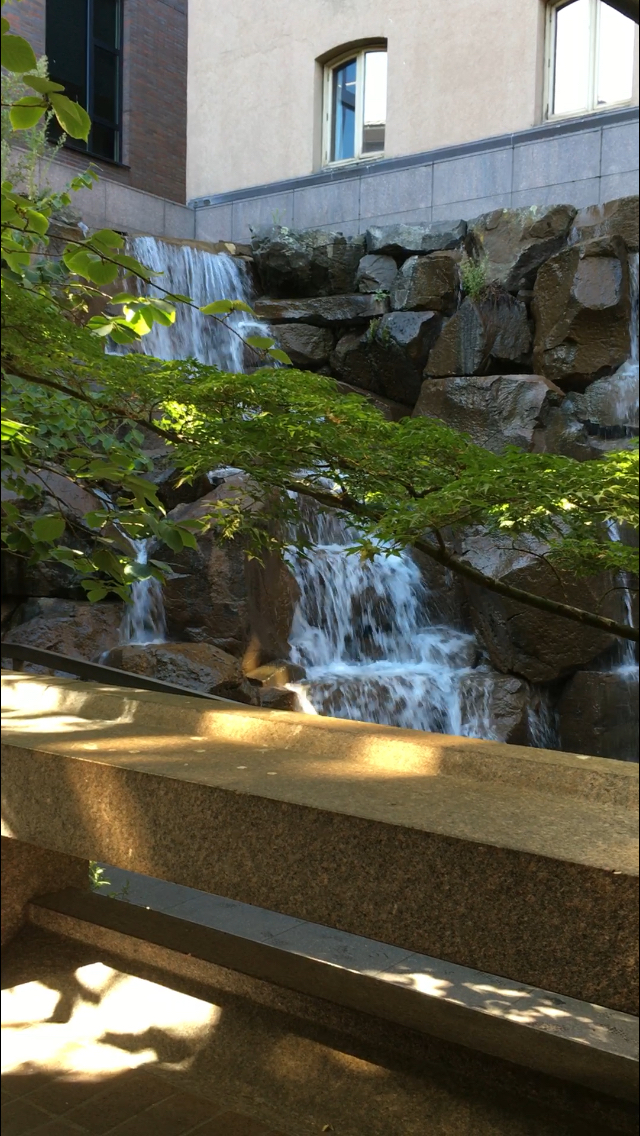
We'll go here when we meet IRL in Seattle.

Thank you, Eileen, for reaching out to meet when you were here. Thank you, Cai, for challenging us all to seek each other out.

A postscript: My daughter was a bridesmaid last weekend and she mentioned that everyone kept their phones put away during the ceremony. This surprised me a little--and delighted me, too. The couple hired a great photographer and let her document the event so everyone else could be fully present in the moment (though someone did crack a joke about doing a Facebook Live of it).

Natalie reported that she actually kept her phone stowed in her bag the entire wedding day, the longest time she can remember going without it except while camping. For this reason and others, I am not too worried about the Millennials. (And big congrats, Kelli and Gus.)

Saturday, July 27, 2019

Belonging

One of the things I like best about my part-time job at the ballpark comes into full flower now in midsummer, when I get to talk with people visiting us from all over the world. Many are in Seattle at the start or the end of a cruise to Alaska. Others are here to escape their hot weather back home. That's a roll of the dice--it can be warm and sunny here one day, as it was yesterday, or rainy and coolish, but there's always something to do on those days, too.

Earlier this year, I felt like running away--from the long, dark Seattle winter, and from a house that never really felt like home after Tom was gone, because Tom was my home. I soon realized that I needed to stay in Seattle to tie up loose ends here, anyway, and it would take most of this year--so I signed a short lease for the place I'm living now, nearly certain I would move on this fall. But now I'm nearly certain that I won't.

For one thing, I have moved five times since 2012, and I'd just like to stay put for a while. I like my apartment a lot, and I may well have to move again in a few years as urban renewal proceeds all around the low-slung 1950s courtyard complex I currently call home.

Mostly, though, it's the trees and the sea telling me to stay put. In June, I drove to a special place on Hood Canal, Harmony Hill, where Tom and I attended a stem cell transplant survivors' weekend just two months before he died. As I walked the labyrinth around an amazing old tree, I heard myself or someone or something tell me, "There's a reason you're here."

I heard the same thing last week while at family camp on Seabeck Bay, as I took communion with the herons and seals and my human beloveds--and again yesterday, my birthday, as I treated myself to an afternoon spent looking for (and finding) more seals, orcas, eagles, and other neighbors from the wild world. The truth is, I was just happy to be out on the Salish Sea on a glorious summer day; the animals were a bonus.  And today, it is raining, which I've come to feel is just fine, too, especially if it keeps our forests dry after two summers aflame.

This post is, yet again, about allowing myself to change my mind and about being a work in progress, even well into my sixth decade of life. It's partly about connecting to a place I didn't necessarily choose when I first moved here to be closer to Tom, but a place that apparently has chosen me.

There's a reason I'm here. Maybe it's to be an unofficial ambassador to the people I meet at the ballpark, or in line as we wait for our boat trip. Maybe it's to help new neighbors learn English--something I plan to do as a volunteer once I earn my TEFL credential next winter. Maybe it's even to take a full-time job at the company for which I've been freelancing for a couple of years, or at the university or the library. Maybe it's something I've yet to discover. More will be revealed, I'm quite sure.


PS You can read more of my writing about Seattle and nearby here. And if you're an editor looking for a feature story or essay about the Pacific Northwest, it's your lucky day because I'm your huckleberry.

Thursday, July 11, 2019

Enough

I bought a salad spinner yesterday. It wasn't an impulse buy; I'd thought about it a few weeks. Now that I live in 400 square feet, I think harder than ever before adding anything new to my store of possessions.

The salad spinner (ironically made of plastic) won out because I'm trying to use less plastic, so I've stopped buying those oh-so-convenient plastic tubs of pre-washed salad greens--yet I'd quickly grown tired of drying rinsed spinach on towels on my tiny countertop. Yet more irony: I've actually found in previous experience that these salad spinners don't work all that well. Maybe I add too much water? Let me know if you have tips.

Or maybe I should just look at a YouTube video or two ... which brings me to my point for this post: I have an essay in the summer issue of 3rd Act Magazine on "Just Enough Technology." When my friend, the magazine's editor Victoria, asked me to write an article on "Technology We Love," I agreed, as long as I could write a sidebar about bringing balance to our technological lives. It's the second in my series of "enough" essays for the magazine; I wrote about "Just Enough News" last year. "Just Enough Space" might be the theme I explore next. After five months in this little apartment, I am discovering like never before what it really means to live a simple, streamlined life, and I like it very much. 

I'll write about that some more another time. Meanwhile, I'm not trying to lifehack my way into getting "just enough" sleep, eating "just enough" food, or experiencing "just enough" love. Instead, I'm trying to learn how to live as intentionally and yes, as joyfully, as I can in a world where hundred-year floods are happening every year and Alaska suddenly feels like California.

My kitchen cabinet, new salad spinner up top
 

Friday, April 5, 2019

Feet first

Giving walkers safe passage in Shoreline, WA
No, I didn't plan to walk six miles round trip to the movie theater yesterday. My intention was to walk there and take the bus back, but I stayed for all the credits and used the restroom afterward--and there was the bus I meant to catch, pulling away across the street just as I walked out the door. 

No worries. Having missed the bus, I decided to walk back a different way from the one I'd come--and on the way, I got to visit two new-to-me city parks and found and photographed some cool public art. (If you love street art, you might want to follow me on Instagram.) It was sunny and about 62 degrees. What could be better?

I'm currently researching a magazine article about people who are driving less to save money. There are so many options to forgo or supplement car ownership these days: transit, car sharing, ride hailing, bike sharing--and my very favorite (and the cheapest option), our own two feet.

After past experience in car-free living, I do have a car these days (thanks, Tom), but I go days without driving it. As a writer and editor, I mostly work from home, of course. I use my feet and the company-provided transit pass (thanks, Mariners) to get to my part-time job. I plan my ballpark commute and many of my errands around the five miles or so I try to walk every day, but the best walks of all can be aimless ones where I set off with only a vague idea of where I am going.

Plenty of factors keep people from walking as much as they'd like, but spring is a wonderful time to walk as much as you can, whether that's around the block or for many miles. The weather is wonderful and new life is blossoming everywhere you look. And yes indeed, I spent several hours of an ostensible workday going to a movie (the gorgeous Cold War) and walking there and back, but here's the thing about walking: If your work--or any part of your life--involves thinking, you can actually get a lot done on a walk. As I meandered, I mentally outlined the article I mentioned above, and I thought about contacts who can potentially help me find sources for several other projects. But mostly, I enjoyed the fresh air and the sunshine and the fact I wasn't stuck in a metal box on a glorious spring day. 

Walking is good!

Friday, February 15, 2019

More will be revealed (again)

I'm moving today--or at least starting a move that will unfold over a few weeks, since I'm not going far and I still have work to do settling Tom's estate. My new address will be the 21st place I've lived in my life and the sixth in the past seven years. (You read that right: Boise to Oakland in 2012, Oakland to Seattle in 2013, then two apartments in Seattle, then here with and without Tom--and now back to Seattle. )

The house I'm leaving has never really felt like home, except when Tom was here.  His presence was strong in the first weeks after he died, but soon this too-big-for-one place felt empty, even with the volumes of stuff I'm still sorting through eight months later.

I could write more about that (and I will), but this is a post about my next stop, a tiny studio apartment/townhouse hybrid I've mainly chosen because it's on the ground floor (for a relatively easy move); in a walkable, transit friendly neighborhood; and I was able to sign a short lease. It's possible--maybe even likely--that I may move again before the end of 2019.

Or it's possible that this new, tiny place will be just enough, just what I need. It's inexpensive by Seattle standards, possibly cheap enough that I can afford to leave for a few weeks to go somewhere warm each winter if I decide to stay in the Northwest.

Or I may feel a pull to move one more time, either in Seattle or to somewhere else, ideally somewhere I might live for more than a few years. It's also possible I may decide to claim no fixed address at all--to fully embrace my peripatetic ways.

As you can tell, I really have no idea. This year will be about trying to sort that out--trying to divine my own wishes after the most intense year of my life.

Although I write infrequently here, I journal every day. I'll be starting a new journal to accompany this move; I decorated it a few days ago. The photo above is from the New Internationalist calendar a few years ago. The ticket stub from an Elizabeth Gilbert lecture a few years ago has my favorite quote from that night: "Be a highly disciplined half-ass."  The poem is by Jan Richardson, a favorite of mine since I first heard it in UU Wellspring a few years ago and an especially apt one for this new season of discernment:

Travel the most ancient way
of all:
the path that leads you
to the center
of your life.

See you around again soon.

Monday, December 17, 2018

In praise of the pivot

I write today with one simple idea: It's fine to change your mind, to flip flop, to revise course.

I say this for myself as I contemplate the infinite variety of choices I might make for my next chapter of life.

I say it for you and your loved ones, because the best gift we can give ourselves or someone we love may be permission to change direction, even in matters as big as political persuasion, religious affiliation, sexuality, or career.

And I say it for our country and our world because brinksmanship and inflexibility are inhumane. There's always another way forward, even if some will choose to call it a retreat.

When we pay attention, we can see the power of principled, thoughtful course correction (or at least the possibility of it) around us every day, even among people whose views may be vastly different from our own. I heard two examples in 15 minutes of radio news this morning. In the first, a Republican strategist urged the president to pivot away from his demand to build a wall on the U.S.-Mexico border and explained how he could save face doing so. In the second, a Christian writer who penned a bestselling book on saving sex for marriage has asked his publisher to stop printing new copies of it. He hasn't turned his back on his beliefs, but he's seen the harm and heartbreak that an inflexible approach to life and love can cause. 

We can see examples among friends and family, too. One of my dear ones was leaning toward getting a new job in 2019 until a heartfelt talk with his boss made him realize how much he values his current working relationship and how much he might contribute in the coming year. Of course, new facts and feelings could make him change his mind again--and that's OK, too. When we feel free to change our minds based on new evidence, the happier we can be.

Personally, the only thing I know with certainty is that I'll be moving again in a few months. I'm eager to leave a house that really only felt like home to me while Tom was here--and I am inclined to leave (at least in winter) a region that is cold and damp and sees only eight hours of daylight this time of year.

With my portable career and love for new vistas, I am truly spoiled for choice. One day, one hour, one minute, I think I know exactly where I want to go and what I want to do first, then I see another possibility and think "hmmmm ..." And there are certainly other opportunities of which I'm not yet aware, too.

At some point, I will need to decide where I want to be, at least for a while. The beautiful thing is that need not be my final decision. And whatever choices you make today need not be your final decisions, either.

Saturday, June 2, 2018

The core of discovery

Sometime soon,  a six-year-old boy named Henry and his dad will head west on the Oregon Trail--and I'll be their guide.

Well, sort of. As writer B.J. Hollars began preparing for this journey, he found a copy of my Oregon Trail book. As he writes on his work-in-progress website for Go West Young Man:

When selecting our guide, Henry and I go with what seems simple and practical.  Something that steers me clear of coordinates and paces and other pitfalls that might mean a world of trouble for a navigationally-challenged person such as myself.  Upon cracking wide Julie Fanselow’s Traveling the Oregon TrailI know I’ve found my guide. 
Originally published in 1992, Julie’s account offers more than distances to destinations.  Interspersed throughout its more informational pages are glimpses of memoir, flashes of personal experience that bring her journey to life.  In its opening pages, I come across Julie’s most memorable moment on the Oregon Trail, which just so happens to have involved her six-year-old daughter.
B.J. reached out to me for a phone call about my experiences traveling on the trail, first on my own in the early 1990s and later that decade with my young daughter as I updated the book. I love B.J.'s recounting of our talk, which you can read here. Here's my favorite part:
As our conversation winds down, I relay to Julie the question Henry most wanted me to ask.
“How do you not get bit by a rattlesnake?”
She laughs.
“The key is seeing and hearing and being aware of your surroundings,” she says, explaining that this means keeping my attention on the moment rather than peering zombie-eyed at my phone or listening to the music in my ear buds.    
This seems like sound advice.
But there’s another key she tells me: we can’t let ourselves be afraid.
“Going out and seeing the world is the absolute most fun thing you can do,” she says.
Indeed. If I've learned anything in my life beyond the wonder of loving and being loved, it's this: Travel is by far the best way to spend your time and money, and it's both more possible and more important now than ever before.

It's possible because even if you're living with limited means, you can fly to another continent and back for a few hundred bucks; sleep in hostels or Airbnbs (with the occasional splurge on a modest hotel); and eat like the locals do, with farmers market food and trips to the grocery store. Or you can pack up the car like Henry and his dad will--or hop on a bus or train--and make memories with people you love.

It's important because we live at a time when people starting a trip hear "safe travels" more often than "bon voyage!" Simply put, travel trumps fear. It gets us out of our comfort zones and into places where we can witness our common humanity.  I could write for days about this, but I'll let Rick tell you more. Travel is at the core of discovery: of yourself and of our amazing world.

In another chapter of his pre-trip writings,  B.J. writes about playing the classic Oregon Trail computer game with Henry. Among the game's lessons: When shooting buffalo, "never kill more than you can carry." I don't have a gun when I travel (or anytime else, for that matter), so my trip motto is always "Never pack more than you can carry." That's another post. I'll write it soon.

Meanwhile, I'd like to bid Henry and his dad glad tidings for a memorable, meaningful journey--and leave you, dear reader, with my wish that you, too, will take a trip somewhere soon, even if you've just returned from one. Because going out and seeing the world is the absolute most fun thing you can do.

P.S. Traveling the Oregon Trail went out of print a few years ago, but there are still plenty of used paperback copies floating around--or you can buy the e-book version and I'll get a small royalty.  Either way, happy trails!

Monday, April 16, 2018

An April 15 to remember

April 15, 1947, was the day Jackie Robinson started for the Brooklyn Dodgers, becoming the first black man to play Major League Baseball in the modern era. The day has become an annual celebration of inclusion and diversity in baseball, and I can't imagine a better one than we had yesterday--at least for the teams whose games were not snowed or rained out amid this spring's tempestuous weather.

At about the same time political junkies were glued to ABC News (and I'll get around to reading the George Stephanopoulos-James Comey transcript later today), baseball fans were riveted by a pitching duel for the ages on ESPN's Sunday Night Baseball. On one side, the Texas Rangers and journeyman pitcher Bartolo Colon, who will be 45 years old next month. On the other, the Houston Astros and Justin Verlander, the longtime Detroit Tigers ace who joined the eventual World Series champs during their playoffs push last summer.

Colon took a perfect game into the eighth inning before giving up a walk and a double in that frame. He would have been the oldest pitcher ever to hurl a no-hitter; it was thrilling to see him get that close. Meanwhile, Verlander surrendered just one hit, a home run, while striking out 11 batters over eight innings. The final score is almost superfluous in a game like this one, but the Rangers prevailed 3-1 in 10 innings.

Earlier in the day, the Seattle Mariners played the Oakland A's at Safeco Field. Both teams had battled in long games on Friday and Saturday nights, so their offense was sleepy. But it was a fun day at the ballpark, as always, and an especially exciting day for me: The seating host line-up card had me down on the dugout for sections 122-123, a plum post I'd never had. (The regular host, Jill, had the day off.)  I got close-up views of our guys all wearing number 42--Robinson's number--and I got to dance with the Mariner Moose and his mascot buddies atop the dugout during the 7th-inning stretch. There's a pretty good chance I was on TV a time or two, right behind Nelson Cruz's shoulder.

Before the game, I had a good conversation with a longtime fan, Kitty, who handed me a stack of baseball cards to pass along. She'd just had her own Ichiro Suzuki card signed by the great outfielder who has recently rejoined the Mariners (and who signed autographs for a good 15 minutes after his workout). We traded notes on growing up as baseball fans--her Tacoma Giants, my Pittsburgh Pirates. On top of all that, the Rockford Peaches were in the house, too, or at least their 2018 doubles: a group of fans dressed up as the All-American Girls Professional Baseball League team made famous in the movie A League of Their Own.

Baseball is a wonderful game, with layers upon layers of history and achievement and human drama. It attracts generous people, on and off the field, and it makes my heart glad. If you love baseball, too, you know what I mean. And if you don't, thanks for reading this anyway.
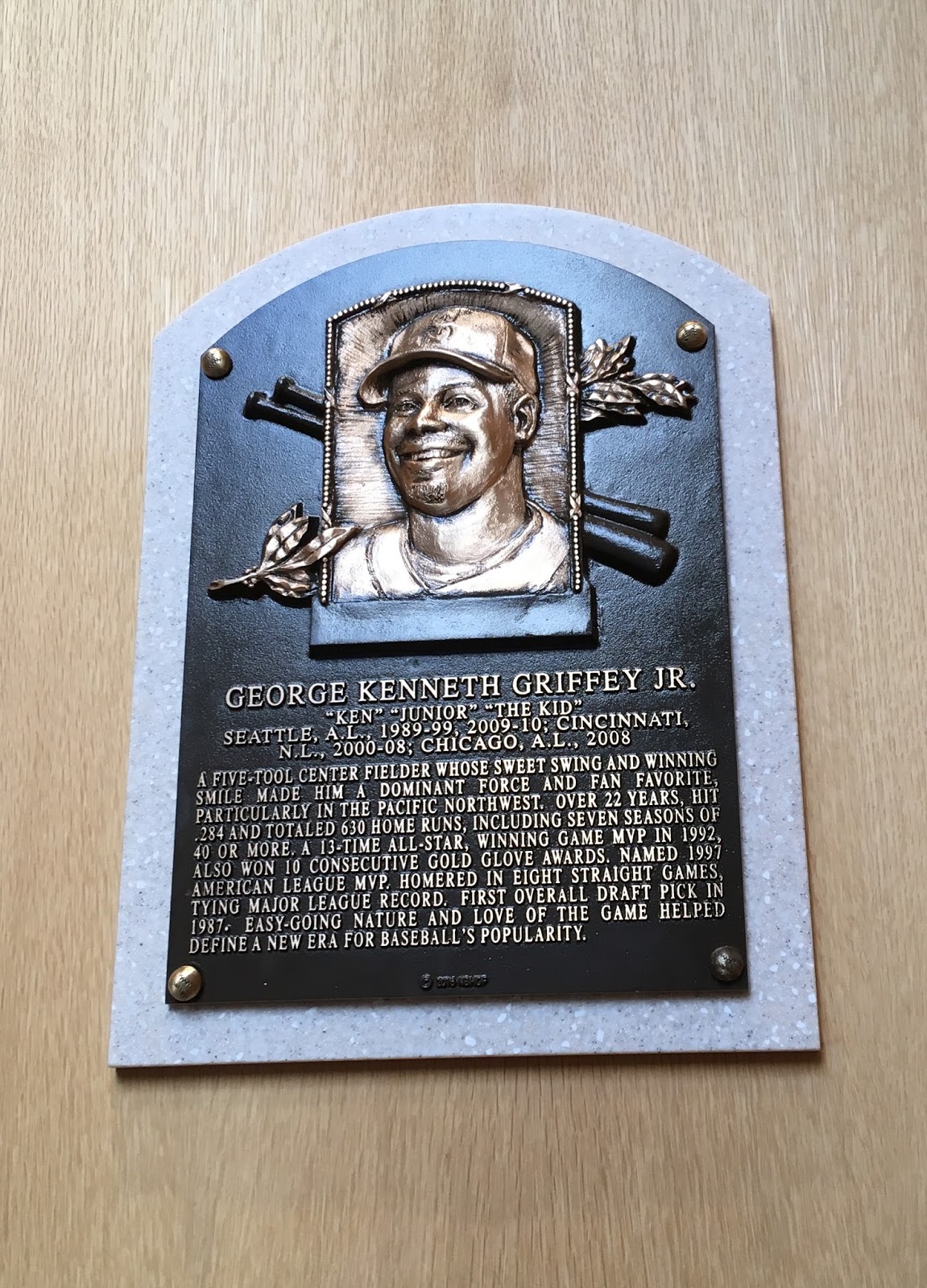
The Hall of Fame plaque for Ken Griffey Jr., who led the way to create baseball's annual Jackie Robinson Day. Griffey, who usually wore number 24 for the Seattle Mariners, wore Robinson's number 42 on April 15, 1997, to raise awareness of Robinson's achievements. The number has since been retired throughout Major League Baseball--except when all players wear it on the annual Jackie Robinson Day games on April 15. 

Thursday, April 5, 2018

'Melancholy: A Way to Happiness'

That's the title of a chapter I read this morning in Ageless Soul: The Lifelong Journey Toward Meaning and Joy by Thomas Moore. I'm enjoying this book. In it, Moore notes how we age throughout our lives--and about how it's natural for melancholy to increase as we get older and see more illness and death in our lives.

Mom, me, Dad
Today marks the sixth anniversary of my dad's death, so it's naturally a melancholy time of year--especially since my mom also died in early spring. As difficult as it is to face the loss of loved ones, I've always felt grateful that my parents both passed from this Earth in its time of rebirth. Spring softened the blow in both cases, even though their deaths could not have been more different. I was just 25 when I suddenly lost my mom; I was 50 when my dad died after years of decline. Both deaths helped prepare me for future losses, but my father's much more gradual passage was much more profound to me because I was old enough to process it in all its complexity.

I remember how, when I was living through my dad's difficult final months, I sometimes referred to the experience as my "holy days of obligation." As his daughter, of course I felt bound to help him through his final days as he and my mom cared for me as a child. That was the obligatory part, the often-difficult work of tending to the ever-shifting needs of someone wrestling with cognitive decline and physical pain he frequently could not articulate.

But it was an unbelievably holy time, too. I remember one evening when I wearily left Dad's apartment, crossing the parking lot to catch my bus on a nearby corner. A full moon had risen and I spontaneously broke into song:

Spirit of life, come unto me, sing in my heart, all the stirrings of compassion ... *

It was a preview of even more profound times to come, culminating in the day Dad said goodbye, three days before Easter 2012. On that day, as my brother and I sat vigil knowing the end was near, the stirrings of compassion became more real. With the help of an angel from hospice, we learned what it means to have a good death.

Moore writes how sadness is part of growing older. We don't need to rage against it; in fact, if we can sit with our melancholy, it need not turn into existential dread or depression "but instead only one strand of mood among others." And that is how I feel this rainy April day: As the best-laid plans sometimes shift and some long-held dreams recede, we learn acceptance and perspective. Or, as Moore says, "If you can allow melancholy its place, you have a better chance to be deeply happy."

* Spirit of Life, a beloved Unitarian Universalist hymn. Words and music by Carolyn Dade.

Tuesday, March 27, 2018

Many, many thanks

Sixth in a series for #UULent2018.

Today's UULent word is gratitude. As I've noted a few times, I'm taking part in UU Wellspring--Spiritual Practices at my church. As befits our spacious Unitarian Universalist faith, we are encouraged to try any number of practices to see which ones work best in our lives. Back in January, we were encouraged to begin a gratitude journal: basically, to take time every night before bed to write down five things for which we were grateful that day.

I've fitfully kept gratitude journals before, as far back as 2005. This time, though, I've done it faithfully nearly every day since starting January 3. Two weeks after I started, I wrote, "This was a good exercise. It helped me recognize how grateful I am for my life as it is right now and that little things mean the most."

I like the idea of going to sleep with a grateful heart, but I've found that it's easier for me to write my gratitudes as part of the quiet mornings I enjoy most days: often before I read a while, sometimes after. Either way, it helps set the stage for a grateful day.

Gratitude journals past and present

Friday, March 23, 2018

The waiting is the hardest part

Fifth in a series for #UULent2018.

Today's UU Lent word is patience. Lord, it's a long, long road.

I had the privilege of seeing Tom Petty perform live twice: once back in the 1980s with Bob Dylan and again last summer at Safeco Field. None of us there for his concert last August knew that he had fewer than 10 shows remaining and that he'd be gone six weeks later. It was all about the moment and the power of music. I'm sure it was the same five weeks later for the people who saw his very last show at the Hollywood Bowl.

Petty's death, especially coming hours after the heartbreaking day in Las Vegas, was a wake-up call for many of us. That's a cliche, but it's true. Stop waiting. Start living.

I've been doing a lot of waiting lately. The client that gave me the largest amount of editing work last year won't need any freelance help for a bit (and even that's not guaranteed). Meanwhile, I've been sending out article queries and essays and letters of interest. It usually feels like these are going into a void and, given the amount of email most of us get these days, I rarely expect a reply.

I have exactly one assignment at the moment, and it's not going well. I need to interview a handful of people in their 50s or 60s who've moved to Edmonds, Washington, from beyond the Seattle area, and I've sent several dozen inquiries to people who might know of such folks. So far, I have found none. Fortunately, I still have about a month until my deadline, so I'll start walking the streets of Edmonds soon in hopes of randomly finding my people. It's not a big place, and wandering its charming downtown is a fine way to spend time, so this isn't exactly a problem--and my inquiries elsewhere may yet bear fruit. Still ... it's more waiting. (And if you or someone you know recently relocated to Edmonds from outside the Seattle area, please raise your hand.)

So my writing and editing work is a big ball of waiting right now. But many other things are just fine. Baseball starts soon, and I'll be back for a third season as an usher at the ballpark. I've had more time to meditate, read books, run errands, do spring cleaning, help my partner, and take long walks. I also have more time to do my favorite thing in the world, and that's travel. My sweetheart and I have a train trip planned soon, and I'll be going to the wild edge of Scotland a month after that, volunteering to get garden beds ready for spring and taking inexpensive room and board in trade for my efforts.

I left full-time work again just over two years ago because I value time more than money. It's a hard way to live at times, and patience has never been my strongest virtue. I get better at it all the time, though, and I'll keep practicing--and living like there may be no tomorrow, or thousands of tomorrows.

Tuesday, March 20, 2018

I want to be in the room where it happens

Fourth in a series for #UULent2018

We’re living in a time when it’s possible to experience anything from a concert to a face-to-face conversation with friends in real time online, no matter where we are.

It’s amazing, but it’s still not the same as being there in person, without a screen as intermediary. Of course, I am writing this on my phone while sitting on the bus. But I’ve been blessed to have a few indelible in-person experiences in the past few weeks.

I traveled to Twin Falls, Idaho, earlier this month for the 25th anniversary party of the Unitarian Universalist fellowship I helped start there in 1993. It was a joy to see people I hadn’t seen in years—both from the Magic Valley UU Fellowship and from the Boise UU Fellowship, which brought its choir and other congregants along to help celebrate.

Earlier that day, I was able to check in on a friend I hadn’t seen in a long time. She was diagnosed several years ago with cognitive decline, so I wondered whether she’d remember me. She did, and we had a lovely visit—one we couldn't have enjoyed on the phone. It’s true her short-term memory is gone; she asked me the same questions over and over, as I expected she would. But she has sweet memories from decades gone by, and she is able to appreciate a favorite painting as much as she ever could. And interestingly, she told me how much less stressed I seem these days than when I was younger and always in a hurry. Hmmmm ...

Later that same wonderful week, I finally saw Hamilton onstage at Seattle’s Paramount Theater. It was all I’d hoped it would be; I still have earworms 10 days later. For weeks before the show, I'd been enjoying the original cast recording, but hearing and seeing this landmark musical in person was one of the best entertainment experiences of my life—made all the sweeter because I was able to share it with people I love.

Technology is a fine way to reach out to people and to experience the world. But being physically present—at least some of the time—is priceless.