Showing posts with label media. Show all posts

Friday, October 23, 2020

Pandemic postcard #31: Waiting to exhale

My phone ring tone has been the same for a very long time, "Right Here, Right Now," the upbeat 1990 song celebrating the fall of the Berlin Wall and authoritarian regimes in Europe. I've lately thought about changing it since there definitely are other places I'd rather be than in the middle--is this the middle?!--of a pandemic and a bonkers election season. But then there's the line that keeps giving me hope, the one about "watching the world wake up from history ..." 
 
We are on a cusp of a new dawning. You can feel it, right? (You've already voted, by mail or in person with early voting, yes?) America has occasionally flirted with a meaningful reckoning over the kind of country we want to be, but we've never quite made the commitment. But this year, amid the manifold crises of 2020, it feels like Decision Day is finally here.  
 
Of course, Decision Day will take a while. Folks have been voting for a few weeks, and we may not know the results until well into November. Meanwhile, I want to know: What do you plan to do on November 4 and beyond, regardless of the election results? I asked this question on Facebook the other day. A few folks answered with notions of day drinking, shopping for flights out of the U.S., and watching riots on TV. I sympathize with the long-simmering stress that those replies belie.

A little escape, for a day or a week or more, was a common theme. Meg and Joan, who've been especially active this campaign season, say they plan to finally take a day off. Frances says she'll either be glued to the TV, "or I might be in the mountains for the day breathing deeply knowing politics and the virus are not there." Eileen reports that she'll be on her first vacation in several years, newly retired Joanne is on a personal retreat exploring a possible relocation, and Elaine mentions the possibility of "a COVID-cautious trip to see friends and family."  
 
Some folks admit they may be adrift, uncertain what they will do, which is such an understandable response given the vast emotional energy we've put into surviving four exhausting seasons of The Trump Show. Others mention the importance of routine. Carol, a doctor, will continue to heal the sick. Felicia will keep up pro bono legal aid work to help small businesses navigate the pandemic "and a recession that is likely to get worse before it gets better regardless of election outcomes." As he has every day since 2013, Joe will get up early and take a music-fueled walk (and knowing Joe, with every step, he'll be thinking about what he can do next to help his friends and his community).
 
Everyone knows that no matter what happens, there will still be plenty of work to do, as activists and humans. Nonprofit executive Rene has a staff meeting planned for 9:30 a.m. November 4 "to help us remember EITHER WAY that much, if not all, of the work we do will carry on." Dennis says he'll continue to advocate for the world he wants to see for his children and brand-new grandchild. "First though I will hug and play with that little boy and be comforted and inspired by his smiles," he adds. That answer made me smile, as did Nathan's, who notes he'll be celebrating his daughter's first birthday the day after the election and working to protect the election results. 
 
Fellow longtime blogger Tom says he'll continue to metaphorically chop wood and carry water. Kristen has been volunteering to monitor election irregularities and misinformation, and Katherine will start a new discussion group the week after the election, pairing chapters from the book Becoming Better Grownups: Rediscovering What Matters and Remembering How to Fly with episodes of On Being With Krista Tippett. (Of course I am signing up for that.)  

Theresa and Diana and David plan to continue to cultivate joy through cooking and music. Rebecca will seek balance through caring for family, "doing what is in front of me to do," and "finding energy in intentional interactions and the random encounters I experience with people ... I have to hold on to my belief that what weaves us together is stronger than what would pull us apart."
I say amen to all of this.
 
As for me, here's how I envision how my November 4 will look: I'll wake up and spend no more than a half-hour getting the latest news. (I'll set a timer.) I'll write in my journal. I'll take a long walk and spend some time near Puget Sound. I plan to avoid the news for most of the day, but I'll check in for an update by late afternoon, and I'll attend a webinar on advancing the National Popular Vote. Night will come early, and I'll end the day at an online vespers service with my faith community. Beyond November 4, I'll continue working to write the change I want to see in the world, here at Surely Joy and also through a revival of my circa 2010 project, Write the Change
 
It won't be long now. In a few weeks, we will know whether a majority of Americans have collectively decided to reject division and build beloved community. We are waiting to exhale and yearning to breathe free, yet the reality is things are going to be messy for a while. 
 
The biggest task ahead of us may be making sure that no one gets left behind: definitely not the people of color who have been waiting far too patiently for this time, and also not the white people who may be hurting because they've lost a false idol. Few people are irredeemable, and almost everyone deserves a lifeline. It is time for us all to thrive, time for us all to joyfully wake up from history.
 
Next week, I'll share a story about what I was doing the day after the last election. No matter what happens in 2020, it won't be any weirder than what I experienced in 2016. Until then, be well and remember: rest is fuel.   
 

Thursday, August 20, 2020

Pandemic postcard #22: Spirit of the radio

This week's post comes a day early to mark National Radio Day. 

Tom Killorin was determined to help launch SPACE 101.1 if it was the last thing he did. And really, it was pretty much the last thing he did. 

Radio sweethearts, fall 2013
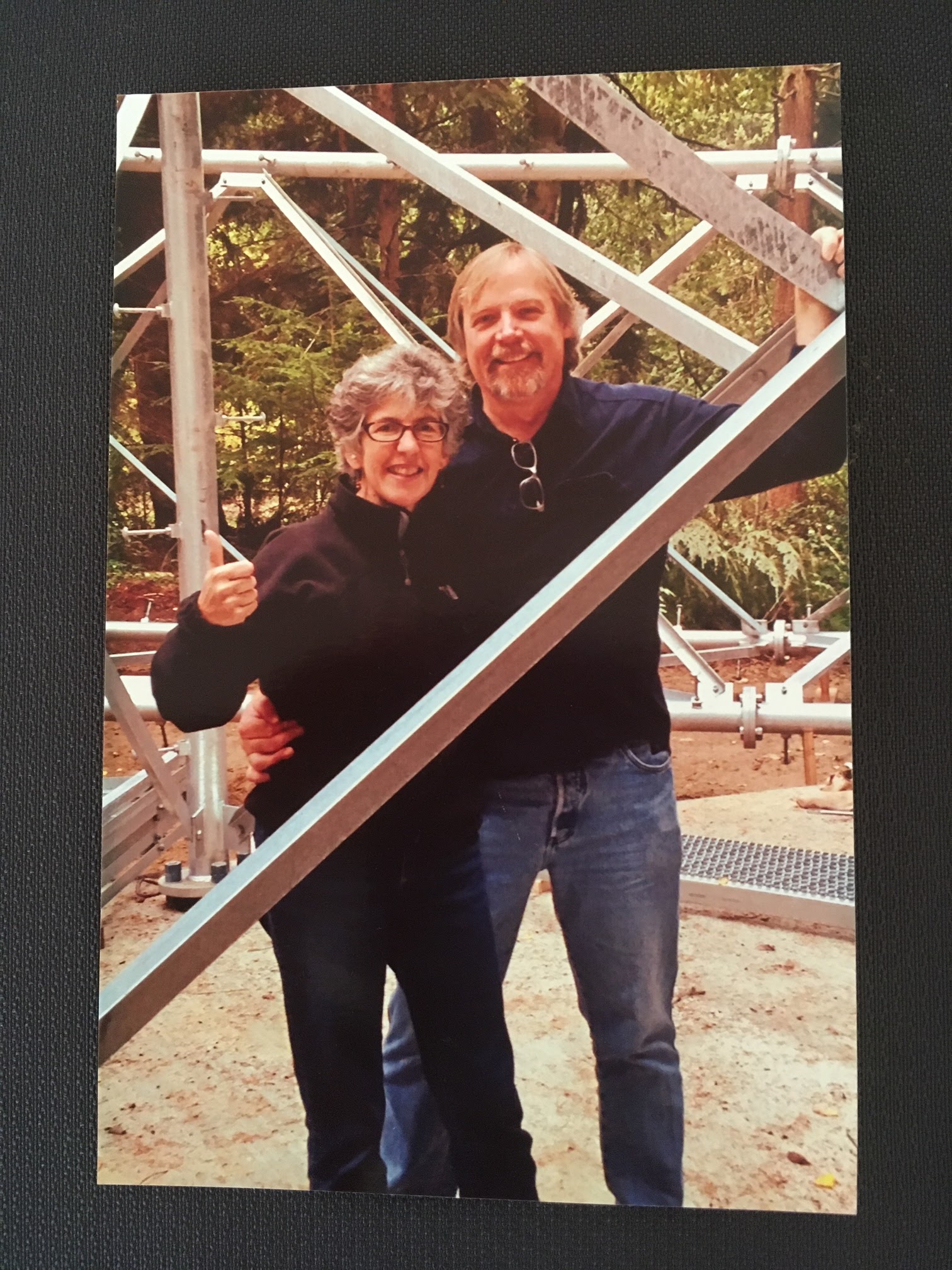
I started falling in love with Tom over the radio after he'd invited me to listen in as he served as a substitute DJ for KSER in Everett. Between his eclectic, enlightened musical taste and his made-for-radio voice, I was intrigued. Tom had worked as a commercial radio DJ for many years before starting a career in music supervision for businesses and brands, but his heart was in non-commercial, community-based radio, so he always had at least one radio side project. One of our first dates was to go see a new radio tower KSER put up on Whidbey Island in the fall of 2013. 

After KSER, Tom helped Bellevue College station KBCS fine-tune its programming, especially its afternoon music mix. And after that, Tom and I were spending an idle Saturday in the art gallery at Seattle's Magnuson Park when we spied a flier announcing the formation of a community radio station. The gallery director, Julianna, explained to us how she hoped the Sand Point Arts & Cultural Exchange could land one of the last low-power radio licenses that would be available anywhere. Tom leaped at the chance to help build a station from scratch. Over the next few years, he donated hundreds of hours and recruited other radio veterans to help out with programming and engineering. When SPACE 101.1 launched in October 2017, I think it was among Tom's proudest moments. 

Tom Killorin 1956-2018
Tom believed in the power of radio to bring people together, to help artists of all kinds be heard, and to advance justice. He also believed in radio as the main instrument of music discovery. In the months after SPACE 101.1 went on the air, Tom would drive all over Seattle to see where he could pick up the station's 100-watt signal. Tom had loaded all the songs into the station's original playlist, but he had no control over when they'd play. So he'd be as surprised as anyone to hear what would come next, and this delighted him, nearly as much as he thrilled to a well-crafted set of tunes he'd deal up ("like cards," he always said) from behind a mixing board. 

That's the thing about radio: You never know what you're going to hear. And while I appreciate the nuances of Spotify's algorithms, there's nothing like the human element of great community radio: to blend music and ideas, empathy and education, heart and soul. "Algorithms don't get the blues," Tom would say, relishing the triple entendre in that phrase. (Is it any wonder I fell for this guy?) 

Tom suffered a recurrence of multiple myeloma in early 2018. By June, we knew he'd likely only have a short time to live--yet he was still working on SPACE. I especially remember one morning, sitting with Tom in the intensive care unit at Swedish Hospital, when he wanted to be sure that week's episode of "American Routes" got to the station for airing later that day. Tom downloaded the show onto a thumb drive and had me meet a volunteer outside the hospital to make the transfer. Two weeks later, Tom was gone, but he'd left a legacy. SPACE 101.1 has grown its programming over the past two years to become a pint-sized community radio powerhouse. Tom would be so happy.

Happy Radio Day 2020. In these pandemic times, radio is inherently socially distanced, yet--when powered by people--it fosters real emotional intimacy. Of course, this is why podcasts have become so popular, too. In our separation, we yearn to hear voices.

In honor of Tom--or whoever your favorite DJ may be--please donate to your local community, non-commercial radio station if you can. And remember: As wonderful as it is to have a great radio station float in over the airwaves, community radio is available to everyone, everywhere through the magic of the Internet--and unlike corporate streaming platforms, it's free. My Spotify subscription expired last week, and while I'll eventually renew it, for now I'm just going to let the radio play. 

___

If you enjoy Surely Joy, please consider supporting my work via Patreon. Pledges start at just $3 a month. Thanks for reading!  


Friday, August 14, 2020

Pandemic postcard #21: Summer reading report

All my life, I have dreamed of having endless time to read, and I've always figured I'd need to wait until retirement for that dream to come true. Then 2020 happened. I have had plenty of time to get lost in a book these past many months. 

Here's a selection of books I've enjoyed so far during the pandemic. All are available via The Optimist, my online independent bookstore at Bookshop.org, and if you enjoy Surely Joy, it'd mean a lot to me if you'd buy a book, any book. Your purchase will help me...and small bricks-and-mortar bookstores, too. As I write this, Bookshop.org says it has raised nearly $6 million for indie bookshops. I'm still working on my first $25. Still, every little bit helps, especially now that the CARES Act unemployment pay is gone.

So without further begging or ado ... 

How to Do Nothing: Resisting the Attention Economy by Jenny Odell. This book captivated me from its first pages, where Odell describes one of her favorite parks in Oakland. (I know it, too.) Odell's mission is to help us pay attention, not to the endless clatter of commerce, but to our heart and soul's delight. This is my favorite book of the year so far. 

The Art of the Wasted Day by Patricia Hampl is part memoir, part travelogue, part meditation on loss. We can't justify distant travel this summer, but we can travel via books. Hampl ranges widely in this volume, from Iron Curtain-era Eastern Europe to Montaigne's France, but I was most captivated by the trip she took closest to home on the upper stretches of the Mississippi River. Like Odell, Hampl understands the inherent value of day-dreaming and drift.

The Vanishing Half  by Brit Bennett. "I've been reading too much non-fiction this summer," I told my daughter. "I really want to read a novel." So this was a birthday gift from her to me, fitting because this is also a story about family love: in our families of origin, families of choice, and families lost and found. It's also timely with its themes of racial and gender identity.

The Hummingbird's Daughter by Luis Alberto Urrea. This had been on my to-read list a long time, and it was the very first book I was able to check out of my local library once it reopened for curbside service last month. Urrea, who spent a few decades researching this satisfying historical novel, has a knack for creating big, well-drawn casts of characters. I look forward to reading the sequel to this, too, as well as The Devil's Highway, Urrea's nonfiction book about U.S.-Mexican border culture. The latter should be a good companion to something else I read earlier this summer, On the Plain of Snakes, a warts-and-all love letter to Mexico by Paul Theroux.

Old in Art School by Nell Irvin Painter. The author is best-known as an acclaimed historian (The History of White People), but she always wanted to paint, so she chased that dream into her 60s while also looking after her elderly parents, who lived 3,000 miles away. An inspiring, illuminating look at one woman disregarding ageism and racism.

The Cactus League by Emily Nemens. One of two fine baseball novels released this year, both written by women. Nemens turns an unassisted triple play with her debut, deftly wrangling multiple plot lines, indelible characters, and strong sense of place. I also enjoyed The Resisters, an anti-authoritarian tale by Gish Jen.

Becoming Wise: An Inquiry Into the Art & Mystery of Living by Krista Tippett. The On Being Project created a new position this summer, Audience Editor. I wanted it so bad, but I'm sure they've hired someone brilliant to help amplify the project's mix of thoughtful voices and practical wisdom for tumultuous times. I've been an On Being fan forever, listened to this on CD when it came out a while back, and recently revisited it via a copy in a Little Free Library.

Keep Going: 10 Ways to Stay Creative in Good Times and Bad by Austin Kleon. I bought this when it came out last year, then it sat on my shelf until May. It was time...and it still is.

When Things Fall Apart: Heart Advice for Difficult Times by Pema Chodron. Another book that merits re-reading, with short chapters that share Buddhist wisdom on how to sit with uncertainty. 

Atlas Obscura Explorer's Journal. I used this for what turned out to be Volume One of my Pandemic Journal. (I started Volume Three last week.) It's too big to use as a travel journal, but it was perfect for documenting the weird inner journey that is 2020.

Next up on my reading list ...

I've been dipping in and out of The Warmth of Other Suns: The Epic Story of America's Great Migration for the past month. I'll finish it this weekend, and I look forward to author Isabel Wilkerson's brand-new book, Caste: The Origins of Our Discontents.

Next up is my library book of On Earth We're Briefly Gorgeous by Ocean Vuong, another novel I've been meaning to read for a while.

I also just ordered a copy of Jailed for Freedom: A First-Person Account of the Militant Fight for Women's Rights. This little-known book by Doris Stevens is the source material for Suffragist, a new Broadway musical that was to premiere in league with this summer's centennial of the 19th Amendment. The production is delayed now, but just hearing creator Shaina Taub describe her discovery of this book was enough to make me want to read it.

Friday, July 31, 2020

Pandemic postcard #19: Keep calm and get ready to vote

It's three months before the general election, and things are getting wacky. Just this past week, the would-be king canceled his coronation party and wonder-tweeted about whether the election ought to be delayed. I honestly have no idea what we're in for these next 93 days--and indeed, what might transpire between now and January 20, when a peaceful transfer of power should occur. Given what's already gone down in 2020, anything could happen. 

Yet I know the Constitution provides guardrails in these matters. I believe that the better angels President Lincoln summoned are still looking out for us, and that other events this week--federal troops standing down and past presidents from both parties eulogizing the great patriot John Lewis--show that cooler heads will prevail as this tense national drama unspools. 

Meanwhile, it's still primary election season in Washington state. We vote by mail, so I am able to complete my ballot in a leisurely, considered way. Yesterday, while getting dinner ready, I listened to a debate in the lieutenant governor's race--one of the most interesting contests we have this year. The current office holder, Cyrus Habib, is leaving politics to become a Jesuit priest, so it's an open seat. Our likely-to-be-re-elected governor Jay Inslee may well wind up in the next Cabinet, so Habib's successor might get a swift promotion. I'll read up on this key race and several others this weekend, and I'll make my picks by Sunday night. On Monday, I'll drop my completed ballot in the mail--or probably one of the special collection drop boxes my county provides to make voting even easier.   

Five states now do all their voting by mail, and every state allows it in what's usually called absentee voting, though some states make it more difficult than others. This year, alternatives to in-person Election Day voting have become essential due to the dangers of COVID-19 and attacks on voting rights, yet this has also turned vote-by-mail and absentee voting into political flash points. I get it; for decades, I loved the ritual of going to the polling place on Election Day and casting my ballot. My daughter reports that she'll vote in person this fall; she likes the tradition, too. 

However you choose to vote this fall, it's important to have a plan for how you'll get it done--and for planning to do it as soon as you can. In addition to voting by mail or absentee voting, many states have in-person early voting, where you can go to your polling place at your convenience a week or two before the first Tuesday in November. Early voting cuts down on long lines, so it's an especially good option this year. 

Or say you're voting by mail but you wonder whether the United States Postal Service might somehow bend to political shenanigans--or maybe you simply don't have a stamp. In many states, you can drop off your ballot in person. Here in the only U.S. county named for Dr. Martin Luther King Jr., we have nearly 70 ballot drop boxes that are available 24/7 for several weeks before Election Day. So easy. Our ballot return envelopes are postage paid, too, eliminating yet another hurdle for people who choose to put their ballots in the USPS' care. (By the way, Washington state's top elections official is a Republican--and I will likely vote for her again.)

I suspect that most of my readers are registered to vote, rarely miss an election, and don't need this information. But if you're curious about voting by mail, early voting, or absentee voting, now is the time to do some research, learn about your options, get ready to vote--and maybe have a Plan B. I've included a couple of tools below for super-easy registration and an absentee ballot request via Vote.org. Your state and county elections offices are your best source for in-person early voting information. And of course, those who seek to subvert this election are going to be messing with us at every opportunity. Don't believe everything you hear, read, or see. Don't believe most of it. Do your own research; use multiple sources and fact-checking sites. This is my favorite.

It's easy to feel a boy-who-cried-wolf vibe when people invariably say that an election is "the most important of our lives." Don't we hear that every four years? But 2020 is not simply another year. Most of us sense that a functioning, fair democracy is clearly at risk. The decision atop the ballot is one that might save our country, and the down-ballot races are opportunities to make progress toward the nation we want to be. 

It's been more than a century since more than two-thirds of voting-age America turned out for a presidential election, and barely half of us showed up in 2016. We can do better, America--in so many ways--and this year, we must, and we will.  


Friday, December 13, 2019

Hindsight is 20/20

As this year winds down, we're also wrapping up a decade. I'm seeing lots of lists recounting the best music, movies, and more of the past 10 years. Right now, I feel most compelled to reflect on the best decisions I made over the 20-tens. I think these are the main ones for me, and I'd be interested to hear yours.

I decided to live debt-free. During the first iteration of my freelance career, I had a big fat line of credit and I used it, amassing debt to write travel guidebooks and magazine articles for publishers who rarely paid expenses. I figured that unreimbursed expenses and interest were all deductible. But paying off the steep interest meant I couldn't save as much as I'd have liked toward my daughter's college fund nor for my then-far-off retirement.

Ten years ago this month, I made my last payment on my business credit card and closed it for good. Since then, I've continued to use credit to earn travel points, but I pay off my balances every month. After owning two homes and settling two estates, I've decided I prefer being a renter. Property is a good investment for many people--but it ties you down; it's not my American dream. I like the freedom and flexibility of letting someone else make and manage that investment. 

I followed my heart. This meant leaving Idaho (and family and friends) for the chance to live among people able to elect leaders who could advance the values I hold deeply--of prizing human diversity, of living more sustainably, of practicing generosity on a civic as well as a personal level. Our country's future is murky, but I feel blessed that I live in the city, state, and region that I do. I also feel great affection for the places and people I left behind; I know people have many reasons for staying where they do.

Following my heart also meant leaving a long and good-enough marriage for a new relationship that showed me a new level of what love could be--both the highs of finding a true companion and the lows of illness and death. It was a painful journey in many ways, yet I am grateful to both men for the love and understanding they gave me and thankful that I was able to be part of their lives.

I distanced myself from politics. Anguished by an unnecessary war in Iraq and inspired by examples of civic imagination, I spent most of the first dozen years of this century enmeshed in politics, trying my best to help candidates and causes from Howard Dean to strong public schools to a sustainable climate. It was time well spent, but I ultimately felt I needed to return to the objective stance I'd learned as a young adult--to my roots as a journalist.

It's funny: I was drawn into journalism by one impeachment--a national crisis that saw a president resign before he could be fired. Now, with another impeachment unfolding, I feel intensely lucky that I've found ways to make a living as a writer and editor that don't require me to cover politics. As I outlined in this essay last year, I pay attention to the news, but as a matter of self-preservation, I'm no longer obsessed by it. I'm inspired by people who act with integrity, saddened that facts are considered malleable, and certain we will get the government we deserve in these distracted, disrupted times. But I know that individually, we don't have to be defined by that government.

Hindsight is 20/20, and the three decisions above are ones that I see giving shape to other decisions I'll be making over the next 10 years--as much as any of us can really decide anything anymore in a future that seems to be spiraling out of control.

I don't want to look away; I want to stay on top of what's going on. I want to see the good as well as the bad and the uncertain. I want to keep bearing witness to the idea that our small daily decisions for joy and kindness and responsibility to and love for others and ourselves may somehow add up to ... something.