Showing posts with label love. Show all posts

Wednesday, November 25, 2020

Pandemic postcard #36: Thanks for the memories

This week's post comes a little early as we usher in this strange holiday season. I wish you all as happy a Thanksgiving as your current circumstances allow.

In 2010, I reflected on the most memorable Thanksgivings I'd had so far and was surprised to realize they'd all been in my 20s. What a difference 10 years makes. Today, I can easily remember how I spent  every single Thanksgiving from the past decade. This feels good at a time of life when my memory is supposed to be fading. 

It's 2011, the first of several in a string of Thanksgivings spent in San Francisco with my brother Jeff and his partner Kevin, both skilled and loving cooks. Such good food, such good company. On Friday, Jeff and Kevin treat Bruce and Natalie and me to a visit to the California Academy of Sciences. A butterfly briefly rests on Kevin's hand. He is the butterfly whisperer.

2012. I have lived in the Bay Area for seven months, decamping there from Idaho just after Dad died. The job I've moved here for is a disappointment, but I absolutely love California: the light, the people, the diversity. I am living a long-held dream of not needing to own a car, but I rent one to fetch Natalie at Humboldt State for her Thanksgiving break. We join Jeff and Kevin and Bruce for another memorable meal. 

Thanksgiving morning 2013. I am at the Oakland airport, nearly giddy with anticipation at seeing Tom for the first time in a few weeks. We share Thanksgiving with Jeff and Kevin and sleep at their place, since my Oakland apartment is packed up. The next morning, Tom and I pick up a small rental truck, meet a packing crew, and get on the road to Seattle, where I've rented an apartment to be closer to my love.

2014. It's just Tom and me this year. We take a morning train to Centralia, WA, and enjoy a leisurely midday dinner at McMenamins' Olympic Club, where the buffet is spread out over several pool tables. We retire to our room upstairs and take a long nap. It is a perfect day. 

Tom and I get two Thanksgivings in 2015. The first is in the Denver suburbs on Sunday, with Tom's brother Marty and his family and a bunch of people from the bar Marty owns. Tom plays his dad's old banjo. On Tuesday, Tom and I board Amtrak's California Zephyr at Denver's Union Station and ride over the Rockies for Thanksgiving #2, with Jeff and Kevin plus Natalie, who has flown down from Boise. 

Thanksgiving 2016 comes a few weeks after Tom's stem cell transplant, and it's just the two of us celebrating at Swedish Hospital. Considering that he had almost died from engraftment syndrome four days before the holiday, Tom is doing much better. I dial up Paul Simon ("These are the days of miracles and wonders ...") and Arlo Guthrie on Spotify, we eat the not-too-bad-for-hospital-food Thanksgiving dinner, and we are grateful. 

2017. I don't have specific memories of this holiday--my most recent one in San Francisco--apart from the warm embrace of family, of building a collaborative playlist, and of gathering around the table for another amazing meal. Of course, we watch Love Actually afterward. This will be Tom's last Thanksgiving. We don't know that yet, but after the wild ride of Thanksgiving Week 2016, I don't take anything for granted.  

2018. It's a weird year. Tom has been gone four four months. Kevin and Natalie both work in the plant-care field and Thanksgiving season means poinsettia distribution. We decide to make it easy on Natalie this year and meet at a rented Airbnb near Boise to mark an early Thanksgiving. I spend the actual holiday handing out food and socks at the Union Gospel Mission in downtown Seattle. 

2019. I have plans to see Natalie in Boise just before Christmas, my extended family in Chicago on December 24 and 25 (for the first time in decades), and Jeff and Kevin in San Francisco for New Year's, so I'm at loose ends on Thanksgiving Day. I consider a solo trip somewhere, but I stay home and make myself a simple dinner. I'm OK company, but I'm grateful that I'll be with family for Thanksgiving 2020. 

2020. Except I won't. And neither will most of you.  

Sigh. And yet, and yet. This past decade has shown me that a rich storehouse of memories and an attitude of gratitude can serve us well in times of loss. Meister Eckhart said, "If the only prayer you say in your life is thank you, that would suffice." And a day before he died, Tom mused to me, "Maybe just being grateful and happy is enough. So thank you." 

I'll leave it at that for now. I am grateful for shared Thanksgivings past, I look forward to making more memories in person with my beloveds in the 2020s, and I wish the same for us all. 

P.S. If you are new to Surely Joy, or even if you're not, you may want to revisit my post from this week in 2018, when I wrote, "This is a season of living while we wait to resume life." Those words, true for me in 2018, are true for us all this year. There will be better days--and yet these are the days we'll remember. 

____

If you enjoy Surely Joy, please consider supporting my work via Patreon, a website where you can help creators whose work you value. Sign up this week to help sustain my work in December and beyond. Pledges start at $3 a month. Thank you! 

Friday, October 9, 2020

Pandemic postcard #29: Turning into my dad

Today is my father's birthday, and if all goes well, my brother and his husband and I will be toasting Dad's memory on a San Francisco beach, not far from where we scattered his ashes. Dad has been gone almost a decade, but--as I wrote a few weeks ago--my parents' memories have been strong with me this fall. I miss them both as much as I ever have, and I think I may be turning into my dad.

I know that many women worry they'll turn into their mother, but that was never going to happen for me. Like many mothers and daughters do, we clashed during my adolescence, and I was just starting to know and appreciate Mom as a fellow adult when she died at age 62. By then, I'd been away from home for eight years.   

Dad was also 62 when Mom died. That's the same age my husband, Tom, was when he died in 2018, and the same age my stepchildrens' maternal grandfather was when he passed on. I'm just a few years shy of that mark, and as 62 looms ever closer, it hurts to be "losing" a year the way we are in 2020. 

Yet it's likely I'll live far beyond 62, as my dad did; he was 87 when he passed away in 2012. He lived long enough to see my ill-advised first marriage end, and to see me meet a good man and marry again, and to see my brother find a loving partner, and to spend lots of time with his only grandchild when she was young. At the end of his life, he gave me the sacred experience of helping a loved one have a good death. Today, on his birthday, let me tell you a little more about my dad. 

Sparrow, #14
Byron Fanselow started out a little guy, and his nickname was "Sparrow," but he still played baseball and basketball. His high school yearbook reports that he was usually laughing. After graduation, he grew several inches, so his nickname went away--until the 1970s, when Dad (and my brother and sometimes I) became "Fonz." Thank you, Happy Days, for helping America finally learn how to say our last name.

Dad went to Illinois Tech for mechanical engineering, then he joined the Navy near the end of World War II. After that, he became a salesman--the natural job for someone with his personality. He started out selling windows and went on to rep several metal building companies in the Midwest. He was offered a transfer to San Francisco but wound up taking one to Pittsburgh instead so he and my mom would remain reasonably close to their families in Chicago, where most of my extended kin still live.

For a short time when I was in elementary school, Dad had an office in a downtown Pittsburgh high-rise, which was fun. But usually, he worked from home and on the road, calling on clients across the Mid-Atlantic states, eating lots of dinners at Howard Johnson's and racking up plenty of points at Holiday Inns. He loved to travel and he loved meeting people, and my brother and I both found careers that incorporated those things.  

Dad worked on commission, money was sometimes tight, and Mom loved to shop. She meant well; she loved to give people gifts, but she'd lose track of what she'd already bought, so we always had lots of stuff but never much extra money. Mom went to work at a fast-food place to help send me to college. That's where she had her first fall, on a slick floor at Wendy's. I took the call on the hallway phone in the dorm my freshman year at Ohio University. Mom had broken her hip, and soon after that, she got cancer, too. I doubled down at school, maxing out my course loads so I could graduate in three years.

Thankfully, Mom beat lymphoma and she and Dad were able to travel a bit. They went to Tokyo and Hawaii mostly for free with all those points from Holiday Inn. But her hip replacement hadn't healed especially well, and one day, her cane caught on the top step of the basement stairs. She fell and hit her head, and we had to let her go. Dad was heartbroken at the loss of his wife of 37 years, and I cannot imagine his grief, even after losing the love of my life. But he'd go on to live another two-and-a-half decades, most of them in a healthy, happy retirement.

You're probably wondering by now: How am I turning into my dad?

I find myself cracking really bad jokes. For example: On my camping trip to Olympic National Park this summer, I arrived at Rialto Beach first thing one morning and found three bored teenagers sitting at a picnic table, ignoring the Pacific Ocean. I tried to get them excited. "It's going to be a great sunrise!" I said. "Too bad we're on the wrong side!"

I find myself wanting to talk to everybody. I'm sure the pandemic and living alone are driving this, but when I see other humans, especially in person but even on Zoom, it's sometimes hard to contain myself. I genuinely miss people at this point. Dad was the same way. I think he was happy living alone--he never had a serious romantic relationship after Mom, that I know of, and he knew how to entertain himself. But the longer he was alone, the more he missed seeing people, and that manifested in wanting to talk a lot when he saw them.

Dad in 1993
What I most admired about my dad was his curiosity about everything. We always had plenty of books around, of course, plus stacks of newspapers and magazines. Dad had no serious lifelong hobbies other than photography, but he'd get interested in something--astronomy, astrology, CB radios, ice cream making, magic tricks, meditation, computers, physics--and he'd learn all he could (or all he cared to), then he'd move on to something else.      

Dad did get downright cranky for a while in the early 2000s, when he started watching too much Lou Dobbs on CNN and briefly, alarmingly, became rabidly anti-immigrant. Fortunately, this xenophobia didn't last long, since it clashed with his moderate politics and his liberal Christianity.

Dad ultimately developed dementia and had a rough last few years, though the course of his disease was fairly swift. The cognitive reserve theory suggests that people who spend a lifetime keeping their brain active may die faster once in the later stages of dementia, and that mercifully seemed to be true for Dad. Unfortunately, his sharp decline came at the very same time I had soul-taxing political work and a teen daughter and a marriage that was showing some strain. I'm adopted, so it's anyone's guess what my fate might be in the brain health department, but the heartache of Dad's final few years is gradually fading for me, and I am not afraid.

I am not afraid. I think that's something else I got from my parents, and something I've tried to pass on to my daughter. Love was our family's default position, and Mom and Dad showed it in their volunteer work, in their friendships and family ties, and at the ballot box. And they showed it to each other; they had a rule that they'd never go to bed holding a grudge. 

Although things are unsettled in our country right now, I believe that love and reason and liberty and justice will prevail, though perhaps not without a fight. I miss my parents, but I'm not sorry they're missing this--and I am grateful for their legacy of valuing love over fear. 

Thank you, Dad. You too, Mom. Keep sending those good vibes, for we surely need them.

My parents on their Havana honeymoon.


Thursday, August 20, 2020

Pandemic postcard #22: Spirit of the radio

This week's post comes a day early to mark National Radio Day. 

Tom Killorin was determined to help launch SPACE 101.1 if it was the last thing he did. And really, it was pretty much the last thing he did. 

Radio sweethearts, fall 2013
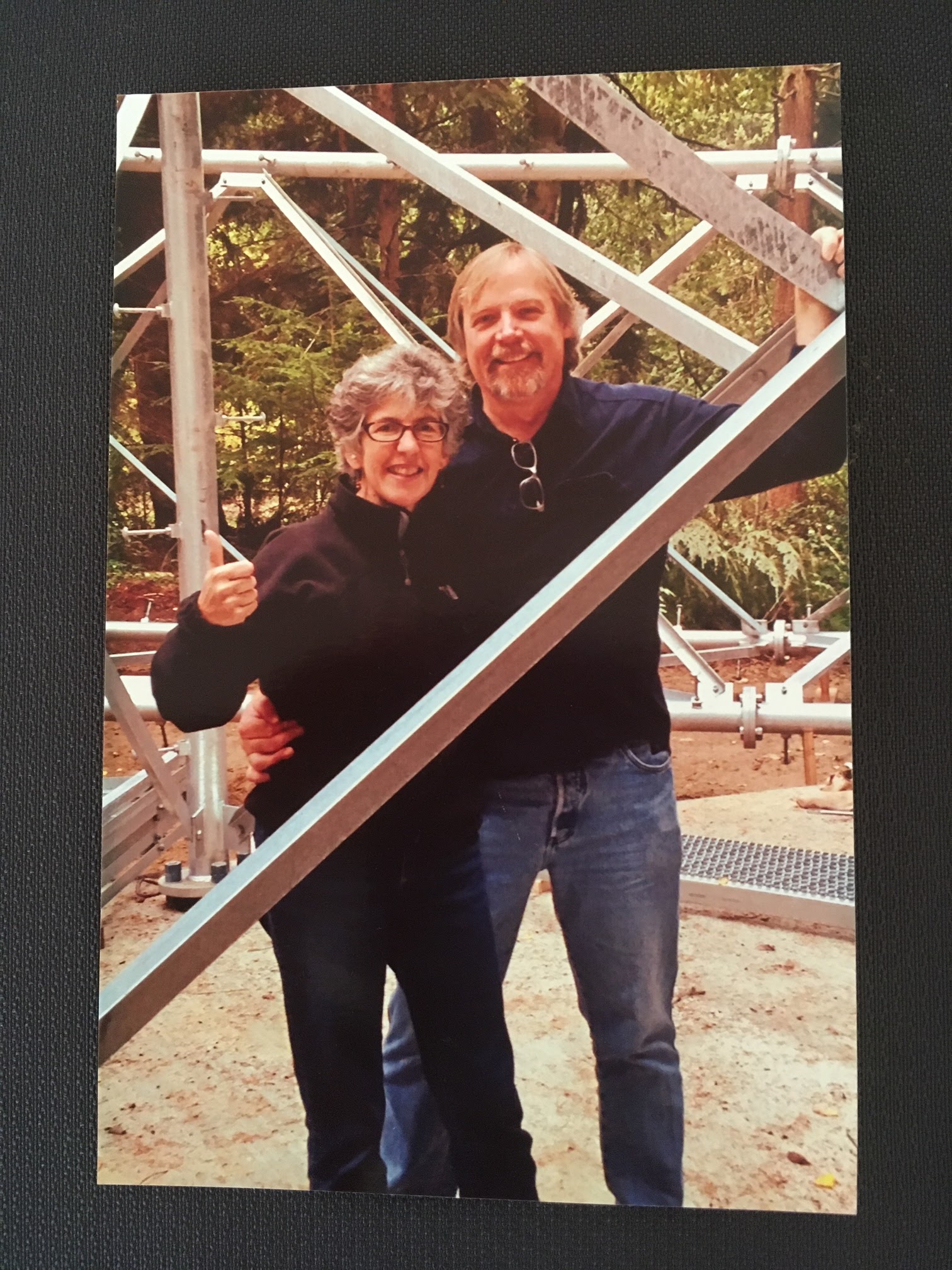
I started falling in love with Tom over the radio after he'd invited me to listen in as he served as a substitute DJ for KSER in Everett. Between his eclectic, enlightened musical taste and his made-for-radio voice, I was intrigued. Tom had worked as a commercial radio DJ for many years before starting a career in music supervision for businesses and brands, but his heart was in non-commercial, community-based radio, so he always had at least one radio side project. One of our first dates was to go see a new radio tower KSER put up on Whidbey Island in the fall of 2013. 

After KSER, Tom helped Bellevue College station KBCS fine-tune its programming, especially its afternoon music mix. And after that, Tom and I were spending an idle Saturday in the art gallery at Seattle's Magnuson Park when we spied a flier announcing the formation of a community radio station. The gallery director, Julianna, explained to us how she hoped the Sand Point Arts & Cultural Exchange could land one of the last low-power radio licenses that would be available anywhere. Tom leaped at the chance to help build a station from scratch. Over the next few years, he donated hundreds of hours and recruited other radio veterans to help out with programming and engineering. When SPACE 101.1 launched in October 2017, I think it was among Tom's proudest moments. 

Tom Killorin 1956-2018
Tom believed in the power of radio to bring people together, to help artists of all kinds be heard, and to advance justice. He also believed in radio as the main instrument of music discovery. In the months after SPACE 101.1 went on the air, Tom would drive all over Seattle to see where he could pick up the station's 100-watt signal. Tom had loaded all the songs into the station's original playlist, but he had no control over when they'd play. So he'd be as surprised as anyone to hear what would come next, and this delighted him, nearly as much as he thrilled to a well-crafted set of tunes he'd deal up ("like cards," he always said) from behind a mixing board. 

That's the thing about radio: You never know what you're going to hear. And while I appreciate the nuances of Spotify's algorithms, there's nothing like the human element of great community radio: to blend music and ideas, empathy and education, heart and soul. "Algorithms don't get the blues," Tom would say, relishing the triple entendre in that phrase. (Is it any wonder I fell for this guy?) 

Tom suffered a recurrence of multiple myeloma in early 2018. By June, we knew he'd likely only have a short time to live--yet he was still working on SPACE. I especially remember one morning, sitting with Tom in the intensive care unit at Swedish Hospital, when he wanted to be sure that week's episode of "American Routes" got to the station for airing later that day. Tom downloaded the show onto a thumb drive and had me meet a volunteer outside the hospital to make the transfer. Two weeks later, Tom was gone, but he'd left a legacy. SPACE 101.1 has grown its programming over the past two years to become a pint-sized community radio powerhouse. Tom would be so happy.

Happy Radio Day 2020. In these pandemic times, radio is inherently socially distanced, yet--when powered by people--it fosters real emotional intimacy. Of course, this is why podcasts have become so popular, too. In our separation, we yearn to hear voices.

In honor of Tom--or whoever your favorite DJ may be--please donate to your local community, non-commercial radio station if you can. And remember: As wonderful as it is to have a great radio station float in over the airwaves, community radio is available to everyone, everywhere through the magic of the Internet--and unlike corporate streaming platforms, it's free. My Spotify subscription expired last week, and while I'll eventually renew it, for now I'm just going to let the radio play. 

___

If you enjoy Surely Joy, please consider supporting my work via Patreon. Pledges start at just $3 a month. Thanks for reading!  


Friday, July 17, 2020

Pandemic postcard #18: Beacons in the dark

Have you been able to see Comet NEOWISE? It is visible in the Northern Hemisphere for a while longer, rising in the evening sky and coming closest to Earth on July 23. I haven't seen it yet; I was up before dawn trying to catch a glimpse last weekend, when it was close to the horizon, but city lights and hills precluded a view. (A rising Venus was amazing, though!)

I'll never forget seeing Comet Hale-Bopp in the spring of 1997 on a drive home from Salt Lake City to Twin Falls, Idaho. Motoring north through dark high desert skies on Interstate 15, then Interstate 84, I had the comet in my view for several hours, nearly the whole way home. That evening ranks with the 2017 total solar eclipse as one of the great natural phenomena I've experienced. How fitting is it that Comet NEOWISE seemingly came out of nowhere in late March, becoming visible to NASA scientists during the first pandemic surge? We need all the bright lights we can find in these dark times, and I hope to see this new comet sometime next week.

As I mentioned in last week's post, I've been "at camp" this week. It's all been online, of course, but it has been wonderful to reconnect with my Eliot friends, even over Zoom. We've been hearing timeless tales of many cultures from talented storyteller Will Hornyak. We've had a talent show, games, (including a fun offline scavenger hunt), TED Talks, worship services, small-group discussions, and much more. I will be sad to see it end. I may even sign up for the August camp, which I've never attended--but I continue to have lots of time on my hands. (More on that below.)

Camp meant a lot of screen time, but I've managed to spend this entire week away from social media, and I took in only a bit of news each day. I'll be sad to see that end, too, but as Will related in one of his programs, a vision quest can't go on forever. Ultimately, people need to return to their daily lives. Of course, this is something we're all wrestling with now. As people go back to their routines of in-person socializing, many people are getting sick and sickening others. It's an unsteady dance we're doing, and it seems we'll be doing it for another year or so, until a widespread vaccine is available. I know this is especially hard on families, as well as on people experiencing homelessness and people with little social contact of any kind.

Will told a story this week about two villages. (You can watch an earlier performance of it below.)  A natural disaster had brought the villages to the brink of war, but with imagination and creativity--and some wise grandmothers--the villagers solved their problem without bloodshed. As Will says, we need new steps, new dances, new songs, and new stories in times like these. Stories can break the spells we weave around ourselves, the narratives that sometimes keep us feeling like change is impossible.

With the end of July nigh, I am among the millions of Americans who face the end of enhanced unemployment benefits next week. Although I've freelanced much of my life, I'd love to find a full-time job that I can dig in and do until it's time to retire. I applied for one in late May that would've been perfect for me, finally learning just this week that although my resume made it through several "cuts," I will not be a finalist. I know it is no easy task to find work in one's late 50s, but I still believe something good will emerge in due time. I'll keep looking for the beacons in the dark, and I will try to be one, too. My superpower is helping people tell their stories, after all, and there's a big need for that these days.

Thanks for reading. I'm going to spend some more time away from screens next week--to go camping, look for the comet, and hopefully see my daughter (who lives 500 miles away) for the first time in 2020. I'll be back with another dispatch in two weeks. Until then, be well...and be the light.


Friday, May 1, 2020

Pandemic postcard #7: May we give thanks

I have two friends, Joe and Kevin, part of a group of Ohio University alumni who reconstituted online once the Internet ramped up about a decade after we graduated. Credit for that goes to another friend, Meg, who started a list serv to loosely knit us all together. We were people who--one way or another--hung out at OU's student union, whether it was working on student government, the school newspaper, the campus radio station, the events board...or tending bar at the Frontier Room campus pub.

Ah, the Frontier Room in May. This time of year, it would be empty, because everyone would be outside on the patio, enjoying the Appalachian spring. If you got there early, you could grab a seat on the brick walls on the corner of Union and College streets, hailing friends passing below who hadn't managed to leave their class schedule blank after 3 p.m. The Frontier Room was less than a hundred steps from The Post, where I spent most of my non-class time, but I am pretty sure I whiled away at least as many hours at the bar as I did at the office. They were good times, and I made lifelong friends.

I didn't know Kevin and Joe well while we were in school, and I can count on one hand the number of times we've seen each other in person since then. But each has enriched my online life in a significant way. Let me explain.

Back in 2013, when Kevin was awaiting a kidney transplant, he started making a Facebook post the first day of each month, always starting "Rabbit rabbit rabbit" for good luck and then sharing an update from his life. The posts "were just meant to help me recalibrate during the last years of dialysis, but I'm grateful others get something from them," he tells me. Kevin always includes some words of encouragement and, once in a while, a gentle admonition. Today, he asked us all to please wear our masks. "Millions like me have a compromised immune system," he wrote. "I've beat cancer twice, please don't kill me with your sneeze. Thanks." He ends each of these monthly posts with these words, "No day but today," from the finale of Rent.

Like me, Joe walks every day. (Actually, Joe says he has only missed two days of walking since 2010. I am in awe.) Joe averaged over five miles a day last year, and every morning on his return, he posts on Facebook. He gives the weather report from Central Ohio, logs the first six selections from his music shuffle playlist, and ends each post with the words "We Can Stop It." Joe says that when he began adding that coda about a year ago, the phrase referred to gun violence, "but it does apply to COVID-19 and about anything else that we have the ability to stop."

As I've written before, Facebook has been a lifeline for many of us in these new times, but I really appreciate Kevin and Joe for their years of steadfastness, so I just wanted to let them know. If someone in your life has made a difference for you during these tough times, or anytime, be sure to tell them.

It's the little things, people. Sometimes they're not so little.

I'll conclude this post with one of the tunes from Joe's May 1 morning shuffle. Take us out, Howard Jones ...

Tuesday, May 21, 2019

Writing down the days

This morning, I am grateful for the wonderful day Tom and I had yesterday (and for Tom's mindfulness in mentioning several times how wonderful it was).

This is a sentence from my journal a year ago today. I mentioned a while back that although I post infrequently here, I write every day in my journal. I'm grateful that I have this practice and I can revisit where I was--physically, emotionally, and/or spiritually--at times in my past.

I've been in a grief and loss group at church this spring, and one of the other participants asked whether I could have coffee to talk about journaling, something she'd like to do more of. We haven't had a chance to do that yet, and I figure other people may be interested, too, so I'm writing some thoughts here.

Although I've kept journals off and on most of my life, I've become much more intentional about it over the past few years. I don't think your journal needs to take any special form, and mixing them up is fine. Mine is often a gratitude journal; I often write first thing in the morning and recount what I was grateful for the previous day. I know other people do the same thing just before bed--write about what they loved in the day just ending, and that seems like a lovely way to finish one's day.

In The Artist's Way, Julia Cameron advocates for writing three free-form, loose-leaf "morning pages" first thing each day, basically as a way to get whatever's on your mind out of your head and onto the page so you can go about the rest of your day. I've done these occasionally, and I think they can be helpful as a creative exercise. For me, though, one of the best parts of journaling is storing my thoughts bound in a beautiful book, either one I've found that I love or one I've made. (I enjoy taking a plain old composition book and pasting stuff on it.)


Art by William S. Rice
Art by Hannah Viano


A trip journal
I have "home" journals for my everyday writing and "away" journals for when I travel; the latter are wonderful souvenirs. I always bring a glue stick when I travel so I can paste in ticket stubs and other mementos. I leave empty pages for adding other things later, such as photos or even an empty packet of seeds from Monet's garden in Giverny. (Here's a lovely essay from Rick Steves on why he journals as he travels.) I also have an especially nice journal in which I write only once a year, on or near my birthday.

Some people journal online, and if that's the best way for you, why not? Although I do most of my journaling on paper, I use my phone's notes app when I'm out and about and want to capture some thoughts. One digital journaling tool I especially love is the FutureMe website, which allows you to write a letter to yourself to be delivered via email in the future; you specify the date you'd like to receive it, whether a few months or a few years down the road. I've written about a dozen letters to myself via this site, usually when I am going through periods of transition and need to think about how things can and will get better.

Journals can be tools of optimism. In February 2018, Tom started on a clinical drug trial that we hoped would help him beat back another recurrence of cancer. That month, my Valentine's Day gift to both of us was a guided journal, One Question a Day for You & Me, with room for three years' worth of daily reflections. We only got a few months, but I treasure this book--both for what's in it and the memory of how, each night before bed, I'd ask the day's question and write down our answers.

A year ago, as Tom was caught in a swirl of medical procedures and I helplessly went along for the ride, journaling nearly every day helped me vent my fear and frustration and keep sight of what was good, even in difficult times. "I'm counting up the days and nights I get to spend with this remarkable man," I wrote a year ago today in my "everyday" journal, not knowing how much time we had left ... days, weeks, months, years?

One more thought: Although social media has its downsides, it is a record of your life. Many of us now have a decade's worth of Facebook posts documenting our days, and that is a journal of sorts, too. I try to use my social media time in this way, so if Instagram still exists 10 years from now, I'll remember this beautiful flower I saw on my way home from work one May day in 2019.


Life can be a blur, but if you take some time to write every day, you can see a bit of the shape of your life--where you've been, where you are now, where you may be going.

Monday, December 17, 2018

In praise of the pivot

I write today with one simple idea: It's fine to change your mind, to flip flop, to revise course.

I say this for myself as I contemplate the infinite variety of choices I might make for my next chapter of life.

I say it for you and your loved ones, because the best gift we can give ourselves or someone we love may be permission to change direction, even in matters as big as political persuasion, religious affiliation, sexuality, or career.

And I say it for our country and our world because brinksmanship and inflexibility are inhumane. There's always another way forward, even if some will choose to call it a retreat.

When we pay attention, we can see the power of principled, thoughtful course correction (or at least the possibility of it) around us every day, even among people whose views may be vastly different from our own. I heard two examples in 15 minutes of radio news this morning. In the first, a Republican strategist urged the president to pivot away from his demand to build a wall on the U.S.-Mexico border and explained how he could save face doing so. In the second, a Christian writer who penned a bestselling book on saving sex for marriage has asked his publisher to stop printing new copies of it. He hasn't turned his back on his beliefs, but he's seen the harm and heartbreak that an inflexible approach to life and love can cause. 

We can see examples among friends and family, too. One of my dear ones was leaning toward getting a new job in 2019 until a heartfelt talk with his boss made him realize how much he values his current working relationship and how much he might contribute in the coming year. Of course, new facts and feelings could make him change his mind again--and that's OK, too. When we feel free to change our minds based on new evidence, the happier we can be.

Personally, the only thing I know with certainty is that I'll be moving again in a few months. I'm eager to leave a house that really only felt like home to me while Tom was here--and I am inclined to leave (at least in winter) a region that is cold and damp and sees only eight hours of daylight this time of year.

With my portable career and love for new vistas, I am truly spoiled for choice. One day, one hour, one minute, I think I know exactly where I want to go and what I want to do first, then I see another possibility and think "hmmmm ..." And there are certainly other opportunities of which I'm not yet aware, too.

At some point, I will need to decide where I want to be, at least for a while. The beautiful thing is that need not be my final decision. And whatever choices you make today need not be your final decisions, either.

Thursday, November 22, 2018

Mind the gaps

My sweetheart Tom used to tell a story about a near-death experience he had shortly after his diagnosis with multiple myeloma. To paraphrase: He was on his way to an oncology appointment, driving on Interstate 5 near downtown Seattle, when his windshield shattered. He still made it to his appointment; he was a get-it-done guy. But later that day, a police officer examining the vehicle handed Tom a metal rod, several inches long. It had flown off a truck into Tom's car--and had its trajectory been just a little different, it would have struck Tom's head after it hit the windshield. Yet it didn't, and Tom didn't die that day. His cancer went into remission, he saw his kids graduate from high school, he helped launch a new radio station while working his day job in music, and he fell in love with me.

I've spent much of this year since June 30 cleaning out Tom's stuff, and I came across a longer, written account of that day that he gave as a talk at Toastmasters shortly before Thanksgiving a year or two after it happened. His message, of course, was that you never know when something might fly through your windshield and kill you, so be happy and grateful--and Tom usually was.

Five years ago this morning, I met Tom at the Oakland airport. He'd flown down from Seattle on Thanksgiving morning to spend the holiday with my brother and his husband and me. The next day, we packed up a small rental truck and set off for Seattle, where I'd decided to move to be closer to Tom. We'd only been together a few months at that point, but when you fall in love with someone who has cancer, you don't want to waste a lot of time.

Tom and I had another four-and-a-half years together. It would be more than two years before his cancer returned in early 2016. We spent Thanksgiving that year in a hospital room, three weeks after his autologous stem cell transplant and four days after Tom's oxygen dropped and his temperature spiked to 106.8 as his body briefly rebelled against his re-infused cells. He'd nearly died again, but with quick action from his medical team, Tom pulled through--and a few days later, we noshed on a not-bad hospital Thanksgiving meal while listening to Arlo Guthrie's Alice's Restaurant and Paul Simon's The Boy in the Bubble. Two days later, we were home.

"... these are the days of miracles and wonders ..."

A few weeks after that Thanksgiving, Tom would watch his son graduate from college via a streaming site on the Internet. He'd live another 19 months, regain his strength to work hard (mostly from home) and travel several more times, launch another radio station, see his daughter turn 21, and marry me on his 62nd birthday.

Eleven days after that, he was gone.

I'm tempted to say I've written off this Thanksgiving--and likely the whole holiday season. But that's not really true. Last weekend, I joined in an early celebration with my daughter and her dad and my brother and his husband. Later today, I'll volunteer on the reception team for Thanksgiving dinner at the Union Gospel Mission homeless shelter. At this point in my life, it's often easier to be with strangers than grieve with kin, though I look forward to spending time with family and friends, too.

After Tom's death, I started experiencing some serious health challenges. I don't find it useful to post about such things online; some people gain strength from sharing, but I find it draining, so I've kept the details mostly to myself and a few friends and family. Suffice it to say, I'm feeling better now than I did a few months ago and I'm doing what I need to do to address the remaining issues--even as I do the work of settling Tom's estate and as much paid editorial work as I can manage. (I'm lucky to manage four hours a day of the latter, but for now, that's enough.)

Next Thanksgiving, I hope I'll be doing something similar to what I did on Thanksgiving in 2000, when I sat enjoying a plate of pasta at a waterfront restaurant in Melbourne, Australia, ahead of Lonely Planet's Authors Week. Maybe I'll be in Mexico; maybe I'll be in Vietnam. I'll have no fixed address, living nowhere and everywhere (though I'll get back to the Northwest for Christmas). I plan to travel for at least a few years with my portable editing and writing career, and I hope to teach English as a foreign language, too. I've started the process to learn TEFL and will ramp up that plan in the new year once I've concluded my estate duties.

Meanwhile, this is a season of living while we wait to resume life. I have low expectations for myself and everyone around me. We all still miss Tom. Good days and bad. Yes, I'm shedding a few tears as I write this. Mostly, I'm giving thanks for what we had.
____

Surely Joy is ad-free. If you enjoy my writing, please consider supporting me at Patreon. Pledges start at $3 a month. Thank you for reading.

Sunday, October 7, 2018

Steady joy

This a a wonderful day. I've never seen this one before. -- Maya Angelou on Twitter, May 17, 2013 *

It's a hard time for so many. My nation is bruised as badly as it's ever been. I have spent a little more time than I usually do with the news because I want to empathize with what others are feeling and thinking at this raw time. But as usual, I feel it's best to consciously ration my media consumption. (Here's an essay I wrote about that for 3rd Act Magazine.)

It's a sour and confusing season we're living through. I feel this keenly, as personal grief over the loss of my beloved and brilliant Tom suffuses my days and nights--and yet amid this cultural acrimony and wrenching personal loss, I can still seek and I find the steady hand of joy. Maybe not every minute or every hour, but every day, often enough.

I named this blog for Henry David Thoreau's affirmation that "surely joy is the condition of life." But another quote about joy speaks to me now: Brother David Steindl-Rast's observation that joy "is the happiness that doesn't depend on what happens." This is steady joy, and it's a gift to be treasured--and a practice to be cultivated--especially at a time like the one we find ourselves in.

That's all the wisdom I have to offer right now, but you might enjoy this lovely "On Being" conversation about gratitude between Brother David and Krista Tippett.

* The great poet Angelou indeed made a "mistake" in this tweet; of course, she meant "This is a wonderful day." For whatever reason, she never edited her tweet, and I won't, either, even though I make my living as an editor. OK, one more thought, courtesy the Rev. Lindasusan Ulrich of BraverWiser: "Spirit of Compassion, remind us that our task as humans is not perfection." Amen to that.

Appletree Cove, Kingston, Washington. Photo by Julie Fanselow

Thursday, August 16, 2018

Make it up as we go along

I have a habit that's developed over the past two weeks: Since I need to wait at least a half-hour between taking the pill for my mysterious new medical condition and drinking my morning coffee, I fetch my phone--which I try to leave outside the bedroom; I usually sleep better that way--and listen to SPACE 101 in bed for a while. It's a low-power Seattle radio station that my husband helped launch during the year before he died.

Often, I'll hear Tom's voice lingering on in station IDs. Always, I'll hear his music: the thousands of inspired, eclectic tracks he programmed for the times of day when there's no one live on the air. This morning, I heard R.E.M.'s "Driver 8" and "40 Years in the Wilderness" by Bruce Cockburn, "Festina" by Thomas Bartlett and Nico Muhly, "Call the Police" by LCD Soundsystem, and "Blue Juice" by Jimmy McGriff.

The random automation occasionally drops a heart bomb. "This Must be the Place" has been a favorite song of mine for decades, and I remember playing the Talking Heads' track as the highly symbolic first song I listened to in a few new apartments over the years, from small-town Ohio in my 20s to Oakland, California, in my 50s. This summer, when I heard it a few days after Tom died--again, early in the morning on SPACE, knowing he'd programmed it--I knew it had been ruined for me forever, if ruining a song means that tears will start flowing whenever I hear it from now on, and that those tears will be sad and welcome at the same time.

I gave it a good go this morning. Maybe I'll try to sing along, I thought. I sat up, got out of bed, choked out a few phrases as I pulled the shades open and poured my coffee. I made it most of the way, but I had dissolved into tears by the time David Byrne sang "Did I find you or you find me?"

In his excellent book The Wild Edge of Sorrow, Francis Weller describes the intersection of joy and grief, which William Blake summed up as "the deeper the sorrow, the greater the joy." "On my visit to Africa, I remarked to one woman that she had a lot of joy," Weller writes. "Her response stunned me: 'That's because I cry a lot.'" She wasn't happy because she worked a lot or shopped a lot or watched a lot of TV, but because she cried a lot.

I am crying a lot. Some days go by with no tears, but it's better when I cry. I am hopeful that however and whenever and wherever the tears come, they will wash away whatever silt has built up in my bloodstream and organs and pores over the past few months--that music can heal me, cover up the blank spots, and eventually let me find the next place I'm meant to be.

Listen to SPACE 101fm

Saturday, June 2, 2018

The core of discovery

Sometime soon,  a six-year-old boy named Henry and his dad will head west on the Oregon Trail--and I'll be their guide.

Well, sort of. As writer B.J. Hollars began preparing for this journey, he found a copy of my Oregon Trail book. As he writes on his work-in-progress website for Go West Young Man:

When selecting our guide, Henry and I go with what seems simple and practical.  Something that steers me clear of coordinates and paces and other pitfalls that might mean a world of trouble for a navigationally-challenged person such as myself.  Upon cracking wide Julie Fanselow’s Traveling the Oregon TrailI know I’ve found my guide. 
Originally published in 1992, Julie’s account offers more than distances to destinations.  Interspersed throughout its more informational pages are glimpses of memoir, flashes of personal experience that bring her journey to life.  In its opening pages, I come across Julie’s most memorable moment on the Oregon Trail, which just so happens to have involved her six-year-old daughter.
B.J. reached out to me for a phone call about my experiences traveling on the trail, first on my own in the early 1990s and later that decade with my young daughter as I updated the book. I love B.J.'s recounting of our talk, which you can read here. Here's my favorite part:
As our conversation winds down, I relay to Julie the question Henry most wanted me to ask.
“How do you not get bit by a rattlesnake?”
She laughs.
“The key is seeing and hearing and being aware of your surroundings,” she says, explaining that this means keeping my attention on the moment rather than peering zombie-eyed at my phone or listening to the music in my ear buds.    
This seems like sound advice.
But there’s another key she tells me: we can’t let ourselves be afraid.
“Going out and seeing the world is the absolute most fun thing you can do,” she says.
Indeed. If I've learned anything in my life beyond the wonder of loving and being loved, it's this: Travel is by far the best way to spend your time and money, and it's both more possible and more important now than ever before.

It's possible because even if you're living with limited means, you can fly to another continent and back for a few hundred bucks; sleep in hostels or Airbnbs (with the occasional splurge on a modest hotel); and eat like the locals do, with farmers market food and trips to the grocery store. Or you can pack up the car like Henry and his dad will--or hop on a bus or train--and make memories with people you love.

It's important because we live at a time when people starting a trip hear "safe travels" more often than "bon voyage!" Simply put, travel trumps fear. It gets us out of our comfort zones and into places where we can witness our common humanity.  I could write for days about this, but I'll let Rick tell you more. Travel is at the core of discovery: of yourself and of our amazing world.

In another chapter of his pre-trip writings,  B.J. writes about playing the classic Oregon Trail computer game with Henry. Among the game's lessons: When shooting buffalo, "never kill more than you can carry." I don't have a gun when I travel (or anytime else, for that matter), so my trip motto is always "Never pack more than you can carry." That's another post. I'll write it soon.

Meanwhile, I'd like to bid Henry and his dad glad tidings for a memorable, meaningful journey--and leave you, dear reader, with my wish that you, too, will take a trip somewhere soon, even if you've just returned from one. Because going out and seeing the world is the absolute most fun thing you can do.

P.S. Traveling the Oregon Trail went out of print a few years ago, but there are still plenty of used paperback copies floating around--or you can buy the e-book version and I'll get a small royalty.  Either way, happy trails!

Monday, April 16, 2018

An April 15 to remember

April 15, 1947, was the day Jackie Robinson started for the Brooklyn Dodgers, becoming the first black man to play Major League Baseball in the modern era. The day has become an annual celebration of inclusion and diversity in baseball, and I can't imagine a better one than we had yesterday--at least for the teams whose games were not snowed or rained out amid this spring's tempestuous weather.

At about the same time political junkies were glued to ABC News (and I'll get around to reading the George Stephanopoulos-James Comey transcript later today), baseball fans were riveted by a pitching duel for the ages on ESPN's Sunday Night Baseball. On one side, the Texas Rangers and journeyman pitcher Bartolo Colon, who will be 45 years old next month. On the other, the Houston Astros and Justin Verlander, the longtime Detroit Tigers ace who joined the eventual World Series champs during their playoffs push last summer.

Colon took a perfect game into the eighth inning before giving up a walk and a double in that frame. He would have been the oldest pitcher ever to hurl a no-hitter; it was thrilling to see him get that close. Meanwhile, Verlander surrendered just one hit, a home run, while striking out 11 batters over eight innings. The final score is almost superfluous in a game like this one, but the Rangers prevailed 3-1 in 10 innings.

Earlier in the day, the Seattle Mariners played the Oakland A's at Safeco Field. Both teams had battled in long games on Friday and Saturday nights, so their offense was sleepy. But it was a fun day at the ballpark, as always, and an especially exciting day for me: The seating host line-up card had me down on the dugout for sections 122-123, a plum post I'd never had. (The regular host, Jill, had the day off.)  I got close-up views of our guys all wearing number 42--Robinson's number--and I got to dance with the Mariner Moose and his mascot buddies atop the dugout during the 7th-inning stretch. There's a pretty good chance I was on TV a time or two, right behind Nelson Cruz's shoulder.

Before the game, I had a good conversation with a longtime fan, Kitty, who handed me a stack of baseball cards to pass along. She'd just had her own Ichiro Suzuki card signed by the great outfielder who has recently rejoined the Mariners (and who signed autographs for a good 15 minutes after his workout). We traded notes on growing up as baseball fans--her Tacoma Giants, my Pittsburgh Pirates. On top of all that, the Rockford Peaches were in the house, too, or at least their 2018 doubles: a group of fans dressed up as the All-American Girls Professional Baseball League team made famous in the movie A League of Their Own.

Baseball is a wonderful game, with layers upon layers of history and achievement and human drama. It attracts generous people, on and off the field, and it makes my heart glad. If you love baseball, too, you know what I mean. And if you don't, thanks for reading this anyway.
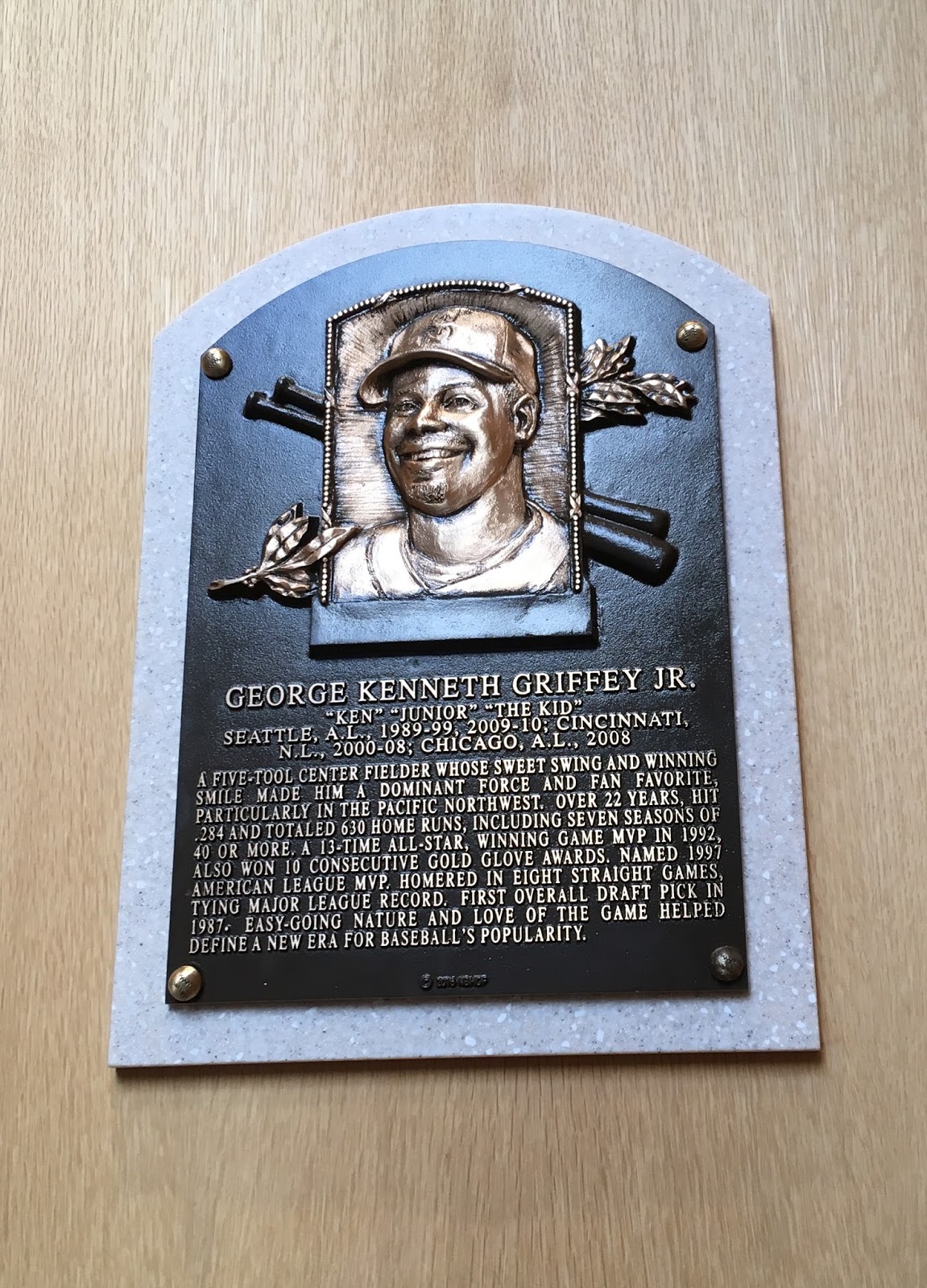
The Hall of Fame plaque for Ken Griffey Jr., who led the way to create baseball's annual Jackie Robinson Day. Griffey, who usually wore number 24 for the Seattle Mariners, wore Robinson's number 42 on April 15, 1997, to raise awareness of Robinson's achievements. The number has since been retired throughout Major League Baseball--except when all players wear it on the annual Jackie Robinson Day games on April 15. 

Thursday, April 5, 2018

'Melancholy: A Way to Happiness'

That's the title of a chapter I read this morning in Ageless Soul: The Lifelong Journey Toward Meaning and Joy by Thomas Moore. I'm enjoying this book. In it, Moore notes how we age throughout our lives--and about how it's natural for melancholy to increase as we get older and see more illness and death in our lives.

Mom, me, Dad
Today marks the sixth anniversary of my dad's death, so it's naturally a melancholy time of year--especially since my mom also died in early spring. As difficult as it is to face the loss of loved ones, I've always felt grateful that my parents both passed from this Earth in its time of rebirth. Spring softened the blow in both cases, even though their deaths could not have been more different. I was just 25 when I suddenly lost my mom; I was 50 when my dad died after years of decline. Both deaths helped prepare me for future losses, but my father's much more gradual passage was much more profound to me because I was old enough to process it in all its complexity.

I remember how, when I was living through my dad's difficult final months, I sometimes referred to the experience as my "holy days of obligation." As his daughter, of course I felt bound to help him through his final days as he and my mom cared for me as a child. That was the obligatory part, the often-difficult work of tending to the ever-shifting needs of someone wrestling with cognitive decline and physical pain he frequently could not articulate.

But it was an unbelievably holy time, too. I remember one evening when I wearily left Dad's apartment, crossing the parking lot to catch my bus on a nearby corner. A full moon had risen and I spontaneously broke into song:

Spirit of life, come unto me, sing in my heart, all the stirrings of compassion ... *

It was a preview of even more profound times to come, culminating in the day Dad said goodbye, three days before Easter 2012. On that day, as my brother and I sat vigil knowing the end was near, the stirrings of compassion became more real. With the help of an angel from hospice, we learned what it means to have a good death.

Moore writes how sadness is part of growing older. We don't need to rage against it; in fact, if we can sit with our melancholy, it need not turn into existential dread or depression "but instead only one strand of mood among others." And that is how I feel this rainy April day: As the best-laid plans sometimes shift and some long-held dreams recede, we learn acceptance and perspective. Or, as Moore says, "If you can allow melancholy its place, you have a better chance to be deeply happy."

* Spirit of Life, a beloved Unitarian Universalist hymn. Words and music by Carolyn Dade.

Wednesday, October 4, 2017

How to be a survivor

The sun is setting as we leave Sacramento. I am happy to see this day end, happy to be on an airplane heading home after this double gut-punch of a day. 

Morning started quietly, the golden California light spilling into our hotel room. We'd flown south to watch the Mariners play their last game of the season, and although we lost, we'd seen another MLB park, met up with some fellow fans, and enjoyed ourselves. 

With a few extra hours between our hotel checkout and flight, we planned to go to a movie. But first, breakfast. At home, I never have the TV on anytime close to breakfast and I don't watch cable news. On the road ... is there a hotel breakfast room anywhere in the United States without cable news? At least the sound was turned down as we saw grave-faced Las Vegas officials speak behind the headline at the bottom of the big screen: 58 dead and more than 500 hurt at a music festival. 

My first thought was of the woman we'd sat with on the flight south who was joining her brother and other family and friends in Las Vegas to celebrate his 50th birthday. My second thought was of the other violence at concerts and dance halls and movie theaters over the past decade, and how it's become almost routine to hear of madmen targeting people out for a good time. 

We stuck to our plan and went to the movie -- Stronger, about Jeff Bauman, the Boston Marathon bombing survivor who loses two legs and eventually gains a spine through his ordeal. Josh Ritter's yearning, determined "Homecoming" plays during the credits. I feel a little better. Then, as we leave the theater, Tom learns via an email on his phone that Tom Petty has died. Yet another dose of heartbreak -- and of course, I take it personally. 

Those of us who remain must wonder how many more senseless episodes like this are ahead of us. I say something to Tom about not feeling too sure how many more years of this world--as messed up as it is now--anyone might reasonably want to endure. 

And he says the perfect thing, the only thing. He says it's yet another reminder to be mindful and grateful every day. Of course it is. 

One of the most horrible things about Sunday's shooting was how it maimed 10 times as many people as it killed. These are the people who could reasonably question whether they'd rather be dead. Jeff Bauman had something to say to them via his Facebook page the other day: 

To those who lost friends and loved ones—I’m so sorry. I know there are no words that can bring comfort but please know that the world is behind you.
To the victims waking up in a hospital right now wondering how life will ever be the same... I know your pain. The most important advice I can give is to remember that healing your mind is just as important as healing your physical, visible injuries. It took me too many years and dark moments to realize that and it is so, so important. You will walk again. You will laugh again. You will dance again. You will live again.
Please consider making a gift to the Las Vegas Victims Fund. Support like this is what got me through-every little bit counts in the days ahead.

If you are reading this, you are a survivor. Maybe the key to living through times like these is, indeed, to give. Some will give money, others will share words or hugs or comfort. It all matters.

Southern California coast, October 2017. Photo by Julie Fanselow

Thursday, October 13, 2016

Autumn is sending you invitations


This was one of the first fallen autumn leaves I saw this year, on September 17, by itself on a sidewalk in my neighborhood. I took its picture and posted it on Instagram and Facebook with the caption, "This seems to happen earlier these days. #fleeting #cultivatecalm." About two dozen of my Facebook friends and acquaintances liked the post, and one added a comment:

Autumn is sending you invitations!

Sometimes I'm tempted to give up social media, but it's moments like this I know I probably never will. I've been meditating on Sara's five words ever since that day, thinking about why the falling leaves are astonishing and poignant and meaningful, and why they become more so every year we spend on this planet.

This has been a year full of reflection for me. On the nature of work, as always. On the importance of love, and the balance between solitude and companionship. These matters merit my attention, and they help direct my attention to the handful of people who need me most (and from whom I am learning the most, too).

This blog takes its name from something Henry David Thoreau wrote, something I first read on a bumper sticker at the Walden Pond gift shop, "Surely joy is the condition of life." I bought three or four stickers and gave them to friends over the years. At long last, during my Wellspring travels and our study of the writer's work earlier this year, I was compelled to finally read this phrase in its context.

In his 1842 essay Natural History of Massachusetts, Thoreau wrote of growing weary of politics and even "the din of religion, literature, and philosophy," then he describes how his spirit is continually refreshed and renewed by nature, by

the young fry that leap in ponds, the myriads of insects ushered into being on a summer evening, the incessant note of the hyla with which the woods ring in the spring, the nonchalance of the butterfly carrying accident and change painted in a thousand hues upon its wings, or the brook minnow stoutly stemming the current, the lustre of whose scales worn bright by the attrition is reflected upon the bank.

And so it is for me. The first big windstorm of the fall is due tonight. It's raining now, and rain is forecast for the next week and probably for the next month, since this is October and it is Seattle. Yet I feel fortified for any darkness and uncertainty ahead by many walks in beautiful places this fall. I've been recording my impressions less in words and more in memories and photos, because that's where I am in my life.


I don't write here much, and I don't post much on social media. I take comfort (and, yes, joy) in what Thoreau says about "the inexpressible privacy of a life -- how silent and unambitious it is."


Autumn's invitation to me, especially in this season of din and angst, is to dare to be unambitious, to dwell in the present moment, to recognize and gratefully acknowledge gifts as they're revealed to me, and to share when I am moved to do so.

Thanks, Sara, and HDT, too.


Sunday, February 14, 2016

Hearts full of soul

It's the first Sunday of #UULent. On my Instagram feed, I am posting a photo each day to represent the word of the day. On Sundays, we are called to reflect, embody and enact the word, too. And of course, today's word is love.

I woke up this morning with the famous 1st Corinthians:13 passage in my mind, "Love is patient, love is kind." There's more before and after that, as you've likely heard at many weddings, but really, the first two phrases of that fourth verse say it all.

Love is patient. 
Love is kind. 

The rest is commentary.

I've been in love a few times in my life. Today, my sweetheart, Tom, and I celebrate our third Valentine's Day together. For us, love is patient, kind, frequently passionate, rarely prickly.

Most of all, it's companionable.

This box arrived last year filled with chocolate-covered strawberries. When it was empty, I decided to fill it with memories. It's filled over the brim already, and we're just getting started.


Romantic love is wonderful, but today, I'm also feeling love for my daughter. When I arrived at church, the early service not quite done, I opened the door and saw a mother quietly nursing her baby, just the two of them alone.

"That's true love," I said to her. I mentioned having happy memories of that experience, then noted that my "baby" will be 22 this year.

"They sleep through the night by then, right?" We both laughed.

Maybe not, but it's not for me to know. My daughter is living her life. It's the life I gave her; it's now fully her own, but she'll always be part of me and vice versa.

And there is even more love somewhere. As people gathered for the service, I happened to see -- and talk with -- a half dozen or more people with whom I've shared a bond in our faith community, through a Covenant Group last church year and Wellspring in this one. Shining faces, smiles and waves of recognition. I've only been part of my current congregation for two years, but I feel the love growing there. As usual, the more you give, the more you get.

Love starts within, and it ripples outward. May it ever be so. Meanwhile, got a date ... have to run ... :^)