Showing posts with label grief. Show all posts

Wednesday, November 25, 2020

Pandemic postcard #36: Thanks for the memories

This week's post comes a little early as we usher in this strange holiday season. I wish you all as happy a Thanksgiving as your current circumstances allow.

In 2010, I reflected on the most memorable Thanksgivings I'd had so far and was surprised to realize they'd all been in my 20s. What a difference 10 years makes. Today, I can easily remember how I spent  every single Thanksgiving from the past decade. This feels good at a time of life when my memory is supposed to be fading. 

It's 2011, the first of several in a string of Thanksgivings spent in San Francisco with my brother Jeff and his partner Kevin, both skilled and loving cooks. Such good food, such good company. On Friday, Jeff and Kevin treat Bruce and Natalie and me to a visit to the California Academy of Sciences. A butterfly briefly rests on Kevin's hand. He is the butterfly whisperer.

2012. I have lived in the Bay Area for seven months, decamping there from Idaho just after Dad died. The job I've moved here for is a disappointment, but I absolutely love California: the light, the people, the diversity. I am living a long-held dream of not needing to own a car, but I rent one to fetch Natalie at Humboldt State for her Thanksgiving break. We join Jeff and Kevin and Bruce for another memorable meal. 

Thanksgiving morning 2013. I am at the Oakland airport, nearly giddy with anticipation at seeing Tom for the first time in a few weeks. We share Thanksgiving with Jeff and Kevin and sleep at their place, since my Oakland apartment is packed up. The next morning, Tom and I pick up a small rental truck, meet a packing crew, and get on the road to Seattle, where I've rented an apartment to be closer to my love.

2014. It's just Tom and me this year. We take a morning train to Centralia, WA, and enjoy a leisurely midday dinner at McMenamins' Olympic Club, where the buffet is spread out over several pool tables. We retire to our room upstairs and take a long nap. It is a perfect day. 

Tom and I get two Thanksgivings in 2015. The first is in the Denver suburbs on Sunday, with Tom's brother Marty and his family and a bunch of people from the bar Marty owns. Tom plays his dad's old banjo. On Tuesday, Tom and I board Amtrak's California Zephyr at Denver's Union Station and ride over the Rockies for Thanksgiving #2, with Jeff and Kevin plus Natalie, who has flown down from Boise. 

Thanksgiving 2016 comes a few weeks after Tom's stem cell transplant, and it's just the two of us celebrating at Swedish Hospital. Considering that he had almost died from engraftment syndrome four days before the holiday, Tom is doing much better. I dial up Paul Simon ("These are the days of miracles and wonders ...") and Arlo Guthrie on Spotify, we eat the not-too-bad-for-hospital-food Thanksgiving dinner, and we are grateful. 

2017. I don't have specific memories of this holiday--my most recent one in San Francisco--apart from the warm embrace of family, of building a collaborative playlist, and of gathering around the table for another amazing meal. Of course, we watch Love Actually afterward. This will be Tom's last Thanksgiving. We don't know that yet, but after the wild ride of Thanksgiving Week 2016, I don't take anything for granted.  

2018. It's a weird year. Tom has been gone four four months. Kevin and Natalie both work in the plant-care field and Thanksgiving season means poinsettia distribution. We decide to make it easy on Natalie this year and meet at a rented Airbnb near Boise to mark an early Thanksgiving. I spend the actual holiday handing out food and socks at the Union Gospel Mission in downtown Seattle. 

2019. I have plans to see Natalie in Boise just before Christmas, my extended family in Chicago on December 24 and 25 (for the first time in decades), and Jeff and Kevin in San Francisco for New Year's, so I'm at loose ends on Thanksgiving Day. I consider a solo trip somewhere, but I stay home and make myself a simple dinner. I'm OK company, but I'm grateful that I'll be with family for Thanksgiving 2020. 

2020. Except I won't. And neither will most of you.  

Sigh. And yet, and yet. This past decade has shown me that a rich storehouse of memories and an attitude of gratitude can serve us well in times of loss. Meister Eckhart said, "If the only prayer you say in your life is thank you, that would suffice." And a day before he died, Tom mused to me, "Maybe just being grateful and happy is enough. So thank you." 

I'll leave it at that for now. I am grateful for shared Thanksgivings past, I look forward to making more memories in person with my beloveds in the 2020s, and I wish the same for us all. 

P.S. If you are new to Surely Joy, or even if you're not, you may want to revisit my post from this week in 2018, when I wrote, "This is a season of living while we wait to resume life." Those words, true for me in 2018, are true for us all this year. There will be better days--and yet these are the days we'll remember. 

____

If you enjoy Surely Joy, please consider supporting my work via Patreon, a website where you can help creators whose work you value. Sign up this week to help sustain my work in December and beyond. Pledges start at $3 a month. Thank you! 

Friday, October 30, 2020

Pandemic postcard #32: In search of a clean slate

Last week, I promised a story about what I was doing on November 9, 2016. I'm pretty sure that whatever happens next week, it won't be any weirder than what I lived through four years ago, both because this year's election may take a long time beyond Tuesday night to resolve and because Tom had his stem cell transplant the morning after the last election.
 
The 2012 election was one of only a few in my adult life that I wasn't working in either a newsroom or for a campaign on election night. I felt at loose ends and nervous about the results, so I went to a movie. I was one of a handful of people who attended a showing of Argo at the Grand Lake Theater in Oakland. I stopped in the restroom afterward and heard two women sharing the news that President Obama had won re-election.  
 
When someone gets a stem cell transplant, their immune system is wiped clean and they are home-bound for many months afterward, so Tom and I thought a movie date night sounded like the best way to spend election night 2016, too. We were staying at a hotel near the hospital, and we walked a few blocks to see Moonlight. The night held lots of promise: We’d had a Black president for eight years and we’d soon have a woman in that role. Love and demographic destiny seemed ascendant in America, and Tom would have a new lease on life the next morning.   
 
I knew something was amiss when we left the theater and walked toward a bar on the next corner. Several people were crying on the sidewalk outside, big-screen TVs flickering in the windows behind them, swaths of red slashing across the maps. Despite being far behind in the polls, Donald Trump had won several key states where balloting had already closed. Yet the night was still relatively young for those of us on the West Coast. Things could change. 
 
When we got back to the hotel, I tucked Tom into bed so he could get a good night’s sleep. I stayed awake a few more hours and saw more states—and ultimately the election—called for Trump. Dazed, I climbed into bed and slept badly before waking Tom for our pre-dawn appointment with the transplantation team.  It was a strange morning for everyone, but it was also a relief to have something to take our minds off the news, at least for a few hours. And for Tom, this was the first day of the rest of his life, however long that might be. We still had that fact to celebrate.
 
Six months post transplant
Tom's stem cells gave him about 15 months of remission before the cancer came back in early 2018. Running out of options, we began a clinical drug trial that didn’t go well, one that saw Tom in and out of the hospital for blood transfusions and other interventions. In June of that year, we got married on Tom’s 62nd birthday, our family crowding into the hospital room to wish us well. It was another day of possibility and within days, Tom’s doctor sent us home for a brief honeymoon.
 
It was a risky gift, with Tom’s white blood cell counts still low, yet it was one we embraced. On the fourth night at home, after Tom collapsed twice while trying to get to the bathroom, I knew the honeymoon was over. He died in the hospital two days later, but not before his children and their mother had a chance to visit with him on what would be his last night on Earth. We'd hoped to go home with hospice care the next day, but that was not to be.  

 
I miss Tom every day.  I have no idea what he would have made of what we’ve endured as a nation in 2020, and I am especially grateful that his final months did not come amid COVID-19. But I understand that his brother, who lives in a swing state and usually votes Republican, will vote for the Democrat this time. “This one is for Tom,” he has been saying, and this gives me hope. All of us alive in 2020 have seen our ability to bear the unthinkable bend to the breaking point—and when it comes to discarding old opinions and habits that no longer serve us, breaking free is an act of courage. 
 
There will be no election night movie for me this year; I'll be working for my county elections office as a drop-box attendant. Your vote is your voice, so if you haven't yet made your voice heard, please do that by Tuesday. 
 
Visualize what it will be like to have a clean slate for our nation. I'll see you on the other side.    

Friday, October 9, 2020

Pandemic postcard #29: Turning into my dad

Today is my father's birthday, and if all goes well, my brother and his husband and I will be toasting Dad's memory on a San Francisco beach, not far from where we scattered his ashes. Dad has been gone almost a decade, but--as I wrote a few weeks ago--my parents' memories have been strong with me this fall. I miss them both as much as I ever have, and I think I may be turning into my dad.

I know that many women worry they'll turn into their mother, but that was never going to happen for me. Like many mothers and daughters do, we clashed during my adolescence, and I was just starting to know and appreciate Mom as a fellow adult when she died at age 62. By then, I'd been away from home for eight years.   

Dad was also 62 when Mom died. That's the same age my husband, Tom, was when he died in 2018, and the same age my stepchildrens' maternal grandfather was when he passed on. I'm just a few years shy of that mark, and as 62 looms ever closer, it hurts to be "losing" a year the way we are in 2020. 

Yet it's likely I'll live far beyond 62, as my dad did; he was 87 when he passed away in 2012. He lived long enough to see my ill-advised first marriage end, and to see me meet a good man and marry again, and to see my brother find a loving partner, and to spend lots of time with his only grandchild when she was young. At the end of his life, he gave me the sacred experience of helping a loved one have a good death. Today, on his birthday, let me tell you a little more about my dad. 

Sparrow, #14
Byron Fanselow started out a little guy, and his nickname was "Sparrow," but he still played baseball and basketball. His high school yearbook reports that he was usually laughing. After graduation, he grew several inches, so his nickname went away--until the 1970s, when Dad (and my brother and sometimes I) became "Fonz." Thank you, Happy Days, for helping America finally learn how to say our last name.

Dad went to Illinois Tech for mechanical engineering, then he joined the Navy near the end of World War II. After that, he became a salesman--the natural job for someone with his personality. He started out selling windows and went on to rep several metal building companies in the Midwest. He was offered a transfer to San Francisco but wound up taking one to Pittsburgh instead so he and my mom would remain reasonably close to their families in Chicago, where most of my extended kin still live.

For a short time when I was in elementary school, Dad had an office in a downtown Pittsburgh high-rise, which was fun. But usually, he worked from home and on the road, calling on clients across the Mid-Atlantic states, eating lots of dinners at Howard Johnson's and racking up plenty of points at Holiday Inns. He loved to travel and he loved meeting people, and my brother and I both found careers that incorporated those things.  

Dad worked on commission, money was sometimes tight, and Mom loved to shop. She meant well; she loved to give people gifts, but she'd lose track of what she'd already bought, so we always had lots of stuff but never much extra money. Mom went to work at a fast-food place to help send me to college. That's where she had her first fall, on a slick floor at Wendy's. I took the call on the hallway phone in the dorm my freshman year at Ohio University. Mom had broken her hip, and soon after that, she got cancer, too. I doubled down at school, maxing out my course loads so I could graduate in three years.

Thankfully, Mom beat lymphoma and she and Dad were able to travel a bit. They went to Tokyo and Hawaii mostly for free with all those points from Holiday Inn. But her hip replacement hadn't healed especially well, and one day, her cane caught on the top step of the basement stairs. She fell and hit her head, and we had to let her go. Dad was heartbroken at the loss of his wife of 37 years, and I cannot imagine his grief, even after losing the love of my life. But he'd go on to live another two-and-a-half decades, most of them in a healthy, happy retirement.

You're probably wondering by now: How am I turning into my dad?

I find myself cracking really bad jokes. For example: On my camping trip to Olympic National Park this summer, I arrived at Rialto Beach first thing one morning and found three bored teenagers sitting at a picnic table, ignoring the Pacific Ocean. I tried to get them excited. "It's going to be a great sunrise!" I said. "Too bad we're on the wrong side!"

I find myself wanting to talk to everybody. I'm sure the pandemic and living alone are driving this, but when I see other humans, especially in person but even on Zoom, it's sometimes hard to contain myself. I genuinely miss people at this point. Dad was the same way. I think he was happy living alone--he never had a serious romantic relationship after Mom, that I know of, and he knew how to entertain himself. But the longer he was alone, the more he missed seeing people, and that manifested in wanting to talk a lot when he saw them.

Dad in 1993
What I most admired about my dad was his curiosity about everything. We always had plenty of books around, of course, plus stacks of newspapers and magazines. Dad had no serious lifelong hobbies other than photography, but he'd get interested in something--astronomy, astrology, CB radios, ice cream making, magic tricks, meditation, computers, physics--and he'd learn all he could (or all he cared to), then he'd move on to something else.      

Dad did get downright cranky for a while in the early 2000s, when he started watching too much Lou Dobbs on CNN and briefly, alarmingly, became rabidly anti-immigrant. Fortunately, this xenophobia didn't last long, since it clashed with his moderate politics and his liberal Christianity.

Dad ultimately developed dementia and had a rough last few years, though the course of his disease was fairly swift. The cognitive reserve theory suggests that people who spend a lifetime keeping their brain active may die faster once in the later stages of dementia, and that mercifully seemed to be true for Dad. Unfortunately, his sharp decline came at the very same time I had soul-taxing political work and a teen daughter and a marriage that was showing some strain. I'm adopted, so it's anyone's guess what my fate might be in the brain health department, but the heartache of Dad's final few years is gradually fading for me, and I am not afraid.

I am not afraid. I think that's something else I got from my parents, and something I've tried to pass on to my daughter. Love was our family's default position, and Mom and Dad showed it in their volunteer work, in their friendships and family ties, and at the ballot box. And they showed it to each other; they had a rule that they'd never go to bed holding a grudge. 

Although things are unsettled in our country right now, I believe that love and reason and liberty and justice will prevail, though perhaps not without a fight. I miss my parents, but I'm not sorry they're missing this--and I am grateful for their legacy of valuing love over fear. 

Thank you, Dad. You too, Mom. Keep sending those good vibes, for we surely need them.

My parents on their Havana honeymoon.


Friday, September 25, 2020

Pandemic postcard #27: The book of Ruth

My mom loved the old saying that "you can catch more flies with honey than with vinegar." As a kid, this didn't make a lot of sense to me; I'd wonder why I would want to catch flies at all. I was more interested in lightning bugs and praying mantises and caterpillars--critters I could catch, watch a while, and release. (Unless I forgot the release part, which I did once in a while. Sorry, bugs.)

Eventually, I understood the saying as my mother intended it: You can influence more people by being pleasant and kind than by being bitter and sour. My parents lived that idea. Mom and Dad were both easy-going, low-drama people for the most part. They had a strong religious faith, but they also revered reason, and they weren't afraid to change their minds. They were Eisenhower Republicans from the Land of Lincoln until Vietnam and Watergate made them reconsider their loyalty to the GOP. 
 
I've been thinking about Mom and Dad a lot this week as we mourn a famous woman of their generation who shared my mom's first name. Ruth Bader Ginsburg also shared my parents' devotion to the common good and to finding common ground. The late justice was rightly hailed as a liberal lioness, yet she was no firebrand. When, as a young litigator for the American Civil Liberties Union, she brought cases before the then-all-male Supreme Court, Ginsburg didn't frame them in terms of "women's rights" but of equal rights. And although she supported a woman's right to end a pregnancy, she favored legislative reforms to safeguard access to reproductive healthcare. She correctly foretold how the sweeping Roe v. Wade decision would ensure pitched battles over the issue for decades to come.
 
One of the RBG quotes I've seen most often this week is this reminder: "Fight for the things you care about, but do it in a way that will lead others to join you." As David Cole, current national legal director for the ACLU, wrote this week in The New York Review of Books, "Her dissents did not aim barbs at the majority, but instead coolly, painstakingly, and effectively dissected the ruling’s errors, and often placed her emphasis on areas of agreement and avenues the majority decision left open." She was able to dissent without being disagreeable, and she famously was close friends with her opposite on the high court, Antonin Scalia. 
 
Ruth Bader Ginsburg consistently chose honey over vinegar. When she died a week ago just as Jews prepared to observe the High Holy Days, Jewish theologians noted that the timing made her a Tzadik, a person of great righteousness. I'm not sure what this makes Mitch McConnell, who refused to take up President Barack Obama's nomination of a Supreme Court justice more than seven months before the 2016 election, yet who now seeks to swiftly confirm a third lifetime appointment for a man who lost the popular vote four years ago and seems likely to lose it again on November 3. Calling on another religious concept, I'd like to think that karma will eventually have an answer for the likes of Mitch McConnell and Donald Trump, but I'm not sure where that leaves us this fall.
 
"The problem for America, as for many other democracies at this point in history, is this is not an even match," Robert Reich wrote in The Guardian this week. "Those who fight for power will bend or break rules to give themselves every advantage. Those who fight for principle are at an inherent disadvantage because bending or breaking rules undermines the very ideals they seek to uphold."
 
Ruth Bader Ginsburg became an icon, but it wasn't a role she chose. Like Thurgood Marshall, her life and work were grounded in principle as she fought to make sure everyone's equality was recognized under the law. Is there still time to make this election about that fundamental (if yet-unrealized) American value? And if nakedly unchecked authoritarian power prevails--even as it is being dismissed by a majority of voters, many of whom are already casting ballots--what happens next? 
 
Our news feeds suggest we're about to find out. I miss my thoughtful and moderate parents. Part of me wishes they were still here to see what they would make of this circus--and another part is grateful they didn't live long enough to experience it--but their legacy of valuing love over fear remains strong with me as I seek to chart a course of nuance, reflection, and hope in these darkening autumn days. 
 
I also take heart remembering that my parents were people who were never afraid nor ashamed to change their minds. Just as my folks eventually turned against Nixon, I am sure others like them have finally seen enough to put country over party.
 
Rest in Power, Justice Ginsburg, and thanks for all you did--and the way you did it.       


Friday, September 11, 2020

Pandemic postcard #25: The next right thing

It's funny how books and ideas show up at the right time. I've been doing a lot of camping this summer, mainly because it's the one kind of travel that feels low-risk during the pandemic--until this week of hellfire, that is--and also because it is cheap and it gives me lots of distraction-free time to read. For a recent trip out to the Olympic Peninsula, I brought along Plan B, one of Anne Lamott's collections of essays about faith that had been on my bookshelf a long time. I thought I remembered picking it out of a Little Free Library, but a receipt buried in its pages revealed that I actually bought it at National Airport in Washington, DC, on March 19, 2008, when I would've been on my way home from a national bloggers' conference. 

A dozen years doesn't seem so long in the course of a lifetime, but at this point, 2008 feels like many lifetimes ago. By 2008, I had been heavily involved in politics for much of that decade, thus the invitation for the all-expenses-paid weekend of training for progressive bloggers. I gladly took the trip, but I was actually trying to back away from politics at that time, turning my attention toward a three-quarter-time contract job with a favorite client that had hired me to extend the then-still-new tools of blogging and social media to communities doing important small-d democracy work. It felt like I was living a calling. I was as happy as I have ever been in my professional life.
 
Yet within a few months, I'd pivoted back into politics. An opportunity had arisen with my state Democratic Party for a job I'd sought a few years earlier. We were on the cusp of electing the first Black president and maybe Idaho's first Democratic member of Congress in many years, too. It felt like the right decision at the right time. Although the job turned out to be heartbreaking on many levels, I don't regret taking it. I did some good work and I was able to share the historic 2009 inaugural with my daughter and some dear friends. Still, I wonder what might have happened had I stayed on the contract gig with my all-time favorite client.

Fast-forward to 2020. Once it became clear that most of my pre-pandemic freelance work was gone, I began looking for a full-time job, focusing on things that could feel like career capstones, or at least really good fits for me. By late July, I was demoralized: I'd come close on a few opportunities, but rejection is hard, and I was ready to give it a rest. Then I saw one more possibility--from my long-ago favorite client, for a lightly advertised job that seemed as if it had been written with me in mind. I applied and immediately got an interview. I was sure it was meant to be.

But after a few weeks passed with no news, I learned that the job had gone to a Black man, a talented young writer. And honestly, that is how it should be. The organization's central focus is on helping communities face up to racism--something which, although I have a heart for the work, I have no lived experience. (Of course, I know that better in 2020 than I ever have before.) I was crushed, but I understand that things usually happen--or don't--for a reason. I was ready to move to New England for this job, for one thing, and maybe that simply wasn't supposed to happen because I love the Northwest and my family is on this side of the country. 

Now it's September, and I've given up trying to find full-time work, at least for the time being. Too many people are looking, and I am older than most of them. But I am too young to retire, so I have to find ways to make ends meet--likely some combination of freelance and seasonal work, which is what I've done much of my working life, anyway. 

This brings me back to Lamott's book. As best I can tell, I read part of it on my cross-country flight, then forgot about it for 12 years. Still, it had survived many moves and lots of serious book-winnowing missions, so I was keeping it for a reason. Plan B finally found its way into my tote bag last month and I read most of it in one afternoon while camped near the Strait of San Juan de Fuca.
 
Early in the book, Lamott explains how, two years after her mother had died, she still hadn't scattered her ashes because she was mad at her mom and keeping her remains stashed in the closet seemed like fitting punishment. She was also deep in grief about the turn our country had taken since September 11, 2001, especially the unfounded decision to make war on Iraq. Then one Sunday, Lamott's pastor preached about how, in a time of war,  

... now was not the time to figure everything out--for instance who was to blame. It was not the time to get a new plan together and try to push it through. It was the time to be still, to center ourselves, to trust what we'd always trusted in ... 

Lamott writes how, taking these words to heart, she was able to quiet herself and her harsh, scary, "thinky thoughts." She took long walks. She sat in prayer and meditation. Then she found a photo of her mom that she hadn't seen for a while, and she just knew: It was time, and "scattering her ashes was the next right thing."

Those four words. "The next right thing." It feels impossible in this moment to know what awaits us with the election and its aftermath, or when COVID-19 will be over, or the trajectory that climate havoc will take. Long-term plans feel impossible; there are too many x-factors. But as individuals, we can know the next right thing, whether it's something small, like working to get out the vote or checking in on a loved one, or embarking on some really big change we've truly thought through a while. Intuition is not impulse.

As I finished this post, I read a new piece in The Atlantic that blames America's poor pandemic response on failures of intuition, comparing our situation to that of ants following one another into a death spiral. I want to make clear that when I talk about the power of intuition, I'm talking about how we can use it on a personal level--not as a guide for public policy, where science and reason must prevail. But in our own lives, I know we can be guided by intuition--on following that invisible thread, those few feet of headlights you need to make your way home, even when you can't see where you're going. (Thank you, William E. Stafford and E.L. Doctorow.) 

In some ways, this has been the hardest week of the pandemic for me. The news of the world is unrelenting, and mostly grim. Smoke-choked air means I can't even enjoy a long daily walk, which has been the one constant in my life since March. Of course, that is a small inconvenience compared to the loss of life and homes up and down the West Coast. My heart goes out to the people working on the fire lines and in the fields. May they be safe. 

Let the rains come soon, and justice, too. Meanwhile, I will try to remember that rest is fuel--and sometimes it is definitely the next right thing.

P.S. To those of you who get Surely Joy via email (thank you!): Please check out the web version of this post--click on the headline--for Loosen Loosen Baby by Aly Halpert, a musical meditation that has been pure soul balm for me since I first heard it at church earlier this year. I like to sing along. I've also included a beautiful video from Leon Bridges that was featured at our congregation's vespers service just a few nights ago.
 

Thursday, August 20, 2020

Pandemic postcard #22: Spirit of the radio

This week's post comes a day early to mark National Radio Day. 

Tom Killorin was determined to help launch SPACE 101.1 if it was the last thing he did. And really, it was pretty much the last thing he did. 

Radio sweethearts, fall 2013
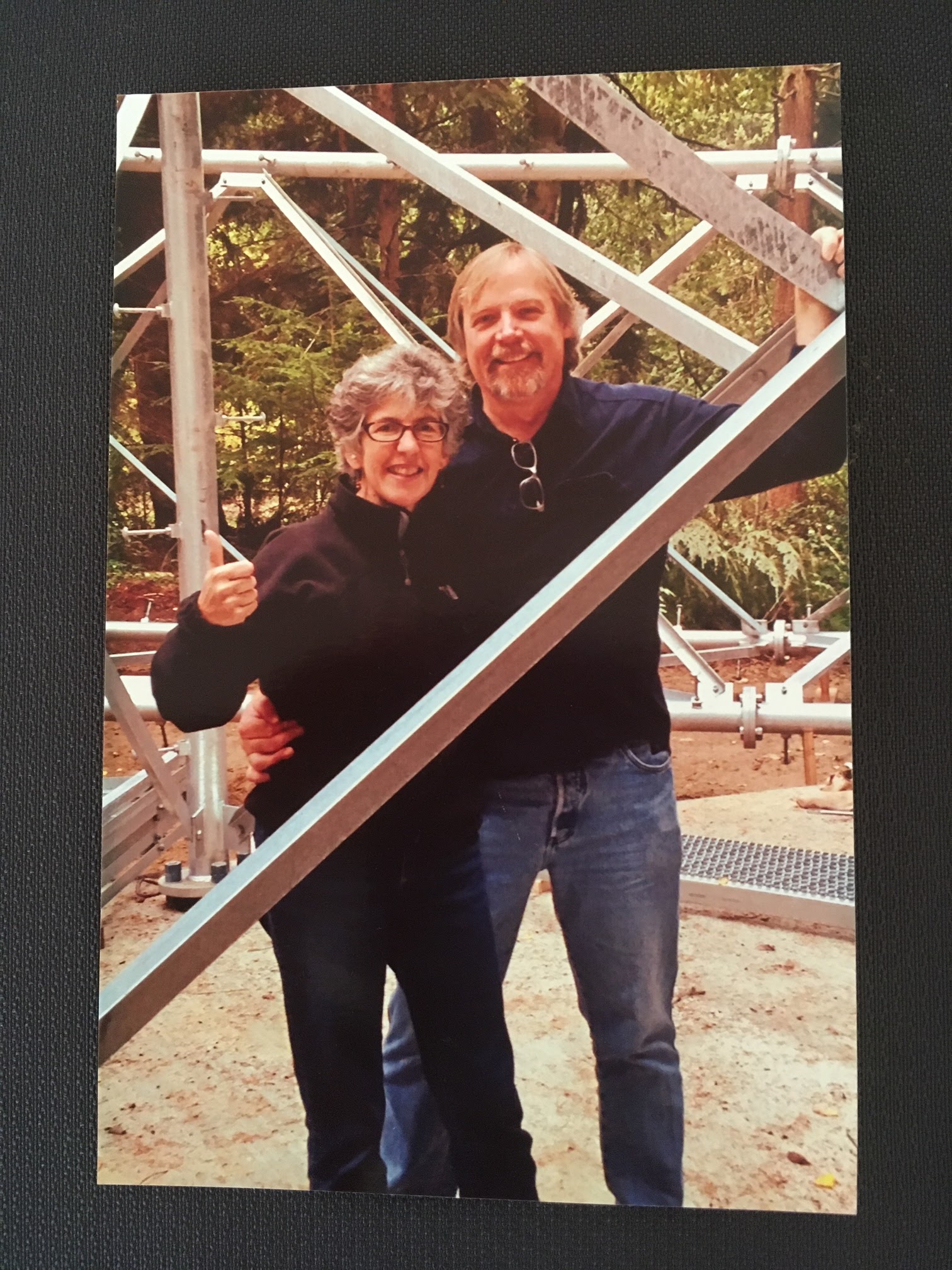
I started falling in love with Tom over the radio after he'd invited me to listen in as he served as a substitute DJ for KSER in Everett. Between his eclectic, enlightened musical taste and his made-for-radio voice, I was intrigued. Tom had worked as a commercial radio DJ for many years before starting a career in music supervision for businesses and brands, but his heart was in non-commercial, community-based radio, so he always had at least one radio side project. One of our first dates was to go see a new radio tower KSER put up on Whidbey Island in the fall of 2013. 

After KSER, Tom helped Bellevue College station KBCS fine-tune its programming, especially its afternoon music mix. And after that, Tom and I were spending an idle Saturday in the art gallery at Seattle's Magnuson Park when we spied a flier announcing the formation of a community radio station. The gallery director, Julianna, explained to us how she hoped the Sand Point Arts & Cultural Exchange could land one of the last low-power radio licenses that would be available anywhere. Tom leaped at the chance to help build a station from scratch. Over the next few years, he donated hundreds of hours and recruited other radio veterans to help out with programming and engineering. When SPACE 101.1 launched in October 2017, I think it was among Tom's proudest moments. 

Tom Killorin 1956-2018
Tom believed in the power of radio to bring people together, to help artists of all kinds be heard, and to advance justice. He also believed in radio as the main instrument of music discovery. In the months after SPACE 101.1 went on the air, Tom would drive all over Seattle to see where he could pick up the station's 100-watt signal. Tom had loaded all the songs into the station's original playlist, but he had no control over when they'd play. So he'd be as surprised as anyone to hear what would come next, and this delighted him, nearly as much as he thrilled to a well-crafted set of tunes he'd deal up ("like cards," he always said) from behind a mixing board. 

That's the thing about radio: You never know what you're going to hear. And while I appreciate the nuances of Spotify's algorithms, there's nothing like the human element of great community radio: to blend music and ideas, empathy and education, heart and soul. "Algorithms don't get the blues," Tom would say, relishing the triple entendre in that phrase. (Is it any wonder I fell for this guy?) 

Tom suffered a recurrence of multiple myeloma in early 2018. By June, we knew he'd likely only have a short time to live--yet he was still working on SPACE. I especially remember one morning, sitting with Tom in the intensive care unit at Swedish Hospital, when he wanted to be sure that week's episode of "American Routes" got to the station for airing later that day. Tom downloaded the show onto a thumb drive and had me meet a volunteer outside the hospital to make the transfer. Two weeks later, Tom was gone, but he'd left a legacy. SPACE 101.1 has grown its programming over the past two years to become a pint-sized community radio powerhouse. Tom would be so happy.

Happy Radio Day 2020. In these pandemic times, radio is inherently socially distanced, yet--when powered by people--it fosters real emotional intimacy. Of course, this is why podcasts have become so popular, too. In our separation, we yearn to hear voices.

In honor of Tom--or whoever your favorite DJ may be--please donate to your local community, non-commercial radio station if you can. And remember: As wonderful as it is to have a great radio station float in over the airwaves, community radio is available to everyone, everywhere through the magic of the Internet--and unlike corporate streaming platforms, it's free. My Spotify subscription expired last week, and while I'll eventually renew it, for now I'm just going to let the radio play. 

___

If you enjoy Surely Joy, please consider supporting my work via Patreon. Pledges start at just $3 a month. Thanks for reading!  


Friday, August 7, 2020

Pandemic postcard #20: Terrible beauty

"The weirdest part was that the sky was so blue at that point. I never saw the mushroom cloud that you see in the video. I saw the lingering smoke from it ... but it was almost golden hour, so the light was just beautiful." -- New York Times reporter Vivian Yee describing the Beirut explosion aftermath 

Decades of strife 
Inept government 
Waves of refugees
An economy in ruins 
A spike in COVID-19
and then this ...

Explosions rock the port
An ancient city convulses

Strangers tend to strangers' wounds
dressing bloody gashes with splashes of liquor
Grim humor rises anew to greet another catastrophe

"In a land conditioned by calamity, people knew what to do ..." (headline from Vivian Yee's first-person account of the chaos in Beirut after the blasts) 

I am at a loss for more words to say about Lebanon, so I will just marvel yet again at the ways how, when the unimaginable happens, people rise to meet it--and also how people somehow notice beauty even amid the most horrific experiences. 

Read and/or listen to Yee's story.

In this year of layered crises and rolling waves of grief,
on the 75th anniversary of the bombings of Hiroshima and Nagasaki, 
let us do what we can to help alleviate suffering and prevent it, too. 
Help us know that borders are illusions
and that nationalism is absurd.


Friday, July 17, 2020

Pandemic postcard #18: Beacons in the dark

Have you been able to see Comet NEOWISE? It is visible in the Northern Hemisphere for a while longer, rising in the evening sky and coming closest to Earth on July 23. I haven't seen it yet; I was up before dawn trying to catch a glimpse last weekend, when it was close to the horizon, but city lights and hills precluded a view. (A rising Venus was amazing, though!)

I'll never forget seeing Comet Hale-Bopp in the spring of 1997 on a drive home from Salt Lake City to Twin Falls, Idaho. Motoring north through dark high desert skies on Interstate 15, then Interstate 84, I had the comet in my view for several hours, nearly the whole way home. That evening ranks with the 2017 total solar eclipse as one of the great natural phenomena I've experienced. How fitting is it that Comet NEOWISE seemingly came out of nowhere in late March, becoming visible to NASA scientists during the first pandemic surge? We need all the bright lights we can find in these dark times, and I hope to see this new comet sometime next week.

As I mentioned in last week's post, I've been "at camp" this week. It's all been online, of course, but it has been wonderful to reconnect with my Eliot friends, even over Zoom. We've been hearing timeless tales of many cultures from talented storyteller Will Hornyak. We've had a talent show, games, (including a fun offline scavenger hunt), TED Talks, worship services, small-group discussions, and much more. I will be sad to see it end. I may even sign up for the August camp, which I've never attended--but I continue to have lots of time on my hands. (More on that below.)

Camp meant a lot of screen time, but I've managed to spend this entire week away from social media, and I took in only a bit of news each day. I'll be sad to see that end, too, but as Will related in one of his programs, a vision quest can't go on forever. Ultimately, people need to return to their daily lives. Of course, this is something we're all wrestling with now. As people go back to their routines of in-person socializing, many people are getting sick and sickening others. It's an unsteady dance we're doing, and it seems we'll be doing it for another year or so, until a widespread vaccine is available. I know this is especially hard on families, as well as on people experiencing homelessness and people with little social contact of any kind.

Will told a story this week about two villages. (You can watch an earlier performance of it below.)  A natural disaster had brought the villages to the brink of war, but with imagination and creativity--and some wise grandmothers--the villagers solved their problem without bloodshed. As Will says, we need new steps, new dances, new songs, and new stories in times like these. Stories can break the spells we weave around ourselves, the narratives that sometimes keep us feeling like change is impossible.

With the end of July nigh, I am among the millions of Americans who face the end of enhanced unemployment benefits next week. Although I've freelanced much of my life, I'd love to find a full-time job that I can dig in and do until it's time to retire. I applied for one in late May that would've been perfect for me, finally learning just this week that although my resume made it through several "cuts," I will not be a finalist. I know it is no easy task to find work in one's late 50s, but I still believe something good will emerge in due time. I'll keep looking for the beacons in the dark, and I will try to be one, too. My superpower is helping people tell their stories, after all, and there's a big need for that these days.

Thanks for reading. I'm going to spend some more time away from screens next week--to go camping, look for the comet, and hopefully see my daughter (who lives 500 miles away) for the first time in 2020. I'll be back with another dispatch in two weeks. Until then, be well...and be the light.


Friday, June 26, 2020

Pandemic postcard #15: Turn, turn, turn ...

Tom always loved cars.
When Tom died two years ago this week, he left behind a fleet of three vehicles: a 1991 pick-up truck, a 1996 camper van, and a 2010 Prius. Tom always loved wheels of all kinds, and he had a knack for finding good deals. I'd lived without a car much of the past decade, I didn't even especially want to own a car, and all of a sudden I had three.

I had plans for the van and the truck, which I'll get to in a minute. I figured I'd keep the Prius, at least for a while--but when I went to start it a few days after Tom died, it was dead, too. I was flying to Denver the next day to see Tom's family, so I waited until I returned to call AAA. They were unable to jump the battery, so I had to have the car towed down the street to Tom's mechanic--but not until later that week, the earliest they could see it. Meanwhile, I worried and I wondered: Was this a dead 12V battery that wouldn't cost too much to replace, or was this the much more expensive hybrid battery? If it was the latter, did I want to keep the car? As it turned out, it was the 12V. The mechanic replaced it and I had him do an oil change as long as he had the car, only to learn afterward Tom had done one just 1,500 miles before. No big deal. The Prius was good to go.

At the Greenwood Car Show
Tom bought the lovingly converted Ford Aerostar camper van in the fall of 2016 shortly before he underwent a stem cell transplant to address a recurrence of multiple myeloma. He had taken a leap of faith that, come spring, we'd be able to hit the road, and we did. We took the rig to Ocean Shores, WA, a couple of times to visit our friends Marty and Cai; we went camping on Hood Canal; and we motored to Oregon to see the total solar eclipse with our friends Dale and Rebecca. Tom even ordered a special plate for the van and named it Ove. (If you understand, great. If not, this will explain. That was classic Tom.) But by the spring of 2018, Tom's brief remission had ended and he was too sick to travel.   

Before he passed away, knowing that I wasn't interested in keeping the van, Tom had arranged to sell it to Marty, who picked it up a few weeks before Tom died. On the very same day I'd finally had the Prius towed to the garage--it was Friday, July 13th, by the way--I got a text from Marty. He had been driving the van on the interstate at rush hour when the brakes and steering started to give out. I asked him to call me and--after he assured me he was OK--I told him it was fine if he didn't want to buy the van. Well, Marty did still want to buy the van. He said he'd get the repairs made and deduct the cost from the price he and Tom had agreed on. Marty is a good egg.

The pick-up truck was a short-bed manual transmission Toyota, somewhat beat up but still handy to have around. Tom had tried to sell it off and on, with no luck. It had become a communal vehicle for our household and that of Tom's first wife and her husband, who lived about a mile away. We traded it back and forth to haul stuff, so I was pretty sure that Grace and Jon would take the truck, and they did.

Which brings me back to the Prius.

Fast forward 18 months to early this year. I had moved from the suburbs back into Seattle, where I really don't need a car. The Prius stayed parked for weeks at a time. I walked to the grocery store every few days, buying only what I could carry. But I started camping again last summer so I thought, OK, I'll enjoy the car one more summer and then I'll see if either of my stepkids wants it.

And then the pandemic hit. And all of a sudden, I'm not riding buses anymore. I'm not walking to the grocery store as much; I shop less often, but I buy more when I do, so the car has come in handy. Pre-COVID, I preferred to fly or take a train than drive at vacation time, but now it seems road trips are the way we're going to travel for a while until we get a vaccine. I've taken two camping trips with the car this month and I see many more in my future this summer, at least. To everything, there is a season, and these days, the Prius is packed with my camping gear and my inflatable kayak, ready to escape as I get the time and inclination.

The car hit 100,000 miles this week. Its annual registration and insurance are due soon, and I will pay them. A Prius sips gas and is cheap to maintain, and I've learned that the hybrid battery may last another 50,000 miles, maybe more, before it must be replaced. At the rate I drive, that could be another decade.

This will probably be the last car I own, whether I decide I don't need it once the pandemic has passed or I decide to hang onto it as long as I keep driving. One way or another, I just wanted to say once again: Thank you, Tom.


Friday, June 19, 2020

Pandemic postcard #14: Yours forever more

My love, you would have turned 64 today. In a perfect world, you and I would be celebrating in a cottage on the Isle of Wight, "if it's not too dear," maybe after finally making that trip to Ireland that we talked about. Of course, I miss you every day, as do countless others.

Beautiful Human

A year ago, a bunch of us gathered at the ballpark to toast your memory and your birthday--the first one since you'd left us--as the Mariners beat the Royals, 8-2. Alas, there is no home game today. There isn't baseball at all, and no one is flying overseas. (I'll explain in a minute.) So I'm hopeful your family and friends will remember you by tuning into SPACE 101 (still going strong!) for a while and listening to the Mariners classic game on the radio tonight. That's what I'll be doing.

These things sound comfortable and familiar, but our world is not the one you left on June 30, 2018. For the past few months, we've all been facing down a viral threat. Some people don't even exhibit any symptoms, but others get gravely ill. Seattle was an early hot spot for this highly contagious disease. Nearly half a million people have died. Many millions have recovered.

For several months, much of the world was in some form of "lockdown," with people isolating much as we did after your stem cell transplant in 2016. No movies. No restaurants. No concerts. No sports. Millions of people lost their jobs as entire industries closed down. Many people who can do so have been working from home. Schools all went online, and some will remain that way this fall. "Stay home, stay safe" was the mantra all spring. Lately, though, many people have become frustrated or bored or angry at being told what to do, so we are slowly going back to business as usual, even though there is no cure and no vaccine for this new coronavirus. We take heart that most people who get it won't die. Life must go on. 

Still, the risks are real, especially for people in crowded factories and prisons and nursing homes, and for people who are already battling other illnesses and the people who care for them. Remember how we got married two years ago this morning on your 62nd birthday, and how we welcomed your siblings and your mom and your children into a very crowded hospital room afterward? That would be impossible today. In fact, it's possible that--had you been hospitalized in 2020 instead of 2018--you would have died alone. That is a thought I cannot bear, so although I continue to mourn losing you too soon, I am grateful you did not spend your final months in a time like we have now.

On top of this unfolding health crisis, a Minneapolis cop murdered a man named George Floyd on Memorial Day. It was just the latest incident of racist police brutality, but for some reason, this particular killing--caught on video--lit a fuse, igniting Black Lives Matter marches and vigils across the country and around the world. More than ever before, white Americans are starting to reckon with 400 years of systemic, structural racism. A small portion of Capitol Hill here in Seattle has become a staging ground for people who seek to dismantle this system. The man that most of us grudgingly call president believes they are terrorists and has threatened military action (while our mayor and governor defend the activists' constitutional rights). Meanwhile, although the skies and roads cleared for a while as people stayed home, climate havoc is another existential threat we refuse to take seriously.

Wow. That all sounds pretty grim. But I want you to know there are many reasons for hope in the myriad inspiring ways that people are facing all that besets us right now. Folks are looking after one another. People are seeing one another as fully human for the first time. People are exercising their creativity, their compassion, and their conscience in lovely, fruitful fashion. Musicians are playing concerts from home. Chefs are feeding the homeless. Teachers (and parents) are helping children learn. Healthcare workers are saints and angels and wizards and miracle workers, but you knew that.

Oh, and our trio of twenty-somethings? They, and their entire generation, are rocking the house. They're taking charge, they're calling BS, and they're not taking no for an answer. (And by the way, May graduated last week in four years flat despite losing you halfway through college and despite having her senior year disrupted by the pandemic.) You know me; as a journalist and a contemplative, I tend to favor objectivity and nuance, but I've come off the sidelines a bit, because the right side is clear. We are either on the side of dismantling racism and doing what we can to save democracy and the planet, or we're not. As Stephen Colbert famously said, "Reality has a well-known liberal bias."

I miss you, Tom. I miss your sense of humor, your solid presence, and the fact that you lived fully until the day you died. Our time together was too short, but it equipped me in many ways to deal with what we're facing now. You'd be proud of how I traveled to Mexico earlier this year, pre-pandemic, and earned my certification to teach English as a foreign language. (I am "intrepid," you'd say, and you'd be right.) I'm looking for new work now, some way to be useful. Please know that although I am alone, I am not lonely, and on most days, I believe the best is yet to come.

Yours forever more,

Julie 

____

If you enjoy Surely Joy, please consider supporting my work via Patreon. Pledges start at just $3 a month. Thanks for reading! 

Friday, May 29, 2020

Pandemic postcard #11: Sitting with sadness

You'll have to excuse me: I've had a hard time coming up with anything meaningful to say this week, the week we passed 100,000 deaths in the U.S. from COVID-19, a week we saw naked police brutality that claimed the life of yet another black man, a week we saw his city wracked by grief and more violence that is escalating as I write this, a week when we saw yet again that the emperor has not a stitch of decency.

I'm sad, and I'm just going to sit with that sadness. 

So in lieu of a new message, allow me to send you back to this post of mine from April 2018 that is resonating with me again, and recommend two things I discovered online this week. (Apologies to those who avoid social media, but it's been a cornucopia of useful things. That said, I look forward to this week's tech sabbath!)

On Facebook, writer Luis Alberto Urrea is making posts in a series he calls Operation Uplift. He gives us a cue ("Chapter 68. Kindness. An unexpected blessing. A touch of grace. A gift. A moment’s peace. A touch of Zen. A safe feeling. A quiet shelter. The color of joy. Hope now") and one of his own photos, and people post their own words and pictures on the theme. The name is apt: I always feel a little better after I look at the latest chapter (and better still if I contribute).

On Instagram, Los Angeles creative director Lisa Hennessy is posting a lockdown journal of doodles, many with poignant written reflections about the absurdity and humanity of what we are all going through. I found this by accident and I am glad I did. I also followed her bio link to her values-based branding agency with the impossibly apropos name of fernweh, German for a longing for distant places and for exploration. That makes me feel sad, too, except it is somehow a happy sad, knowing that however distant the world may seem right now, it is still out there waiting for us.

See you next week. Prayers for Minneapolis and for us all. And try to remember--even in the worst weeks of this hardest time--that joy is "the happiness that doesn't depend on what happens," that we can be grateful in every moment, if not for every thing. (Brother David Steindl-Rast)


Friday, May 22, 2020

Pandemic postcard #10: Holiday in Pandemia

My church had its annual Coming of Age service last Sunday. It's one of my favorites, the culmination of a year when our ninth-graders spend a year thinking about life's big questions. Of course, the service was online, and it was still wonderful. "Joyful but realistic," one woman described it in our virtual coffee-hour gathering afterward.

From Easter and Passover and Ramadan to Mother's Day and graduation season, we've checked off nearly all the spring boxes. I love the congratulations-and-stay-strong signs honoring graduates all over my city, and it's been fun to listen to online commencement speeches by everyone from President Obama to Awkwafina to ... Donald Trump? And now it's Memorial Day Weekend, the unofficial start of summer. On Monday, when we pause to recall those who have died fighting for our country, let's remember the most recent casualties: the doctors, the nurses, the cashiers, the meat packers, the beloved grandparents.

It doesn't feel like summer. The steam heat in my apartment came on again yesterday amid a Seattle cold snap. The ballparks are empty, from the biggest stadiums to the forlorn sandlots, now given over to dogs and their people playing fetch. Concerts and sleep-away camps have been canceled. And yet ...

Italy? Mexico? Seattle!
I am not sure where or even if I might travel this summer. Except for a few recent forays to state parks open for day use, I haven't gone beyond a two-mile radius of my home. Still, it's been dawning on me anew that I live in a place that people from all over the world visit on vacation. Now that we can venture out a bit, I want to spend some time in my bigger backyard, the Emerald City. I want to wander through a nearly deserted Pike Place Market, see the murals that have popped up at Pioneer Square, and maybe hear a busker play in Georgetown. I want to spend some of my unemployment pay at local restaurants and shops in Ballard and Columbia City. And if I'm feeling really brave, maybe I can meet a friend for a socially distanced picnic or a cup of coffee, or even go to a movie once the neighborhood cinemas reopen. I would totally do that.

In many ways, the new normal is feeling pretty old. Since the pandemic is going to be with us for a while, we might as well try to have fun, safely and responsibly and with thanks to the people who are willing to serve us. We ought to be realistic ... but joyful. This is our life right now, all of it.

Friday, April 17, 2020

Pandemic postcard #5: Farewell, Kelly

Kelly Yost Hove, 1940-2020
It was the early 1990s, and--about a decade out of college--I had finally become a full-time freelance writer. At least that was my aspiration; I didn't have a lot of work at first. But as a former newspaper reporter in Twin Falls, Idaho, the town where I lived at the time, I knew a lot of people. I'm pretty sure it was Judi the bookseller who alerted Sam and Kelly Yost that I could help them out.

Sam and Kelly ran Channel Productions, a small record label that had two releases at the time, both classical piano collections by Kelly. I signed on to help with writing tasks as well as with radio relations, and it's no exaggeration to say I may not have survived my first year as a freelancer without the Yosts. They had plenty of work for me at a time when Channel Productions was adding artists and going full tilt. (Kelly's recordings wound up selling about half a million copies.) As I got busier with other projects--including travel writing and having a baby--Kelly and Sam were always accommodating, welcoming me back whenever I had some time to give them, often accompanied by my infant daughter.

Sam and Kelly eventually parted; Kelly remarried and continued running Channel Productions. I moved to Boise but we stayed in touch; although Kelly was no longer recording, I helped her get her back catalog onto Amazon, and she served as a job reference for me on several occasions. A few more years passed and I moved to the West Coast. In an email exchange during the summer of 2013, I wished her a happy birthday and she wrote back to say she had closed the business, partly because she had been diagnosed with mild cognitive impairment. But she was 73 by then, in good spirits and ready to enjoy retirement with Kent.

I saw Kelly one more time, in 2018 on a rare visit to Twin Falls. Her memory loss was more advanced by then, but she remembered me and I was able to thank her for all she and Sam had done to help me a quarter-century before. I am grateful I had an opportunity to express that gratitude when I did, for Kelly died on Easter Sunday from complications of COVID-19. She was 79.

Kelly's piano playing mirrored her way of being in the world: She was calm, steady, shining quietly from the inside out. She loved her native Idaho and its natural wonders, and she gained fame as far away as Japan, where she was featured in a documentary film, celebrated as much for her environmental activism as for her music. I was truly blessed to know her and to work with her, and my heart goes out to her husband Kent and her son Brook and to the many others now mourning her loss.

Rest well, Kelly.
 
___
 
If you enjoy Surely Joy, please consider supporting my work via Patreon. Pledges start at just $3 a month. Thanks for reading!  

Friday, March 20, 2020

Pandemic postcard #1: Hope suspends eternal

Hello. How are you doing today, this first full day of spring 2020? How is your heart in these days of unknowing?

I am doing OK. This is my first post since my March 1 return from my five-week sabbatical in Mexico. It's mind-boggling to think about how life has changed since then, and how much it might change in the next three weeks.

If I'm sad, it's mostly because I have no idea when I'll be able to travel again. I had hoped to be in Boise next week to see my daughter and volunteer at the Treefort music festival, now on hold until September. I'm also wondering when I might be able to do laundry; we have seven communal laundry rooms in my complex of more than 200 apartments, and I just don't think it's a good idea to use them, so I'm washing stuff in the sink for now. I'm keeping my distance from people and keeping a two-week supply of food in case I get sick anyway.

If I'm comforted, it's because the government, after way too much dithering as this crisis grew, now seems to recognize the dire straits we are in. I am just about out of editorial work and my baseball job is on hold, so I will welcome the federal financial help that seems to be on the horizon. I'm also heartened by how we are all finding new ways to live and to be together. I'll share a few of my favorites in this post.

Like many of you, I've had a longstanding like-hate relationship with Facebook, but I've spent far more time on there over the past two weeks than I have in years. I have mixed feelings about this--I'm trying to guard against spending more than 15 minutes or so at a stretch on social media (or on news sites, for that matter). But for all its miscues, Facebook is a lifeline for many right now in this time of physical distancing. I especially enjoy people's posts about how they're spending their time in this uncertain season. Personally, I've begun sharing a short video clip from my daily walk. Seattle is abloom, and I know many people can't get out these days, so it's a tiny thing I can do to bring a little nature to anyone who needs it.


Speaking of sharing, bless the musicians. Ben Gibbard is doing a daily live stream from his home here in Seattle. It has become a daily ritual for me: to gather with 7,000 or so other people to hear him play tunes from his deep catalog with Death Cab for Cutie and the Postal Service plus some inspired covers. (As an aside, he's had a bad cough; he has been recovering from a very bad flu he had in late February that was possibly the new coronavirus, though he says he'll never know.) I also plan to stream last week's recording of the Philadelphia Symphony Orchestra playing its last concert (for now), featuring Beethoven's 5th and 6th symphonies. There's a lot of live music happening all over Facebook, YouTube, Zoom, and other channels. Check out your favorite artists' feeds to see what they're up to.

What else? I'm a longtime fan of The Daily from The New York Times. This week's shows have been heartbreaking and hopeful, from the interview with the Italian doctor who'd finally taken a break to spend time with his family to today's show featuring a host of entrepreneurs who are shutting their businesses for the knowable future.

It's a good time to read books. Last week, I finished The Resisters, Gish Jen's new novel about baseball as a force for good in a not-so-distant dystopia. It was the last book I was able to borrow from my Seattle Public Library branch before it closed for who knows how long. After that, I returned to The Agony and the Ecstasy, a biographical novel of Michelangelo I've been reading off and on for a few months. This hefty Irving Stone epic (the bestselling book during the week I was born) has helped put our current political and health predicaments into perspective; Michelangelo spent his entire life struggling against various popes, often facing delays of many years--as well as various plagues and wars--as he nonetheless created one of the most astonishing bodies of work the world has known.

This weekend, I plan to take a tech sabbath and a break from the news from sunset tonight until sunset Saturday. I will refrain from using the Internet, though I'll still listen to CDs on the old boombox and watch a DVD or two. I'll also bake a bit, maybe make some art, play some music, do a little spring cleaning--and of course take a long walk. It's going to be rainy and overcast in Seattle next week, so I will enjoy the warmth and the sun while it lasts. 

We will get through this. It will take time. I'd love to hear about how life has changed for you, and the different ways you are spending your days now that we are living in ways none of us expected to live just a few weeks ago.

Friday, December 13, 2019

Hindsight is 20/20

As this year winds down, we're also wrapping up a decade. I'm seeing lots of lists recounting the best music, movies, and more of the past 10 years. Right now, I feel most compelled to reflect on the best decisions I made over the 20-tens. I think these are the main ones for me, and I'd be interested to hear yours.

I decided to live debt-free. During the first iteration of my freelance career, I had a big fat line of credit and I used it, amassing debt to write travel guidebooks and magazine articles for publishers who rarely paid expenses. I figured that unreimbursed expenses and interest were all deductible. But paying off the steep interest meant I couldn't save as much as I'd have liked toward my daughter's college fund nor for my then-far-off retirement.

Ten years ago this month, I made my last payment on my business credit card and closed it for good. Since then, I've continued to use credit to earn travel points, but I pay off my balances every month. After owning two homes and settling two estates, I've decided I prefer being a renter. Property is a good investment for many people--but it ties you down; it's not my American dream. I like the freedom and flexibility of letting someone else make and manage that investment. 

I followed my heart. This meant leaving Idaho (and family and friends) for the chance to live among people able to elect leaders who could advance the values I hold deeply--of prizing human diversity, of living more sustainably, of practicing generosity on a civic as well as a personal level. Our country's future is murky, but I feel blessed that I live in the city, state, and region that I do. I also feel great affection for the places and people I left behind; I know people have many reasons for staying where they do.

Following my heart also meant leaving a long and good-enough marriage for a new relationship that showed me a new level of what love could be--both the highs of finding a true companion and the lows of illness and death. It was a painful journey in many ways, yet I am grateful to both men for the love and understanding they gave me and thankful that I was able to be part of their lives.

I distanced myself from politics. Anguished by an unnecessary war in Iraq and inspired by examples of civic imagination, I spent most of the first dozen years of this century enmeshed in politics, trying my best to help candidates and causes from Howard Dean to strong public schools to a sustainable climate. It was time well spent, but I ultimately felt I needed to return to the objective stance I'd learned as a young adult--to my roots as a journalist.

It's funny: I was drawn into journalism by one impeachment--a national crisis that saw a president resign before he could be fired. Now, with another impeachment unfolding, I feel intensely lucky that I've found ways to make a living as a writer and editor that don't require me to cover politics. As I outlined in this essay last year, I pay attention to the news, but as a matter of self-preservation, I'm no longer obsessed by it. I'm inspired by people who act with integrity, saddened that facts are considered malleable, and certain we will get the government we deserve in these distracted, disrupted times. But I know that individually, we don't have to be defined by that government.

Hindsight is 20/20, and the three decisions above are ones that I see giving shape to other decisions I'll be making over the next 10 years--as much as any of us can really decide anything anymore in a future that seems to be spiraling out of control.

I don't want to look away; I want to stay on top of what's going on. I want to see the good as well as the bad and the uncertain. I want to keep bearing witness to the idea that our small daily decisions for joy and kindness and responsibility to and love for others and ourselves may somehow add up to ... something.

Monday, November 11, 2019

In search of the strong and the trusted


Today is Veterans Day. Last night, I spent some time looking over letters my dad sent home during his Navy days at the end of World War II. Like most young adults serving in that era, he didn't understand everything he was asked to do, but he had trust that the people in charge were looking out for him.

I've been thinking a lot about our military these past few weeks, especially the people on the ground in the Middle East, and about the Ukrainian military, too. And I've been thinking about a song Nick Lowe penned 45 years ago that has more resonance than ever before. "Where are the strong and who are the trusted?" Lowe asked in "(What's So Funny 'Bout) Peace, Love, and Understanding?" Indeed.

There's a new book out, It Shouldn’t Be This Hard To Serve Your Country. Its author, David Shulkin, had served 18 months as Under Secretary of Veterans Affairs for Health in the Obama administration and he assumed he’d leave the job when Donald Trump took over. But no one told him one way or another, and he learned via a Trump press conference on cable TV just nine days before the 2017 inauguration that not only would he keep his job, he’d be heading the VA. If that seems irregular, it was nothing compared to what was to come. 

Speaking with The New York Times on The Daily a few weeks ago, Shulkin related that his first six months on the job were ones of great productivity since he was able to continue work on changes he’d begun in the previous administration. But it soon dawned on Shulkin that political appointees were working behind the scenes on different priorities, especially to speed up privatization of the VA medical system. Shulkin described how he became a meme when Trump, during a televised meeting in the Roosevelt Room, asked whether Shulkin would be attending a meeting that weekend at his Florida estate on veterans issues. The VA secretary shook his head no. He hadn’t heard about the meeting. 

On The Daily, Shulkin drew parallels between what he experienced in his year serving under Trump (he was fired via tweet in March 2018) and revelations of the back-channel dealings with Ukraine that are now riveting the nation. I wonder what we’ve yet to learn about why Trump has spent nearly three years scrapping U.S. policies and squandering goodwill everywhere from NATO to Syria. 

It shouldn't be this hard to serve your country. Yet from the career diplomats who’ve testified in the Ukraine probe to the active-duty military personnel asked to abandon their peacekeeping roles, it’s become very hard indeed. 

Which brings me back to Lowe’s 1974 hymn to peace, love, and understanding. In 2011, he told Noel Murray of the A.V. Club that he’d come up with the title first and thought he’d write a song about a hippie bemoaning the 1970s turn toward cynicism and irony. “It was originally supposed to be a joke song, but something told me there was a little grain of wisdom in this thing, and not to mess it up.”

He didn’t mess it up; Lowe’s song went on to become a hit for Elvis Costello and Curtis Stigers and it’s been covered dozens of other times, too. It feels like a dirge to me these days, full of questions and frank longing. We all want to know: Is there only pain, hatred, and misery? Is all hope gone? Where are the strong? Who can we trust? Dare we still dream of a government that is civil, capable, and transparent, or is that all just slipping away? 

I still want to believe that truth will prevail. I am thankful for the people serving our country--those in the military and especially the civil servants and journalists--who are trying to help us survive these days of darkness and insanity. Keep doing what you’re doing. Eventually, we're going to get this sorted out.