Halloween has never been my favorite holiday. I don't like to play dress up and I'm not drawn to the macabre; when my daughter and I visited Paris, the catacombs were high on her to-see list and I couldn't have cared less--so I skipped them, took a walk while she waited in the two-hour line, then sat in a sunny park and read a book.
I tried to go back to church in August for the first time since Tom died. I was doing OK until a woman wearing a black-and-white skull motif sweater materialized in front of me and suddenly I had to follow her along the narrow path--a person going to church, in August, wearing a sweater with skulls. Some people really like Halloween.
But not me. So I didn't plan to watch A Ghost Story last night. But I did, and I'm glad, and if you miss someone you loved very much, you might like it, too.
A 2017 release, A Ghost Story is directed by David Lowery and stars Casey Affleck; the two of them teamed up again this year on The Old Man & The Gun, which I saw earlier this week. There's a lot to like about The Old Man & The Gun: its attention to detail, its occasional meandering talkiness (since the character played by star Robert Redford is the taciturn sort, sidekick Tom Waits gets to deliver the movie's best monologue), and above all its meditative quality--yes, a movie that's ostensibly about robbing banks is really about knowing what makes life worth living.
I looked up what else Lowery has made, and I remembered hearing that there was more to A Ghost Story than its title and Halloween-costumed title character. I decided to watch, and I fell into it immediately. Imagine the most perfect moments you ever had with the person you loved, and how those perfect moments lived in an imperfect love that was still far more than enough. Imagine trying to reclaim those moments and--along the way--being of comfort as your beloved deals with your loss. This is what A Ghost Story seems to be about.
I went to bed right after watching A Ghost Story. A soft Seattle rain fell outside the window, and I could imagine having Tom there with me, curled up together as we had been so many times, just like that.
It'll never happen again. What matters is that it happened.
Friday, October 26, 2018

Sunday, October 7, 2018
Steady joy
This a a wonderful day. I've never seen this one before. -- Maya Angelou on Twitter, May 17, 2013 *
It's a hard time for so many. My nation is bruised as badly as it's ever been. I have spent a little more time than I usually do with the news because I want to empathize with what others are feeling and thinking at this raw time. But as usual, I feel it's best to consciously ration my media consumption. (Here's an essay I wrote about that for 3rd Act Magazine.)
It's a sour and confusing season we're living through. I feel this keenly, as personal grief over the loss of my beloved and brilliant Tom suffuses my days and nights--and yet amid this cultural acrimony and wrenching personal loss, I can still seek and I find the steady hand of joy. Maybe not every minute or every hour, but every day, often enough.
I named this blog for Henry David Thoreau's affirmation that "surely joy is the condition of life." But another quote about joy speaks to me now: Brother David Steindl-Rast's observation that joy "is the happiness that doesn't depend on what happens." This is steady joy, and it's a gift to be treasured--and a practice to be cultivated--especially at a time like the one we find ourselves in.
That's all the wisdom I have to offer right now, but you might enjoy this lovely "On Being" conversation about gratitude between Brother David and Krista Tippett.
* The great poet Angelou indeed made a "mistake" in this tweet; of course, she meant "This is a wonderful day." For whatever reason, she never edited her tweet, and I won't, either, even though I make my living as an editor. OK, one more thought, courtesy the Rev. Lindasusan Ulrich of BraverWiser: "Spirit of Compassion, remind us that our task as humans is not perfection." Amen to that.
It's a hard time for so many. My nation is bruised as badly as it's ever been. I have spent a little more time than I usually do with the news because I want to empathize with what others are feeling and thinking at this raw time. But as usual, I feel it's best to consciously ration my media consumption. (Here's an essay I wrote about that for 3rd Act Magazine.)
It's a sour and confusing season we're living through. I feel this keenly, as personal grief over the loss of my beloved and brilliant Tom suffuses my days and nights--and yet amid this cultural acrimony and wrenching personal loss, I can still seek and I find the steady hand of joy. Maybe not every minute or every hour, but every day, often enough.
I named this blog for Henry David Thoreau's affirmation that "surely joy is the condition of life." But another quote about joy speaks to me now: Brother David Steindl-Rast's observation that joy "is the happiness that doesn't depend on what happens." This is steady joy, and it's a gift to be treasured--and a practice to be cultivated--especially at a time like the one we find ourselves in.
That's all the wisdom I have to offer right now, but you might enjoy this lovely "On Being" conversation about gratitude between Brother David and Krista Tippett.
* The great poet Angelou indeed made a "mistake" in this tweet; of course, she meant "This is a wonderful day." For whatever reason, she never edited her tweet, and I won't, either, even though I make my living as an editor. OK, one more thought, courtesy the Rev. Lindasusan Ulrich of BraverWiser: "Spirit of Compassion, remind us that our task as humans is not perfection." Amen to that.
 |
| Appletree Cove, Kingston, Washington. Photo by Julie Fanselow |
Monday, September 3, 2018
Here's to the working people
That's most of us, right? I am going to work a bit today, but that's because I took an early holiday weekend Thursday through Saturday. Being my own boss means having the flexibility to time-shift my time off. But since today is Labor Day, I'm also thinking about the other people who are working today, especially in low-wage jobs and contract labor with no benefits.
I shy far away from politics these days, but today I want to salute organized labor. For two years (2010-2012), I worked alongside and on behalf of thousands of educators in Idaho during a time when they were fighting several pitched battles on behalf of their students and themselves. These were amazing people who put in long hours on their jobs as teachers and coaches and counselors, and who knew the power of spending a bit more time to organize and negotiate good working conditions, wages, and benefits for themselves and their colleagues.
Missouri voters recently said no to a "right-to-work-for-less" proposition on their ballot. This was one of the best developments for American working people in many years. Organizing takes time, people, and money. It's only fair that all the workers who benefit from the fruits of labor negotiations help pay for them.
Those of us who work for ourselves--who've created our own jobs--can take advantage of the Affordable Care Act (which was a brilliant job-creation bill) and grant ourselves time off as we need it. For teachers and nurses and police officers and firefighters and skilled craftspeople--not to mention retail and service and healthcare workers who need advocacy more than most--organizing is one way employers and employees can work together to be sure hard work is valued and recognized.
It'll be great if we can one day live in a world where all work--including the work of parenting and caregiving--were justly valued and fairly compensated, and where we all enjoy healthcare, paid time off, guaranteed retirement income, and the other rewards of hard work. Until then, happy day of remembering that unions built the American middle class and the 40-hour workweek. And don't forget to vote.
I shy far away from politics these days, but today I want to salute organized labor. For two years (2010-2012), I worked alongside and on behalf of thousands of educators in Idaho during a time when they were fighting several pitched battles on behalf of their students and themselves. These were amazing people who put in long hours on their jobs as teachers and coaches and counselors, and who knew the power of spending a bit more time to organize and negotiate good working conditions, wages, and benefits for themselves and their colleagues.
Missouri voters recently said no to a "right-to-work-for-less" proposition on their ballot. This was one of the best developments for American working people in many years. Organizing takes time, people, and money. It's only fair that all the workers who benefit from the fruits of labor negotiations help pay for them.
Those of us who work for ourselves--who've created our own jobs--can take advantage of the Affordable Care Act (which was a brilliant job-creation bill) and grant ourselves time off as we need it. For teachers and nurses and police officers and firefighters and skilled craftspeople--not to mention retail and service and healthcare workers who need advocacy more than most--organizing is one way employers and employees can work together to be sure hard work is valued and recognized.
It'll be great if we can one day live in a world where all work--including the work of parenting and caregiving--were justly valued and fairly compensated, and where we all enjoy healthcare, paid time off, guaranteed retirement income, and the other rewards of hard work. Until then, happy day of remembering that unions built the American middle class and the 40-hour workweek. And don't forget to vote.
Thursday, August 16, 2018
Make it up as we go along
I have a habit that's developed over the past two weeks: Since I need to wait at least a half-hour between taking the pill for my mysterious new medical condition and drinking my morning coffee, I fetch my phone--which I try to leave outside the bedroom; I usually sleep better that way--and listen to SPACE 101 in bed for a while. It's a low-power Seattle radio station that my husband helped launch during the year before he died.
Often, I'll hear Tom's voice lingering on in station IDs. Always, I'll hear his music: the thousands of inspired, eclectic tracks he programmed for the times of day when there's no one live on the air. This morning, I heard R.E.M.'s "Driver 8" and "40 Years in the Wilderness" by Bruce Cockburn, "Festina" by Thomas Bartlett and Nico Muhly, "Call the Police" by LCD Soundsystem, and "Blue Juice" by Jimmy McGriff.
The random automation occasionally drops a heart bomb. "This Must be the Place" has been a favorite song of mine for decades, and I remember playing the Talking Heads' track as the highly symbolic first song I listened to in a few new apartments over the years, from small-town Ohio in my 20s to Oakland, California, in my 50s. This summer, when I heard it a few days after Tom died--again, early in the morning on SPACE, knowing he'd programmed it--I knew it had been ruined for me forever, if ruining a song means that tears will start flowing whenever I hear it from now on, and that those tears will be sad and welcome at the same time.
I gave it a good go this morning. Maybe I'll try to sing along, I thought. I sat up, got out of bed, choked out a few phrases as I pulled the shades open and poured my coffee. I made it most of the way, but I had dissolved into tears by the time David Byrne sang "Did I find you or you find me?"
In his excellent book The Wild Edge of Sorrow, Francis Weller describes the intersection of joy and grief, which William Blake summed up as "the deeper the sorrow, the greater the joy." "On my visit to Africa, I remarked to one woman that she had a lot of joy," Weller writes. "Her response stunned me: 'That's because I cry a lot.'" She wasn't happy because she worked a lot or shopped a lot or watched a lot of TV, but because she cried a lot.
I am crying a lot. Some days go by with no tears, but it's better when I cry. I am hopeful that however and whenever and wherever the tears come, they will wash away whatever silt has built up in my bloodstream and organs and pores over the past few months--that music can heal me, cover up the blank spots, and eventually let me find the next place I'm meant to be.
Listen to SPACE 101fm
Often, I'll hear Tom's voice lingering on in station IDs. Always, I'll hear his music: the thousands of inspired, eclectic tracks he programmed for the times of day when there's no one live on the air. This morning, I heard R.E.M.'s "Driver 8" and "40 Years in the Wilderness" by Bruce Cockburn, "Festina" by Thomas Bartlett and Nico Muhly, "Call the Police" by LCD Soundsystem, and "Blue Juice" by Jimmy McGriff.
The random automation occasionally drops a heart bomb. "This Must be the Place" has been a favorite song of mine for decades, and I remember playing the Talking Heads' track as the highly symbolic first song I listened to in a few new apartments over the years, from small-town Ohio in my 20s to Oakland, California, in my 50s. This summer, when I heard it a few days after Tom died--again, early in the morning on SPACE, knowing he'd programmed it--I knew it had been ruined for me forever, if ruining a song means that tears will start flowing whenever I hear it from now on, and that those tears will be sad and welcome at the same time.
I gave it a good go this morning. Maybe I'll try to sing along, I thought. I sat up, got out of bed, choked out a few phrases as I pulled the shades open and poured my coffee. I made it most of the way, but I had dissolved into tears by the time David Byrne sang "Did I find you or you find me?"
In his excellent book The Wild Edge of Sorrow, Francis Weller describes the intersection of joy and grief, which William Blake summed up as "the deeper the sorrow, the greater the joy." "On my visit to Africa, I remarked to one woman that she had a lot of joy," Weller writes. "Her response stunned me: 'That's because I cry a lot.'" She wasn't happy because she worked a lot or shopped a lot or watched a lot of TV, but because she cried a lot.
I am crying a lot. Some days go by with no tears, but it's better when I cry. I am hopeful that however and whenever and wherever the tears come, they will wash away whatever silt has built up in my bloodstream and organs and pores over the past few months--that music can heal me, cover up the blank spots, and eventually let me find the next place I'm meant to be.
Listen to SPACE 101fm
Saturday, June 2, 2018
The core of discovery
Sometime soon, a six-year-old boy named Henry and his dad will head west on the Oregon Trail--and I'll be their guide.
Well, sort of. As writer B.J. Hollars began preparing for this journey, he found a copy of my Oregon Trail book. As he writes on his work-in-progress website for Go West Young Man:
B.J. reached out to me for a phone call about my experiences traveling on the trail, first on my own in the early 1990s and later that decade with my young daughter as I updated the book. I love B.J.'s recounting of our talk, which you can read here. Here's my favorite part:
Indeed. If I've learned anything in my life beyond the wonder of loving and being loved, it's this: Travel is by far the best way to spend your time and money, and it's both more possible and more important now than ever before.
It's possible because even if you're living with limited means, you can fly to another continent and back for a few hundred bucks; sleep in hostels or Airbnbs (with the occasional splurge on a modest hotel); and eat like the locals do, with farmers market food and trips to the grocery store. Or you can pack up the car like Henry and his dad will--or hop on a bus or train--and make memories with people you love.
It's important because we live at a time when people starting a trip hear "safe travels" more often than "bon voyage!" Simply put, travel trumps fear. It gets us out of our comfort zones and into places where we can witness our common humanity. I could write for days about this, but I'll let Rick tell you more. Travel is at the core of discovery: of yourself and of our amazing world.
In another chapter of his pre-trip writings, B.J. writes about playing the classic Oregon Trail computer game with Henry. Among the game's lessons: When shooting buffalo, "never kill more than you can carry." I don't have a gun when I travel (or anytime else, for that matter), so my trip motto is always "Never pack more than you can carry." That's another post. I'll write it soon.
Meanwhile, I'd like to bid Henry and his dad glad tidings for a memorable, meaningful journey--and leave you, dear reader, with my wish that you, too, will take a trip somewhere soon, even if you've just returned from one. Because going out and seeing the world is the absolute most fun thing you can do.
P.S. Traveling the Oregon Trail went out of print a few years ago, but there are still plenty of used paperback copies floating around--or you can buy the e-book version and I'll get a small royalty. Either way, happy trails!
Well, sort of. As writer B.J. Hollars began preparing for this journey, he found a copy of my Oregon Trail book. As he writes on his work-in-progress website for Go West Young Man:
When selecting our guide, Henry and I go with what seems simple and practical. Something that steers me clear of coordinates and paces and other pitfalls that might mean a world of trouble for a navigationally-challenged person such as myself. Upon cracking wide Julie Fanselow’s Traveling the Oregon Trail, I know I’ve found my guide.
Originally published in 1992, Julie’s account offers more than distances to destinations. Interspersed throughout its more informational pages are glimpses of memoir, flashes of personal experience that bring her journey to life. In its opening pages, I come across Julie’s most memorable moment on the Oregon Trail, which just so happens to have involved her six-year-old daughter.

As our conversation winds down, I relay to Julie the question Henry most wanted me to ask.
“How do you not get bit by a rattlesnake?”
She laughs.
“The key is seeing and hearing and being aware of your surroundings,” she says, explaining that this means keeping my attention on the moment rather than peering zombie-eyed at my phone or listening to the music in my ear buds.
This seems like sound advice.
But there’s another key she tells me: we can’t let ourselves be afraid.
“Going out and seeing the world is the absolute most fun thing you can do,” she says.
It's possible because even if you're living with limited means, you can fly to another continent and back for a few hundred bucks; sleep in hostels or Airbnbs (with the occasional splurge on a modest hotel); and eat like the locals do, with farmers market food and trips to the grocery store. Or you can pack up the car like Henry and his dad will--or hop on a bus or train--and make memories with people you love.
It's important because we live at a time when people starting a trip hear "safe travels" more often than "bon voyage!" Simply put, travel trumps fear. It gets us out of our comfort zones and into places where we can witness our common humanity. I could write for days about this, but I'll let Rick tell you more. Travel is at the core of discovery: of yourself and of our amazing world.
In another chapter of his pre-trip writings, B.J. writes about playing the classic Oregon Trail computer game with Henry. Among the game's lessons: When shooting buffalo, "never kill more than you can carry." I don't have a gun when I travel (or anytime else, for that matter), so my trip motto is always "Never pack more than you can carry." That's another post. I'll write it soon.
Meanwhile, I'd like to bid Henry and his dad glad tidings for a memorable, meaningful journey--and leave you, dear reader, with my wish that you, too, will take a trip somewhere soon, even if you've just returned from one. Because going out and seeing the world is the absolute most fun thing you can do.
P.S. Traveling the Oregon Trail went out of print a few years ago, but there are still plenty of used paperback copies floating around--or you can buy the e-book version and I'll get a small royalty. Either way, happy trails!
Monday, April 16, 2018
An April 15 to remember
April 15, 1947, was the day Jackie Robinson started for the Brooklyn Dodgers, becoming the first black man to play Major League Baseball in the modern era. The day has become an annual celebration of inclusion and diversity in baseball, and I can't imagine a better one than we had yesterday--at least for the teams whose games were not snowed or rained out amid this spring's tempestuous weather.
At about the same time political junkies were glued to ABC News (and I'll get around to reading the George Stephanopoulos-James Comey transcript later today), baseball fans were riveted by a pitching duel for the ages on ESPN's Sunday Night Baseball. On one side, the Texas Rangers and journeyman pitcher Bartolo Colon, who will be 45 years old next month. On the other, the Houston Astros and Justin Verlander, the longtime Detroit Tigers ace who joined the eventual World Series champs during their playoffs push last summer.
Colon took a perfect game into the eighth inning before giving up a walk and a double in that frame. He would have been the oldest pitcher ever to hurl a no-hitter; it was thrilling to see him get that close. Meanwhile, Verlander surrendered just one hit, a home run, while striking out 11 batters over eight innings. The final score is almost superfluous in a game like this one, but the Rangers prevailed 3-1 in 10 innings.
Earlier in the day, the Seattle Mariners played the Oakland A's at Safeco Field. Both teams had battled in long games on Friday and Saturday nights, so their offense was sleepy. But it was a fun day at the ballpark, as always, and an especially exciting day for me: The seating host line-up card had me down on the dugout for sections 122-123, a plum post I'd never had. (The regular host, Jill, had the day off.) I got close-up views of our guys all wearing number 42--Robinson's number--and I got to dance with the Mariner Moose and his mascot buddies atop the dugout during the 7th-inning stretch. There's a pretty good chance I was on TV a time or two, right behind Nelson Cruz's shoulder.
Before the game, I had a good conversation with a longtime fan, Kitty, who handed me a stack of baseball cards to pass along. She'd just had her own Ichiro Suzuki card signed by the great outfielder who has recently rejoined the Mariners (and who signed autographs for a good 15 minutes after his workout). We traded notes on growing up as baseball fans--her Tacoma Giants, my Pittsburgh Pirates. On top of all that, the Rockford Peaches were in the house, too, or at least their 2018 doubles: a group of fans dressed up as the All-American Girls Professional Baseball League team made famous in the movie A League of Their Own.
Baseball is a wonderful game, with layers upon layers of history and achievement and human drama. It attracts generous people, on and off the field, and it makes my heart glad. If you love baseball, too, you know what I mean. And if you don't, thanks for reading this anyway.
At about the same time political junkies were glued to ABC News (and I'll get around to reading the George Stephanopoulos-James Comey transcript later today), baseball fans were riveted by a pitching duel for the ages on ESPN's Sunday Night Baseball. On one side, the Texas Rangers and journeyman pitcher Bartolo Colon, who will be 45 years old next month. On the other, the Houston Astros and Justin Verlander, the longtime Detroit Tigers ace who joined the eventual World Series champs during their playoffs push last summer.
Colon took a perfect game into the eighth inning before giving up a walk and a double in that frame. He would have been the oldest pitcher ever to hurl a no-hitter; it was thrilling to see him get that close. Meanwhile, Verlander surrendered just one hit, a home run, while striking out 11 batters over eight innings. The final score is almost superfluous in a game like this one, but the Rangers prevailed 3-1 in 10 innings.
Earlier in the day, the Seattle Mariners played the Oakland A's at Safeco Field. Both teams had battled in long games on Friday and Saturday nights, so their offense was sleepy. But it was a fun day at the ballpark, as always, and an especially exciting day for me: The seating host line-up card had me down on the dugout for sections 122-123, a plum post I'd never had. (The regular host, Jill, had the day off.) I got close-up views of our guys all wearing number 42--Robinson's number--and I got to dance with the Mariner Moose and his mascot buddies atop the dugout during the 7th-inning stretch. There's a pretty good chance I was on TV a time or two, right behind Nelson Cruz's shoulder.
Before the game, I had a good conversation with a longtime fan, Kitty, who handed me a stack of baseball cards to pass along. She'd just had her own Ichiro Suzuki card signed by the great outfielder who has recently rejoined the Mariners (and who signed autographs for a good 15 minutes after his workout). We traded notes on growing up as baseball fans--her Tacoma Giants, my Pittsburgh Pirates. On top of all that, the Rockford Peaches were in the house, too, or at least their 2018 doubles: a group of fans dressed up as the All-American Girls Professional Baseball League team made famous in the movie A League of Their Own.
Baseball is a wonderful game, with layers upon layers of history and achievement and human drama. It attracts generous people, on and off the field, and it makes my heart glad. If you love baseball, too, you know what I mean. And if you don't, thanks for reading this anyway.
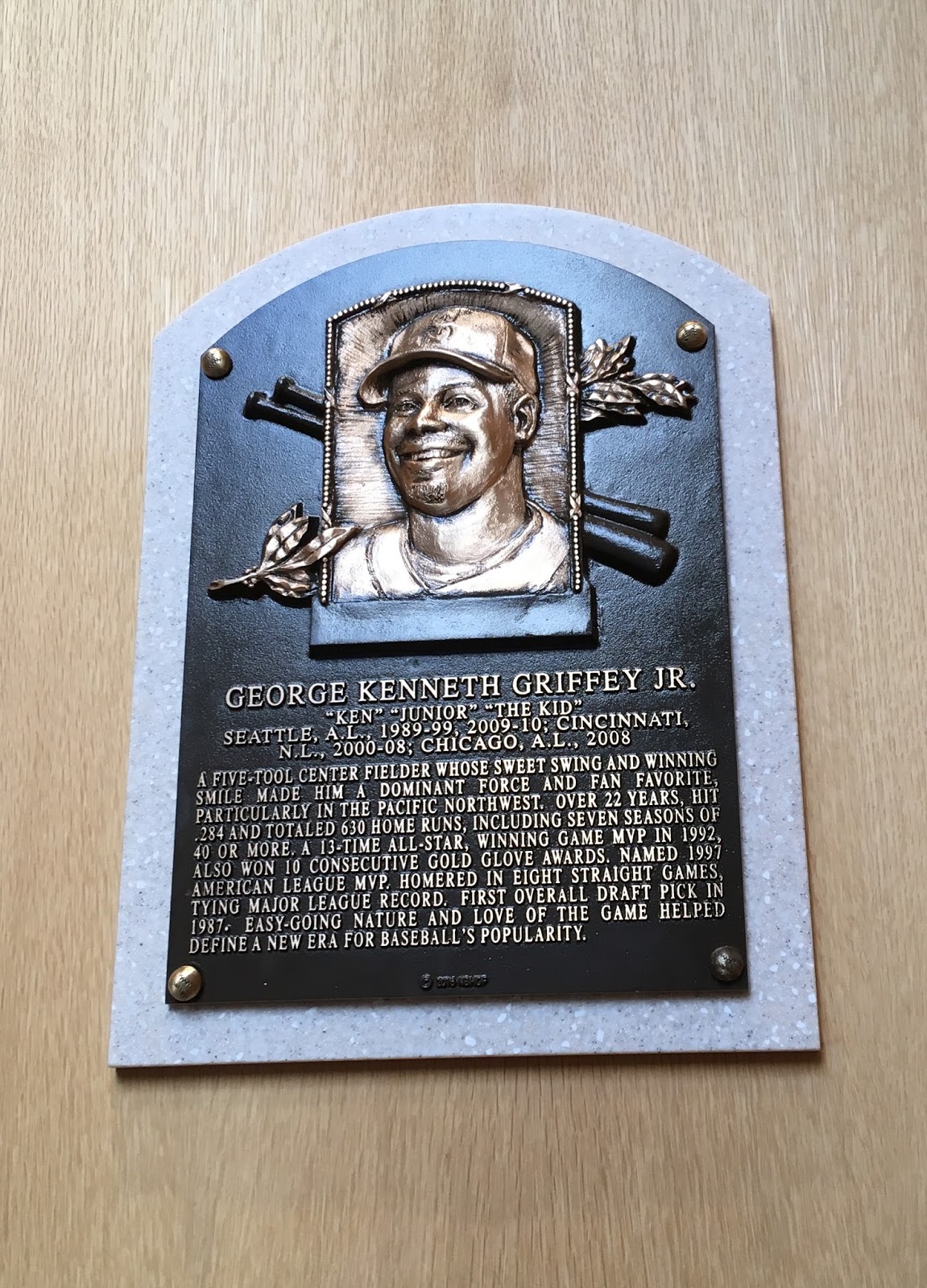 |
| The Hall of Fame plaque for Ken Griffey Jr., who led the way to create baseball's annual Jackie Robinson Day. Griffey, who usually wore number 24 for the Seattle Mariners, wore Robinson's number 42 on April 15, 1997, to raise awareness of Robinson's achievements. The number has since been retired throughout Major League Baseball--except when all players wear it on the annual Jackie Robinson Day games on April 15. |
Thursday, April 5, 2018
'Melancholy: A Way to Happiness'
That's the title of a chapter I read this morning in Ageless Soul: The Lifelong Journey Toward Meaning and Joy by Thomas Moore. I'm enjoying this book. In it, Moore notes how we age throughout our lives--and about how it's natural for melancholy to increase as we get older and see more illness and death in our lives.
Today marks the sixth anniversary of my dad's death, so it's naturally a melancholy time of year--especially since my mom also died in early spring. As difficult as it is to face the loss of loved ones, I've always felt grateful that my parents both passed from this Earth in its time of rebirth. Spring softened the blow in both cases, even though their deaths could not have been more different. I was just 25 when I suddenly lost my mom; I was 50 when my dad died after years of decline. Both deaths helped prepare me for future losses, but my father's much more gradual passage was much more profound to me because I was old enough to process it in all its complexity.
I remember how, when I was living through my dad's difficult final months, I sometimes referred to the experience as my "holy days of obligation." As his daughter, of course I felt bound to help him through his final days as he and my mom cared for me as a child. That was the obligatory part, the often-difficult work of tending to the ever-shifting needs of someone wrestling with cognitive decline and physical pain he frequently could not articulate.
But it was an unbelievably holy time, too. I remember one evening when I wearily left Dad's apartment, crossing the parking lot to catch my bus on a nearby corner. A full moon had risen and I spontaneously broke into song:
Spirit of life, come unto me, sing in my heart, all the stirrings of compassion ... *
It was a preview of even more profound times to come, culminating in the day Dad said goodbye, three days before Easter 2012. On that day, as my brother and I sat vigil knowing the end was near, the stirrings of compassion became more real. With the help of an angel from hospice, we learned what it means to have a good death.
Moore writes how sadness is part of growing older. We don't need to rage against it; in fact, if we can sit with our melancholy, it need not turn into existential dread or depression "but instead only one strand of mood among others." And that is how I feel this rainy April day: As the best-laid plans sometimes shift and some long-held dreams recede, we learn acceptance and perspective. Or, as Moore says, "If you can allow melancholy its place, you have a better chance to be deeply happy."
* Spirit of Life, a beloved Unitarian Universalist hymn. Words and music by Carolyn Dade.
 |
| Mom, me, Dad |
I remember how, when I was living through my dad's difficult final months, I sometimes referred to the experience as my "holy days of obligation." As his daughter, of course I felt bound to help him through his final days as he and my mom cared for me as a child. That was the obligatory part, the often-difficult work of tending to the ever-shifting needs of someone wrestling with cognitive decline and physical pain he frequently could not articulate.
But it was an unbelievably holy time, too. I remember one evening when I wearily left Dad's apartment, crossing the parking lot to catch my bus on a nearby corner. A full moon had risen and I spontaneously broke into song:
Spirit of life, come unto me, sing in my heart, all the stirrings of compassion ... *
It was a preview of even more profound times to come, culminating in the day Dad said goodbye, three days before Easter 2012. On that day, as my brother and I sat vigil knowing the end was near, the stirrings of compassion became more real. With the help of an angel from hospice, we learned what it means to have a good death.
Moore writes how sadness is part of growing older. We don't need to rage against it; in fact, if we can sit with our melancholy, it need not turn into existential dread or depression "but instead only one strand of mood among others." And that is how I feel this rainy April day: As the best-laid plans sometimes shift and some long-held dreams recede, we learn acceptance and perspective. Or, as Moore says, "If you can allow melancholy its place, you have a better chance to be deeply happy."
* Spirit of Life, a beloved Unitarian Universalist hymn. Words and music by Carolyn Dade.
Subscribe to:
Posts (Atom)